
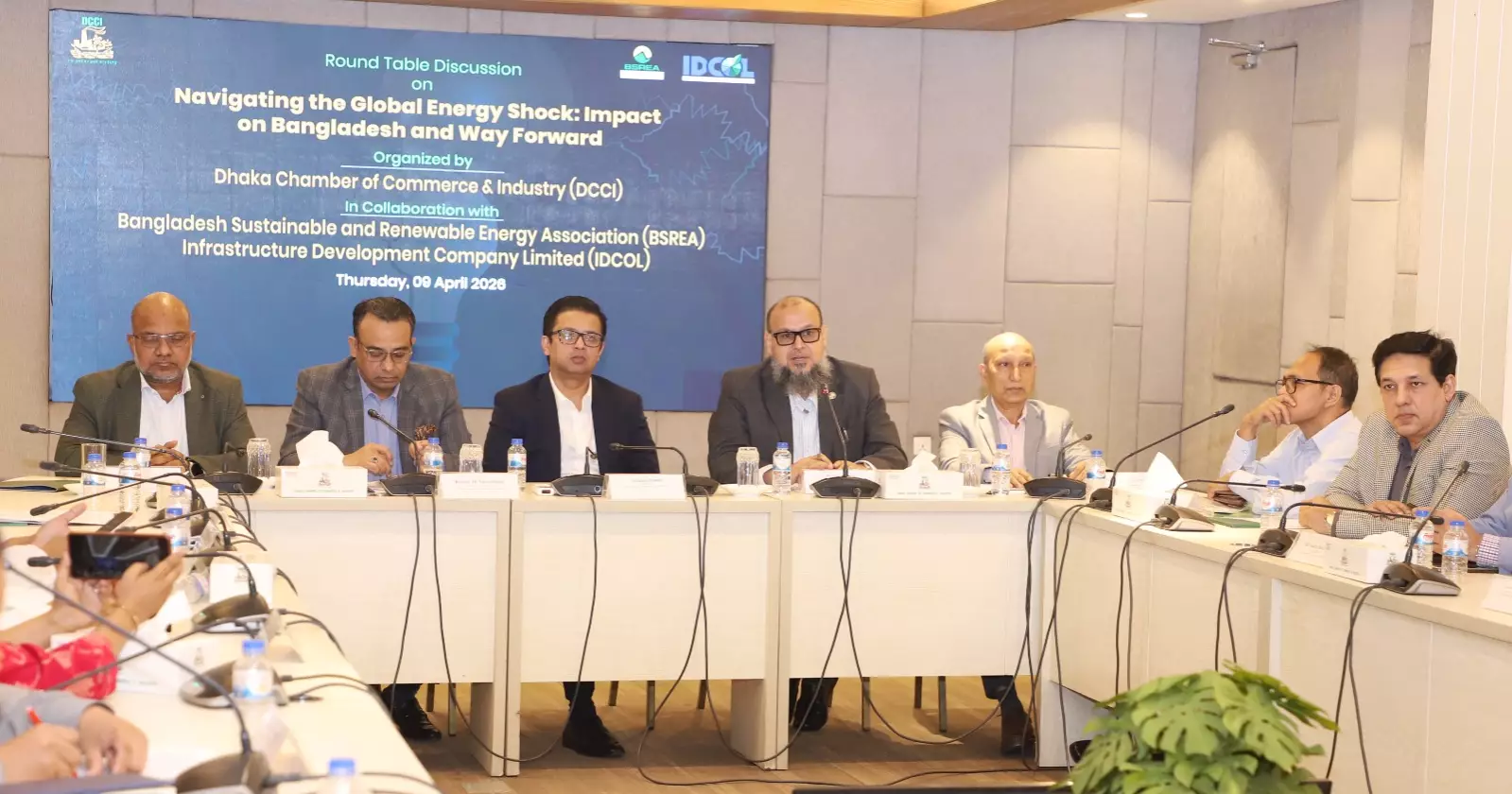
Experts at a roundtable discussion on Thursday called for expanding renewable energy use, strengthening storage capacity, reforming policies and improving coordination among agencies to tackle Bangladesh’s present and future energy crisis.
The views came at a roundtable titled “Navigating the Global Energy Shock: Impact on Bangladesh and Way Forward,” organised by Dhaka Chamber of Commerce & Industry (DCCI) in collaboration with Bangladesh Sustainable and Renewable Energy Association (BSREA) and Infrastructure Development Company Limited (IDCOL) at the DCCI auditorium in Dhaka.
Experts also stressed boosting gas exploration, reducing bureaucratic delays, forming a national-level taskforce and providing financial incentives to attract both local and foreign investment in the energy sector.
Speaking as chief guest, Industries Secretary Md Obaidur Rahman said Bangladesh has long been facing persistent energy shortages, which have worsened due to geopolitical instability in the Middle East.
He noted that the country requires about 600,000 metric tons of fertiliser by June, but production disruptions have created a shortage of around 400,000 metric tons.
Obaidur said the government is taking strict measures to reduce bureaucratic delays, though capacity limitations and lack of initiative in gas exploration remain major challenges.
The secretary also said a policy on electric vehicles is in its final stage and will be finalised soon, adding that current revenue policies are not always consumer-friendly and require reform. He urged both local and foreign investors to come forward to revive struggling industries.
FBCCI Administrator Md Abdur Rahim Khan said the ongoing energy crisis is affecting all aspects of people’s lives and livelihoods, underscoring the need for accurate data to formulate effective strategies.
He emphasised increasing energy storage capacity, removing tariffs on solar and renewable energy equipment, expanding gas exploration and diversifying energy import sources.
Bangladesh Energy Regulatory Commission (BERC) Member (Power) Brig Gen Md Shahid Sarwar (Retd.) said renewable energy could be an effective solution to the current and future crises, but stressed that increasing both offshore and onshore natural gas exploration is essential to ensure long-term energy security.
Additional Secretary of the Commerce Ministry Shibir Bicitro Barua said gaps remain in taking effective initiatives and implementing measures for energy security.
He stressed reducing subsidies through reforms in the operations of relevant agencies and said the ministry will propose to the National Board of Revenue to increase duties on electric vehicle imports to encourage renewable energy use.
BSREA President Mostafa Al Mahmud said ensuring energy security requires strong political will, adding that long-term, low-interest loan support should be provided to SME entrepreneurs in the renewable energy sector.
BSREA Senior Vice President Zahidul Alam said a 27–30 percent duty on imported equipment for the solar power sector is a major obstacle to its expansion, proposed at least a one-year duty-free facility for batteries used in the solar power sector.
Nazmul Haque, chief investment officer of IDCOL, said there is no alternative to forming a national-level taskforce and establishing committees in each ministry to ensure effective action and rapid implementation of decisions.
BGMEA Vice President and Desh Garments Ltd Deputy Managing Director Vidiya Amrit Khan said widespread solar power use in European countries has reduced the impact of the energy crisis, but Bangladesh still lags behind. She called for better coordination among government agencies and expressed concern over the lack of significant initiatives to address post-LDC graduation challenges.
Eng Md Serajul Mawla, president of Bangladesh LPG Autogas Station and Conversion Workshop Owner's Association, said many stations across the country have already shut down due to LPG supply shortages.
He stressed the need for a long-term master plan, diversification of import sources and removal of bureaucratic hurdles to enhance solar sector capacity.
Mohammed Nurul Absar, additional chief engineer (commercial operation) at Bangladesh Power Development Board, said BPDB subsidies reached nearly Tk 63,000 crore in FY2024-25, mainly due to high energy production costs.
He warned that any further fuel price increase would raise subsidy pressure and stressed greater emphasis on renewable energy.
Professor Dr M Shamsul Alam of Daffodil International University said Bangladesh’s energy security is at a critical stage and existing measures are inadequate.
He called for strengthening the capacity of the Energy Regulatory Commission and enhancing stakeholder engagement to reduce the gap between consumers and regulators.
Dr Ijaz Hossain of Bangladesh University of Engineering and Technology said global fuel prices generally decline three to four times a year.
He noted that improving energy conservation capacity would allow Bangladesh to procure fuel in larger quantities at lower prices during downturns, reducing subsidies, and called for building a genuine ecosystem in the energy sector.
DCCI Senior Vice President Razeev H Chowdhury, Vice President Md Salem Sulaiman, board members, entrepreneurs and representatives from public and private agencies were present at the discussion.