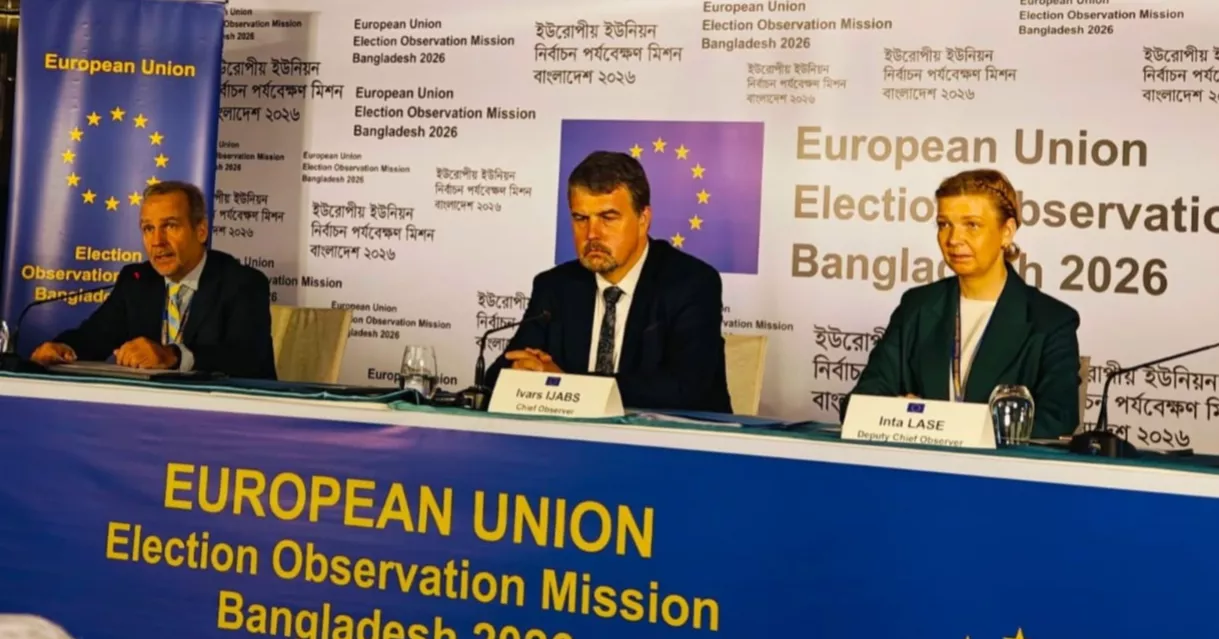
Chief Observer of the European Union Election Observation Mission (EU EOM) Ivars Ijabs on Sunday said these historic elections - referendum and national election - will be crucial to bolster democratic institutions through the ballot box and laid emphasis on participation of all social groups and credible turnout of voters for exercising their democratic rights.
"Hence it will be important that the polls are conducted peacefully and in a credible and transparent manner. My hope is that our work here will also contribute to public confidence and trust in the electoral process," he told reporters at during a media briefing at a city hotel.
Two days after the elections, on February 14, the EU EOM will issue a preliminary statement and hold a press conference in Dhaka.
A comprehensive final report, including recommendations for future elections, will be published and presented to the authorities some two months later.
All EU EOM observers are bound by a strict code of conduct, and the mission carries out its works in accordance with the Declaration of Principles for International Election Observation, endorsed under UN auspices in 2005, he said.
In response to an invitation by the authorities of Bangladesh, the European Union has deployed an Election Observation Mission (EU EOM) for the parliamentary elections scheduled for February 12.
The EU EOM, led by Chief Observer Ivars Ijabs, a Member of the European Parliament from Latvia, commenced its activities in late December 2025 and is scaling up today (Sunday) with the arrival of 56 long-term observers, who will be deployed to all 64 administrative districts of Bangladesh.
This is the first fully-fledged election observation the EU is deploying to Bangladesh since 2008.
"This Election Observation mission reaffirms the importance the European Union attaches to the partnership with Bangladesh, built on mutual respect and shared commitment to democratic principles," said the Chief Observer Ivars Ijabs.
During his first visit to the country, he met a wide range of electoral stakeholders to receive first-hand information on the unfolding electoral process.
In the course of its work the Mission will engage with election administration, political parties, judiciary. civil society and media, to observe and analyse various aspects of the process such as election preparations, the legal framework and its implementation, the conduct of campaign and electoral dispute resolution.
The Mission will also assess the overall space for political and civic participation, including for women, youths and other vulnerable groups.
The EU EOM has dedicated media and social media monitoring units, to weigh the degree to which those channels helped voters to make a well-informed choice.
Overall, the EU EOM will assess the extent to which elections are conducted in compliance with national law, as well as with the regional and international standards for democratic elections Bangladesh has adopted.
"Our technical assessment of these elections is guided by three core principles: independence, impartiality and non-interference. We will employ a robust, well-established methodology of long-term, nation-wide observation. We will observe the process but will not certify the results. These elections belong solely to the people of Bangladesh," said the Chief Observer.
At full strength the mission will comprise around 200 observers from all 27 EU Member States, as well as Canada, Norway and Switzerland.
This includes a core team of 11 analysts based in Dhaka, 56 long-term observers, 90 short-term observers, who will be deployed shortly before the polls, and observers from the diplomatic missions of EU Member States and partner countries.
A delegation from the European Parliament will further reinforce the mission.