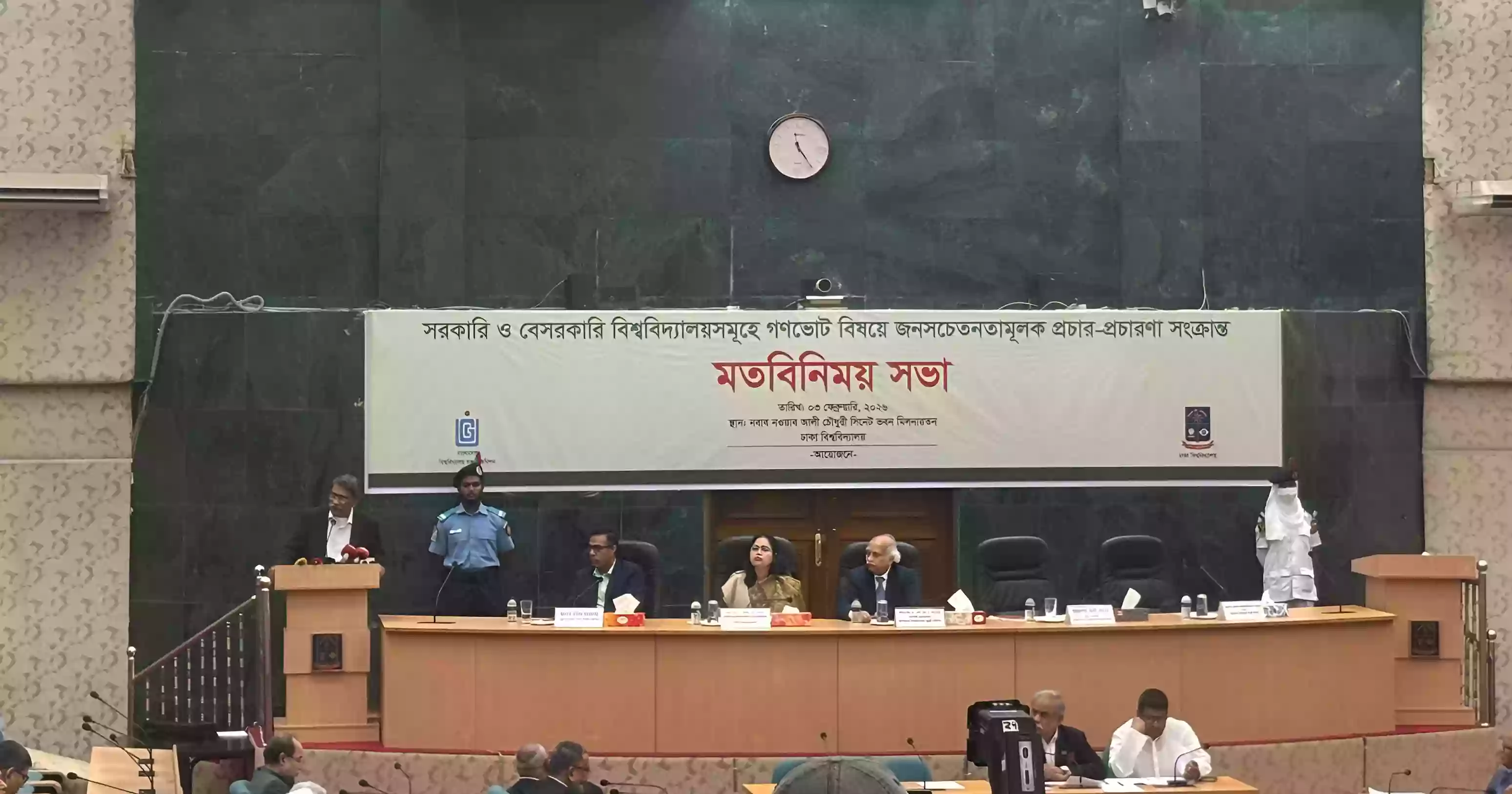
Prof Ali Riaz, special assistant to the chief adviser, on Tuesday said the book of the July Charter presented to the public may be printed in black and white, but every single word of it has been written with the blood of the country’s people.
He made the remarks at an interactive meeting titled ‘Public Awareness Campaign on Referendum in Public and Private Universities’ held at the Nabab Nawab Ali Chowdhury Senate Building auditorium of Dhaka University.
Referring to the sacrifices of the July martyrs and injured, Ali Riaz said they did not seek to become prime minister or president; they wanted a dignified state. The July Charter, he said, is the recognition of that debt.
“Do we have no responsibility? Will we deny the debt that allows us to speak here today?” he asked, adding that acknowledging this debt is precisely what the July Charter represents.
He said the charter was prepared through discussions with political parties, civil society, various organisations, groups, and individuals. “When I open the book of the July Charter, I hear the cries of mothers who lost their children.”
Ali Riaz also discussed the context behind the abolition of the caretaker government system.
He said the July Charter includes safeguards to ensure that ‘one-person rule’ never returns to Bangladesh. “Everyone knows that the farce carried out in the name of three so-called elections in Bangladesh happened at the will of one individual. That became possible through the abolition of the caretaker government system.”
Referring to the 2014 Election Commission, he said, “The President staged another drama.”
He claimed that the name Kazi Rakibuddin Ahmad was not on the search committee’s list, yet he was appointed Chief Election Commissioner at the Prime Minister’s behest, leading to a rigged election in 2014. “No conscientious person with democratic aspirations can say that such a situation should continue.”
He said that through extensive dialogue, political parties have agreed in the July National Charter that future Election Commissions will be formed based on consultations among representatives of the ruling party, the main opposition party and the third party-the second-largest opposition party- in parliament.
Ali Riaz highlighted the role of the Public Service Commission during the previous regime and said that if the July Charter is implemented, the President will no longer hold unilateral authority to grant pardons.
He said the Constitution allows the ‘right to life’ to be violated during a state of emergency, but political parties have agreed that future emergencies will drop the term ‘internal disturbance’ and require cabinet approval with opposition representation.
Mentioning past instances of constitutional amendments made for the benefit of a single individual, he said that any future constitutional amendment would require a two-thirds majority in the parliament, followed by the support of at least 51 members of a 100-member upper house.
He also spoke about reforms related to the presidential election and changes to Article 70. “The situation created by forcing public representatives into party servitude has meant that our parliament has not even become a debating club,” he said.
Awami League must face trial, seek apology before returning to politics: Ali Riaz
Ali Riaz said all political parties have agreed that out of the standing committees of the parliament, four key committees will be chaired by members from the opposition.
He urged all to work in support of the July Charter.
Those present included the Chief Adviser’s Special Assistant Monir Haidar, University Grants Commission Chairman Dr SMA Fayez, DU Pro-Vice-Chancellor Prof Dr Sayma Haque Bidisha, individuals injured in July, and vice-chancellors, teachers, students and officials from various universities.