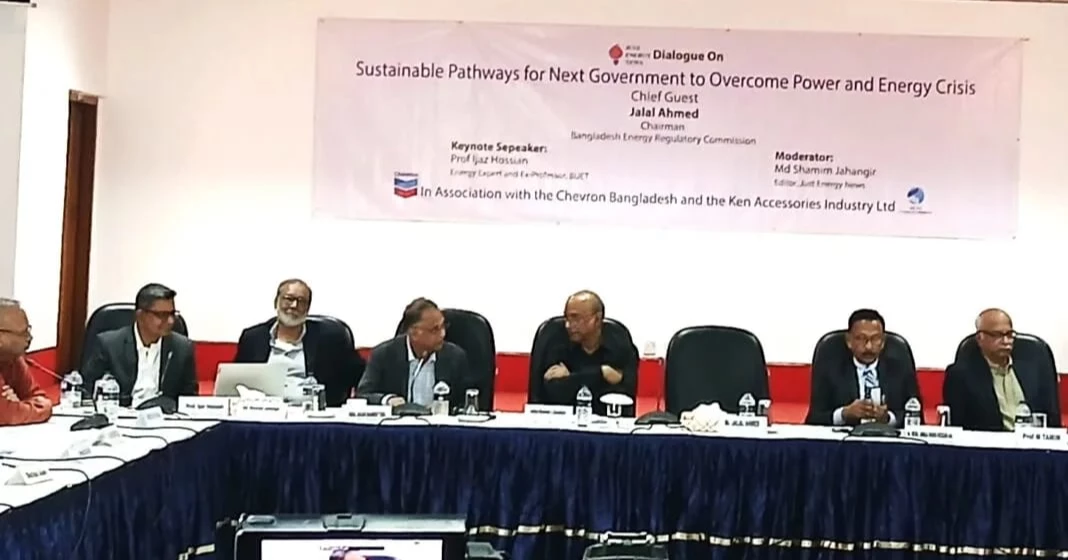
Experts and leaders on Tuesday urged a national consensus to overhaul Bangladesh’s energy sector, warning that chronic overcapacity, heavy import reliance, and governance failures now pose a critical threat to economic stability and security.
Speaking at a policy dialogue in the city, they warned that without cross-party agreement and continuity in core energy policies—regardless of political change—the sector’s mounting financial stress could undermine industrial growth, strain foreign exchange reserves and weaken macroeconomic stability in the years ahead.
The dialogue titled 'Sustainable Pathways for Next Government to Overcome Power and Energy Crisis', held at the CIRDAP auditorium organised by Just Energy News.
Participants stressed that frequent policy reversals with changes of government have aggravated the crisis, arguing that power and energy—like education and health—must be treated as national priorities insulated from partisan politics.
They urged future governments to move away from 'business as usual' and agree on a minimum national framework for the sector, warning that without consensus, reforms would remain fragile and reversible.
Speaking at the event, Bangladesh Energy Regulatory Commission (BERC) Chairman Jalal Ahmed said the crisis stems largely from decades of neglect of primary energy development.
“Bangladesh invested heavily in power generation capacity but failed to invest adequately in primary energy—gas, coal and renewables,” he said, adding that sustainable electricity supply is impossible without strengthening indigenous energy sources.
He pointed to major constraints in LNG imports, noting that the country’s two Floating Storage and Regasification Units (FSRUs) are already operating near maximum capacity.
“In emergencies, LNG imports cannot be increased beyond these limits, a reality often ignored in planning,” Jalal Ahmed said.
He noted that no realistic reservoir management study has been conducted since 2001, while gas exploration has remained stagnant for about 16 years.
Jalal Ahmed said much of the existing generation capacity is unnecessary relative to actual demand, yet consumers continue to bear the financial burden.
Keynote speaker Dr Ijaz Hossain, a former BUET professor, said exaggerated demand projections in the past led to overcapacity and expensive contracts.
“Today, 97 to 98 percent of total energy supply is fossil fuel–based, while around 60 percent of power and energy is import-dependent,” he said, noting that import reliance has increased further over the past year, intensifying pressure on foreign exchange reserves.
Hossain warned that inefficiencies and irregularities in the gas sector have become more severe since the shift to imported LNG.
According to his analysis, nearly 10 percent of supplied gas is lost through theft and mismanagement.
“When 30 to 33 percent of gas comes from imported LNG, such losses translate into billions of dollars in direct foreign exchange wastage every year,” Ijaz Hossain said, adding that curbing these losses could significantly ease the dollar crisis.
BNP Standing Committee member Iqbal Hasan Mahmud Tuku said electricity policy must balance commercial viability with public service obligations, which requires time, stability and political commitment.
“For years, development was treated as an end in itself. Now ordinary people are paying the hidden costs through higher electricity bills and mounting public debt," he said.
Tuku recalled that earlier frameworks aimed to keep 65 percent of power generation under government control, with the remainder developed through public-private partnerships, allowing the state leverage over prices.
Abandoning this approach, along with bypassing public procurement rules through one-to-one negotiations, had encouraged corruption and rent-seeking, he alleged.
Tuku criticised capacity payments for idle plants and warned that continued foreign currency outflows for power projects—including non-operational ones—have intensified economic pressure. “No government alone can fix this. A national consensus is the only way forward.”
Speaking at the dialogue, Bangladesh Jamaat-e-Islami Assistant Secretary General Ahsanul Mahboob Zubair said his party would work to build a national consensus to ensure power and energy as a basic right of citizens.
He also stressed national unity to address the crisis and expressed concern over corruption, alleging that large industrial units are involved in natural gas theft.
Economist Prof Mushtaq Hossain Khan of SOAS, University of London, warned that the power sector required around $5 billion in subsidies last year, much of it paid in foreign currency.
“These losses cannot be financed indefinitely through borrowing or printing money,” he said, cautioning that such a path would fuel inflation and macroeconomic instability, argued that the core problem is not a lack of policy documents but institutionalised corruption since 2010.
“Power generation increased fourfold, but costs rose elevenfold, while capacity charges increased twentyfold,” he said, adding that reforms would fail unless corruption is tackled decisively.
Several speakers, including BEPRC member Dr Md Rafiqul Islam and energy expert Prof M Tamim of Independent University, Bangladesh (IUB), stressed the need for diversifying energy sources and gradually shifting towards renewables.
Prof Tamim said domestic gas remains the cheapest source of electricity and warned that power generated without indigenous fuel cannot be supplied below Tk 10 per unit.
Over-reliance on imports, he said, has eroded opportunities to develop local resources.
At the same time, Tamim cautioned against abrupt cancellation of power contracts without proper review, warning that such moves could disrupt supply and harm consumers.
“Politically sensitive decisions are unavoidable, but they must be taken carefully and transparently,” he said.
Governance and accountability gaps
Former justice Moinul Islam Chowdhury said non-competitive and risk-heavy power purchase agreements have saddled the Bangladesh Power Development Board with disproportionate liabilities, citing estimates that annual losses now exceed Tk 50,000–55,000 crore.
Consumer rights advocate Prof M Shamsul Alam criticised regulatory failures, alleging that oversight bodies have been unable to curb irregularities. Without restoring accountability, he warned, even well-designed policies would fail.
In his concluding remarks, BEPRC Chairman Mohammad Wahid Hossain said the next government would face immense challenges in the power and energy sector and urged the media and academia to help build public understanding.
“Unpopular but necessary decisions become easier when people understand the truth,” he said.
The session was moderated by Md Shamim Jahangir, Editor of Just Energy News.
The discussion ended with a clear message— without a broad-based national consensus that transcends political cycles, Bangladesh’s power and energy sector risks sliding deeper into crisis, undermining economic stability and long-term development goals.