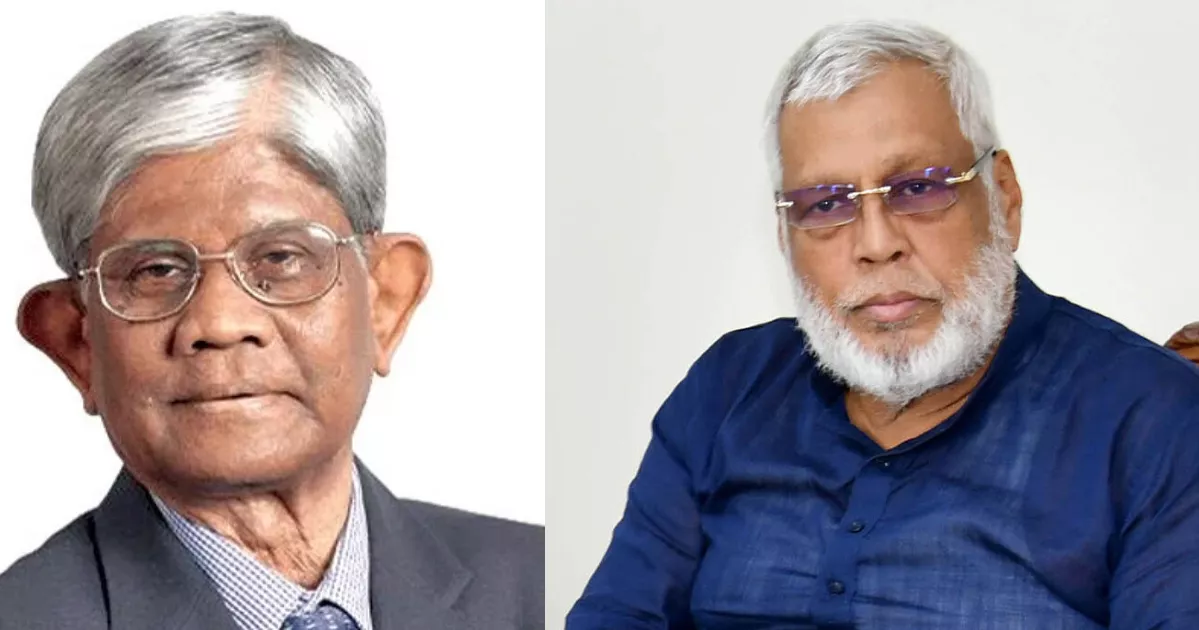
Finance Adviser Dr Salehuddin Ahmed on Sunday urged all concerned to extend cooperation and blessings so that the interim government can turn the country into a better place for the next generation.
“We’re doing good and we’re trying to ensure betterment of the country,” he said while addressing the launch of the book “Bangladesher Rajnoitic Orthonity”, authored by Adviser Dr Muhammad Fouzul Kabir Khan, who is currently in charge of the Ministry of Power, Energy and Mineral Resources, the Ministry of Road Transport and Bridges, and the Ministry of Railways.
The programme was moderated by Dr A. K. Enamul Haque, Director General of the Bangladesh Institute of Development Studies (BIDS), at the BIDS Conference Room.
Adviser to the Ministry of Environment, Forest and Climate Change Syeda Rizwana Hasan, Adviser to the Ministry of Cultural Affairs Mostafa Sarwar Farooqi, PPRC Executive Chairman Dr Hossain Zillur Rahman, Prothom Alo Editor Matiur Rahman, former World Bank Dhaka Office Lead Economist Dr Zahid Hussain, and eminent environmentalist Dr Ainun Nishat also spoke.
Dr Salehuddin said Bangladesh has been able to overcome numerous barriers in recent months. “Those who do not try to see anything positive will not find anything. We’ve now come to a position after overcoming various obstacles and there is no way to deny it,” he noted.
He, however, observed that the country could have progressed further had there been no corruption and mismanagement in the past. The Adviser expressed hope that the reform initiatives of the interim government would be carried forward by successive governments.
“Bangladesh is really progressing and you’ll have to see like half glass full, not half glass empty,” he added, stressing that politicians must demonstrate political will, patriotism and passion rather than focusing only on grabbing power.
Adviser Syeda Rizwana Hasan said it was not possible to implement full-scale reforms within just one and a half years, but the process of reforms has been initiated. She cautioned that the progress made might remain confined to paper if not sustained.
Author of the book, Adviser Dr Muhammad Fouzul Kabir Khan, said a culture of economic practice through due process has been established in the government. He alleged that massive corruption had taken place in the three ministries under his charge during the previous regime, and said Tk 45,000 crore was cut from their allocations. “Now, there is no deal before the deal,” he said, expressing hope that competition in procurement would continue in future.
Adviser Mostafa Sarwar Farooqi alleged that unethical practices had prevailed in the economy during the past regime.
Economist Dr Hossain Zillur Rahman said Bangladesh had been suffering from a “corruption syndrome” and stressed the importance of overcoming it. He also highlighted the upcoming election milestone as crucial for the country.
Dr Zahid Hussain, meanwhile, pointed to pressing challenges including the fragile banking sector, energy scarcity, inefficiencies at ports, and the need for careful policy support to address the high cost of doing business.