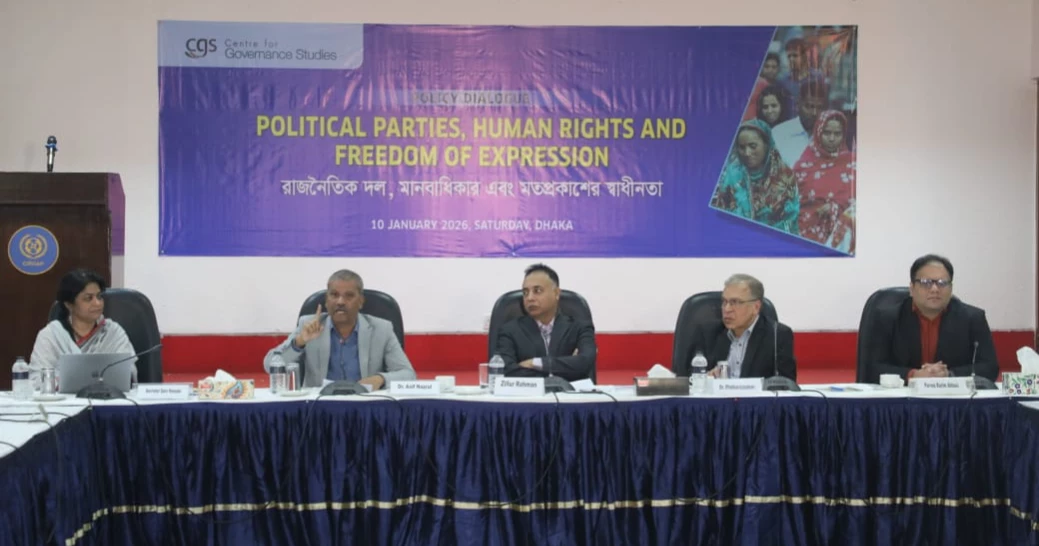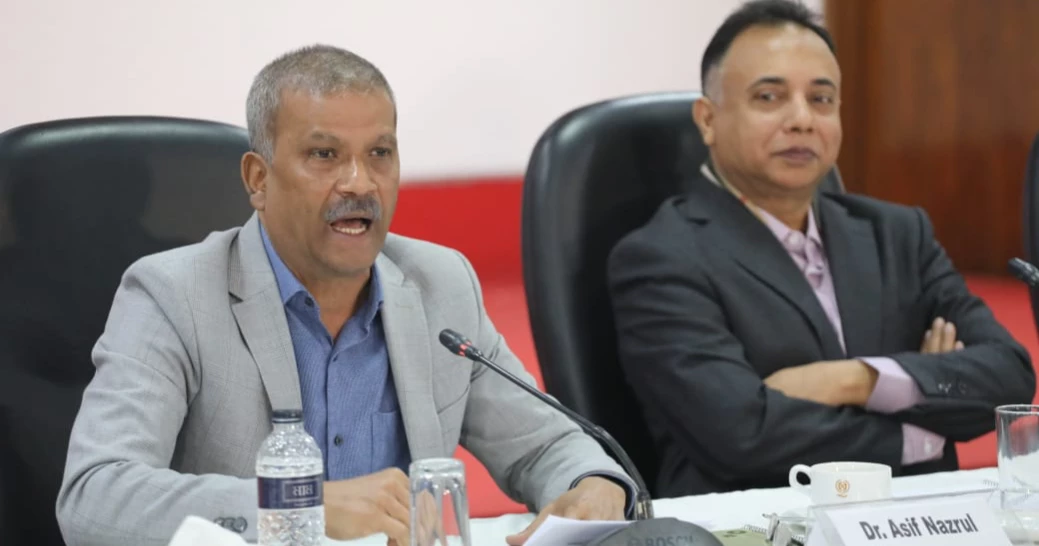
Freedom of expression belongs to everyone except the government, Law Adviser Dr Asif Nazrul said on Saturday.
He came up with the remarks while speaking at a policy dialogue titled “Political Parties, Human Rights, and Freedom of Expression” organised by the Centre for Governance Studies (CGS) at the CIRDAP Auditorium in Dhaka.
Political leaders, civil society representatives, academics, lawyers, journalists, and human rights activists participated in the dialogue. The discussion focused on the extent to which human rights and freedom of expression are reflected in political discourse in the context of the upcoming national election.
Asif Nazrul mentioned that significant reforms have been undertaken, including transferring key judicial matters to the higher courts, enacting a human rights law that he described as one of the strongest in South Asia, and expanding legal aid services that now benefit ten times more people than before.
He claimed that the Digital Security Act has improved by 90 percent and that more than 20,000 cases have been resolved.
He acknowledged widespread cyberbullying against him following the July Uprising and emphasized that comprehensive reform requires time.
He stressed the need for self-reflection by political parties and the media, calling for honesty, conscience, tolerance, and accountability to move the country forward over the next five to ten years.
CGS President Zillur Rahman, who moderated the event, said that as elections approach, human rights and freedom of expression tend to shrink further. Laws are easily turned into political tools, while violence, clashes, threats, and harassment become difficult to control.
Dr Iftekharuzzaman, Executive Director of Transparency International Bangladesh (TIB) that human rights are universal and not relative.
He argued that political parties in Bangladesh capitalize on money, power, and religion, and that the state is enabling the growth of mob power.