The government has taken an initiative to rationalise or review the barriers, including non-tariff barriers that are hindering the expansion of US business in Bangladesh.
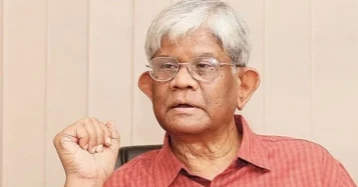
“We will rationalise the non-tariff barriers that are facing by the US business people, we will rationalise those as soon as possible,” Finance Adviser Dr Salehuddin Ahmed told reporters after holding an inter-ministerial meeting held at his Bangladesh Secretariat office.
He also said the government would streamline the process to facilitate trade and commerce between Bangladesh and the United States.
The Finance Adviser said in the meeting they discussed in detail the course of action from the government.
“Firstly, we have taken decision that we will increase our trade and commerce with the US, for that if we need to import necessary items from the US we will do that,” he said.
He also said the government would look after that the competitiveness of the RMG and other items that are exported to the US market remain competitive comparing to the other competitors.
“We will try to increase efficiency of the private sector, we can import various types of services from the US,” he said.
The Finance Adviser said the government has taken necessary steps to engage with the United States authorities over the new tariffs imposed by Washington.
“The impact of the new US tariffs on the economy will not be difficult to manage. The government is hopeful that a positive outcome will emerge from the discussions,” he said.
Dr. Salehuddin also noted that commodity prices were found stable during Ramadan and Eid-ul-Fitr, bringing some sort of relief to the public.
“This year, people had a good Eid. In March alone, the country received $3 billion in remittances, which helped boost the foreign exchange reserves,” he added.
The finance adviser said the country’s overall economic situation is showing signs of improvement, supported by the rising inflow of foreign currency.
Commerce Adviser Sk Bashir Uddin said that in the meeting they have come to a consensus on some specific proposals.
Sk Bashir Uddin said “We will conduct our next course as per the proposals, we are taking steps to review the non-tariff barriers, which will facilitate the trade between the two countries,” he said.
Planning Adviser Dr Wahiduddin Mahmud said that big economies like China and European countries will take counter measurers against the tax hike of the Trump administration.
“We do not know at what point this will stand at the last, there is no doubt that economy of the whole world will get a shake,” he said.
He said the government will conside everything while taking any decision.
“Initially, we are thinking to improve the competitiveness of the RMG sector which has a big market in the USA to compete with other competitors, and we think that we can do that,” he said.
The Planning Adviser mentioned that due to the tax hike the burden would be on the consumers and the buying houses.
IMF happy with Bangladesh's recent economic progress: Finance Adviser
“To determine the burden on us, we have to depend on the negotiations that we will do,” he said.
Dr Wahiduddin Mahmud said there is no scope to reduce the wages of workers.
“The burden of the extra taxes has to be shifted on other side,we can not put any extra burden on that (workers’ wages),” he said.
He also hoped that the policy makers in the USA will understand the matter.
“They also know it very well, from our side we do not have any scope to reduce the wages of the workers,” he said.
Chief Adviser’s High Representative on the Rohingya Problem and Priority Issues Khalilur Rahman said that the government is likely to finalise its position on the US non-tariff measures within the next one to two days.
“We’ll crystallize it over the next 24 to 48 hours,” he told reporters, emphasising the urgency and importance of addressing the issue.
He further stated that there is scope to increase imports from the United States in a way that serves Bangladesh’s own economic interests. “We’ll try our level best to resolve this issue as much as possible, while remaining aligned with the business community,” he added.
Energy and Railways Adviser Muhammad Fouzul Kabir Khan described the situation as evolving and said the government is carefully considering its next steps.
“We’ll immediately take some actions and then closely monitor the situation. A balance must be struck between the expectations of the United States and our own national interests,” he said.
Leading businessman Tapan Chowdhury noted that the imposition of reciprocal US tariffs could open up new opportunities in sectors beyond ready-made garments (RMG). Citing the recent reciprocal tariff on Indian pharmaceuticals, he pointed out that a window of opportunity has been created for Bangladesh’s pharmaceutical industry.
“So, opportunities are emerging from various directions… I believe we will be able to overcome these challenges,” he added.
Another prominent businessman, Syed Nasim Manzur, said the business community had received assurances from the government that the competitiveness of Bangladeshi industries would be protected. He stressed the importance of a level playing field.
Among those present at the high-level meeting were Chief Adviser’s Special Envoy for International Affairs Lutfey Siddiqi, Chief Adviser’s Press Secretary Shafiqul Alam, Bangladesh Bank Governor Ahsan H. Mansur, NBR Chairman Md Abdur Rahman Khan, BIDA Executive Chairman Chowdhury Ashik Mahmud Bin Harun, Finance Secretary Md Khairuzzaman Mozumder, Commerce Secretary Mabubur Rahman, and Policy Research Institute (PRI) Chairman Dr. Zaidi Sattar.