
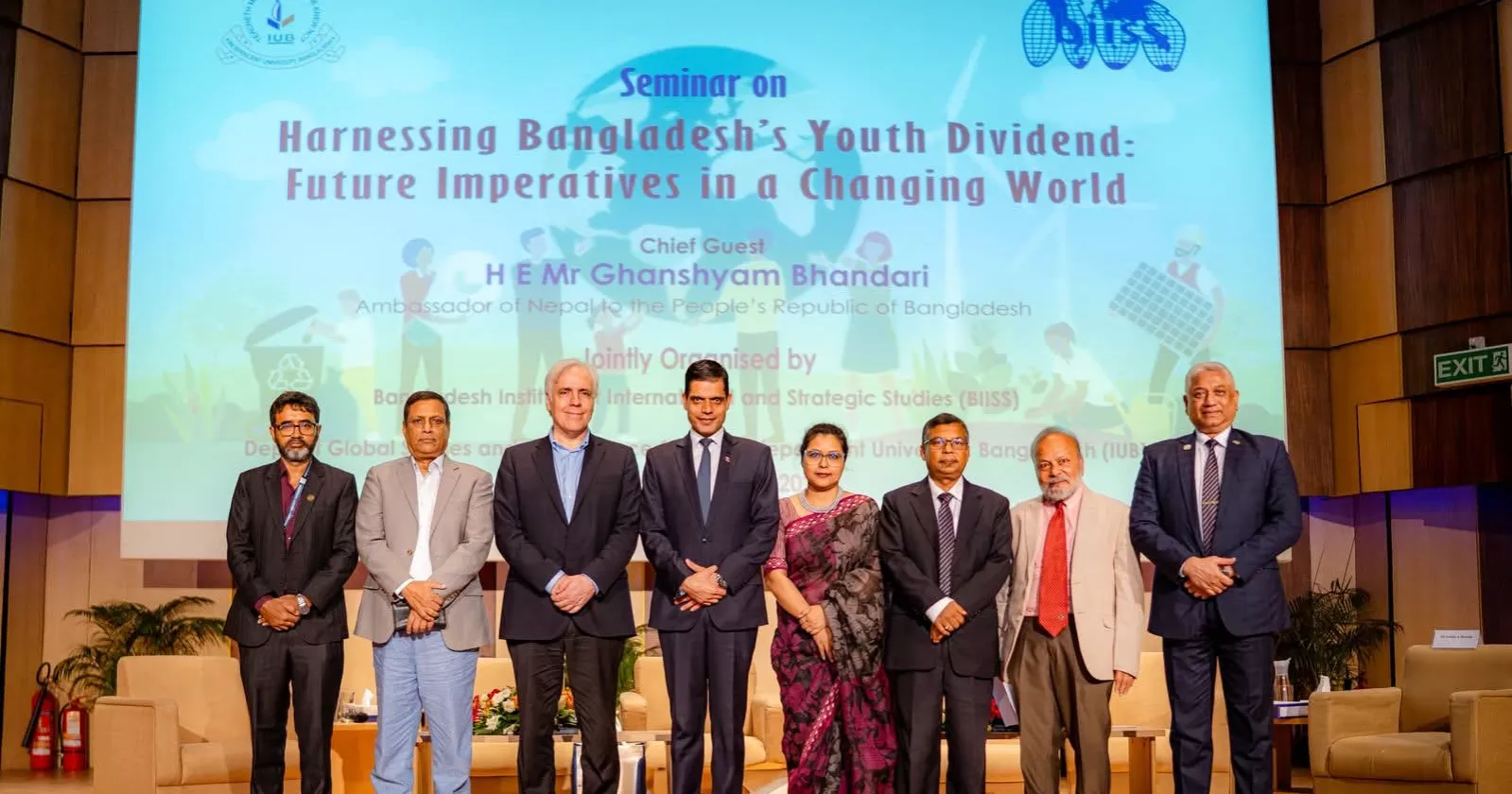
Nepalese Ambassador to Bangladesh Ghanashyam Bhandari on Wednesday stressed the importance of harnessing the ‘youth dividend’ for building a safer, more inclusive, and sustainable future.
Speaking as the chief guest at a seminar jointly organized by the Bangladesh Institute of International and Strategic Studies (BIISS) and the Department of Global Studies and Governance at Independent University, Bangladesh (IUB), he highlighted the opportunities presented by the ‘youth bulge’ in Nepal and Bangladesh.
The ambassador called for joint efforts to empower young people as agents of transformative change—both nationally and in strengthening bilateral ties.
He noted the growing youth involvement in policy and development landscape, digital innovation, climate action, and social justice.
The ambassador emphasised that nurturing entrepreneurship and grassroots innovation is vital for sustaining progress, particularly in light of the impending graduation of both countries from the Least Developed Country (LDC) category.
Bangladesh renews call for full membership of Palestinian state in UN
Secretary (East & West), Ministry of Foreign Affairs, Bangladesh, Dr Md Nazrul Islam was present as the special guest and Country Director, UNAIDS Dr Saima Khan was the guest of honour.
BIISS Director General Major General Iftekhar Anis delivered the welcome
address at the inaugural session while its Chairman Ambassador AFM Gousal Azam Sarker wrapped the session up with some remarks.
Countries endeavouring to accelerate their development and substantially rely on and utilise their youth population, according to BIISS.
Young minds generate and simultaneously help implement new ideas, concepts, and thoughts.
This has been true for all ages, and modern times are no exception.
The Renaissance, Industrial Revolution, today’s social media, and artificial intelligence boom are some glaring examples.
In climate action, today’s youth across developing nations lead campaigns, innovate grassroots solutions, and call for climate justice at various fora with firm resolve.
Singapore and South Korea successfully transformed their economies by capitalising on their demographic dividends.
China invested in its youth heavily for a long time and now is gaining the results.
Bangladesh’s youth dividend is a demographic advantage: with nearly half of the population under the age of 30, it
stands at a rare historic moment, where today’s investment in youth can yield tomorrow’s prosperity, stability, and innovation.
However, to reap those benefits, careful nurturing and equipping the youth with necessary skills will be imperative on all relevant stakeholders.
Bangladesh urges Romania to resume labour recruitment
Speakers brought in various aspects of Bangladesh’s youth dividend, how to use this opportunity for ensuring and sustaining the country’s progress, importance of integrating perspectives of youth into national policymaking, extant and possible difficulties ahead, provided guidelines on how to effectively deal with and overcome these in a rapidly changing world.
Senior officials from different ministries of Bangladesh, foreign diplomatic missions, media, businesspeople, teachers and students from various universities, researchers, representatives from various think tanks and international organisations enthusiastically participated in the lecture and presented their opinions, comments, insights, suggestions, and observations during open discussion sessions.