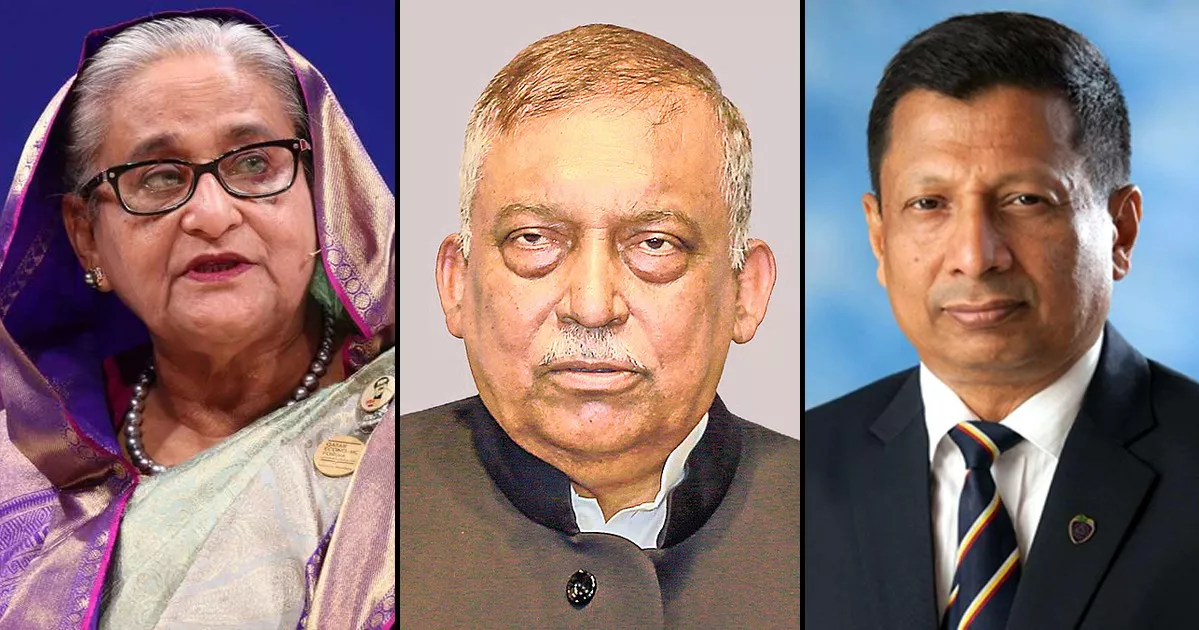
The International Crimes Tribunal-1 on Monday sentenced former Prime Minister Sheikh Hasina and former Home Minister Asaduzzaman Khan Kamal to death in a case filed over crimes against humanity committed during last year’s July-August mass uprising.
The three-member tribunal, headed by Chairman Justice Md Golam Mortuza Majumder began delivering the verdict around 12:30pm unveiling a 453-page judgment.
The tribunal found all three accused guilty of the charges brought against them.
Sheikh Hasina was sentenced to death on two counts of crimes against humanity. Asaduzzaman Khan was awarded the death penalty on one charge. Both of them tried in absentia.
Hasina gets death penalty, jail unto death for crimes against humanity
Besides, former Inspector General of Police Chowdhury Abdullah Al-Mamun, who testified as a state witness in the case, was sentenced to five years in prison.
The tribunal also ordered the authorities concerned to confiscate the property of Sheikh Hasina and Asaduzzaman Khan.
The court also asked the authorities concerned to take steps to provide adequate compensation from this property to the martyrs and injured victims of July-August movement in proportion to the extent of their losses.
About the sentence handed down against Sheikh Hasina under the first charge, the tribunal said the former prime minister was responsible for instigating the crimes, ordering attacks on protesters and failing to act to prevent the offences or take punitive measures against those involved.
She was found guilty of two offences under charge one and sentenced to imprisonment unto death.
The tribunal said Sheikh Hasina was held responsible for two crimes under 2nd charge.
One of the two offences is ordering use of helicopters and lethal weapons to suppress the July mass movement.
By issuing this order, she committed offences under Sections 3(1)(ka), 3(2)(chha)(ja) and 4(1)(2)(3) of the International Crimes Tribunal Act, 1973, it said.
The second offence concerns the killing of six people in Dhaka’s Chankharpul area on August 5 last year and the killing and burning of six others in Ashulia the same day as per her instructions.
The tribunal said the court’s decision was that the only punishment for these crimes is the death penalty.
The tribunal said two other convicts- Asaduzzaman Khan Kamal and Chowdhury Abdullah Al Mamun -- are equally responsible for the offences.
Asaduzzaman Khan Kamal was sentenced to death for the offences, it said.
Although Abdullah Al Mamun also deserves the maximum punishment, as he became a state witness and gave full and truthful testimony regarding the offences, the court showed leniency and sentenced him to five years in prison.
He assisted the judicial process in reaching an accurate decision, said the tribunal.
The tribunal also ordered that a copy of the verdict be sent to the Dhaka District Magistrate.
As Sheikh Hasina and former minister Asaduzzaman Khan fled the country amid the massive movement on August 5 last year only former IGP Mamun was present at the dock during the delivery of the judgment.
Bangladesh Television (BTV) telecast the verdict live and it was also shown via giant screen at 10 spots of the capital.
Initially, Sheikh Hasina was the sole accused in the case.
On March 16 this year, the prosecution appealed to include former IGP Mamun as an accused alongside Sheikh Hasina and the tribunal approved it.
After the Awami League government was toppled on August 5, 2024, the ICT was reconstituted.
The tribunal conducted its first hearing on October 17 last year, issuing an arrest warrant against Hasina that day.
After extending the deadline several times, the tribunal’s investigation agency submitted its final probe report to the Chief Prosecutor’s Office on May 12 this year.
On June 1, the prosecution formally filed charges against Sheikh Hasina and the two accused.
The 5 charges are:
• Inciting violence in a press conference at Ganabhaban on 14 July 2024;
• Ordering the elimination of protestors using helicopters, drones, and lethal weapons;
• Student Abu Sayed’s killing in shooting at Begum Rokeya University, Rangpur;
• The killing of six protestors at Chankharpul, Dhaka;
• The burning of six people in Ashulia.
The tribunal formally framed these charges on July 10.
The day the charges were framed, Mamun confessed to the court his involvement in crimes against humanity during the uprising and became a state witness.
Arguments in the case began on October 12 and concluded on October 23.
Relatives of victims, including the father of martyr Abu Sayed, testified in the case, along with key witnesses including Nahid Islam, Convener of National Citizen Party (NCP) and Amar Desh editor Dr Mahmudur Rahman.
In total, 54 witnesses testified during the trial.
Ex-IGP Mamun gets 5-year jail term for crimes against humanity