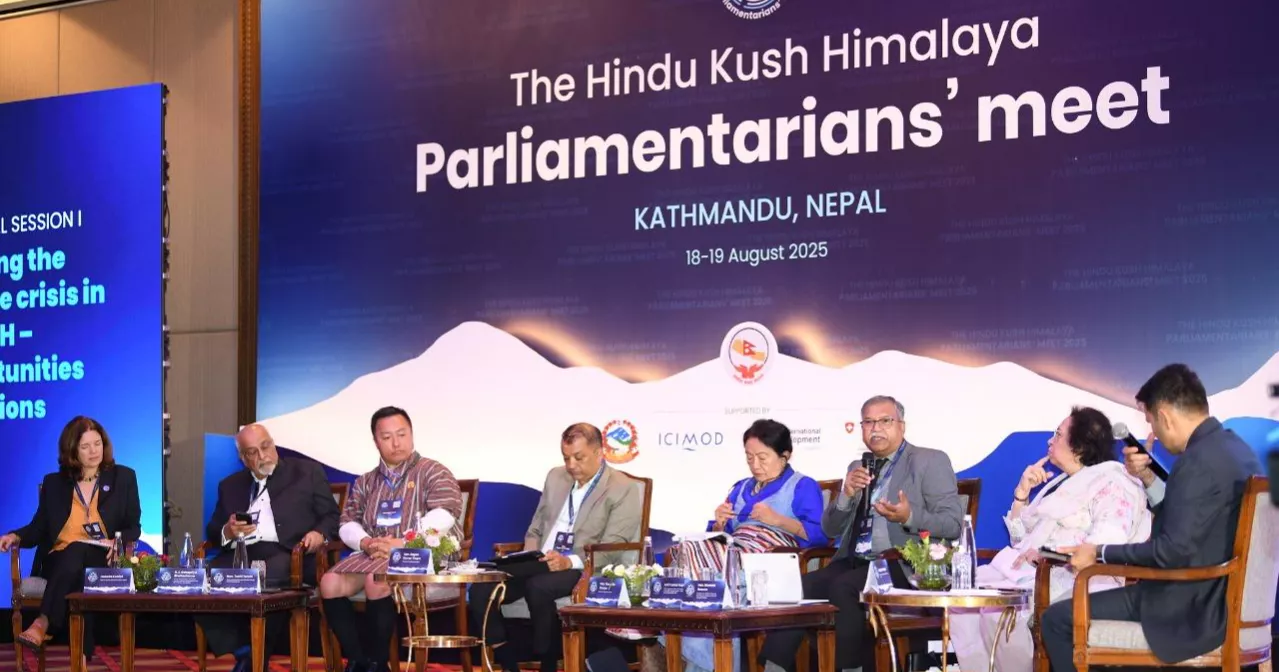
Countries in the Hindu Kush Himalaya (HKH) region, including Bangladesh, have underlined the need for strengthening global solidarity, ‘from mountains to oceans’, to achieve ambitious climate actions, biodiversity conservation and clean air for all.
The Hindu Kush Himalaya (HKH) Parliamentarians’ Meet-2025 concluded here in Kathmandu with a strong message of urgency calling for deeper regional cooperation to address shared environmental, social and economic challenges across the region.
The parliamentarians and representatives from the HKH region, representing Bangladesh, Bhutan, Myanmar, Nepal and Pakistan emphasised the importance of regular exchanges of experience among parliamentarians to deepen cooperation and support innovative responses to shared challenges.
The parliamentarians and political leaders expressed their gratitude to the Agriculture, Cooperatives and Natural Resources Committee of the Federal Parliament of Nepal for organising the event.
Adopted in Kathmandu, the joint declaration reaffirmed the collective responsibility of HKH nations to work together for an inclusive, resilient and sustainable future.
The meeting, which began on Monday under the theme ‘Sustaining Nature, Empowering People’, brought together over 100 parliamentarians and representatives from Bangladesh, Bhutan, China, India, Nepal and Pakistan.
The meeting served as a platform for legislators and policymakers to deliberate on the pressing issues of climate change, biodiversity loss and air pollution, and to seek collective solutions for safeguarding the future of the HKH region.
The participants shared ecological importance of the HKH, the cross-border nature of environmental threats, and the need to strengthen solidarity for climate resilience.
The statement titled ‘An Urgent Call to Action through Regional Cooperation’ said that climate crisis, air pollution, and biodiversity loss directly impact millions of lives and ecosystems in the region and called on legislators to play a stronger role in protecting both people and nature.
The participants committed to holding the HKH Parliamentarians’ Meet regularly to strengthen regional dialogue, solidarity, and cooperation; exploring the possibility of establishing an HKH Parliamentarians’ Forum as a regional platform for dialogue and promoting science, evidence, experiences and best practices among HKH countries on climate change, biodiversity, and air quality.
They laid emphasis on strengthening the oversight role to deliver effective, inclusive, sustainable and climate-resilient policies and legislations; and organising the second HKH Parliamentarians’ Meet at a mutually convenient date and place.
"We believe, and we continue to believe, that the highest point on Earth must serve as a moral high ground for environmental justice. Our role as parliamentarians, thus, has never been more vital. Climate change respects no borders, no flags, no political divisions," said Arzu Rana Deuba, Minister of Foreign Affairs of Nepal, adding that the climate crisis is no longer a distant forecast, but a lived and daily reality.
She said the recent advisory opinion of the International Court of Justice reaffirms that States have a legal duty to protect the climate, reduce emissions, adapt to impacts and prevent transboundary harm - shifting climate change from a moral or political issue to a binding legal, ethical and political obligation.
Nepal’s President urges HKH countries to adopt people-centric, science-based policies
"Nowhere, nowhere is this urgency felt more deeply than in the Hindu Kush Himalaya region," said the Foreign Minister of Nepal.
In recent weeks, she said, massive floods have taken many lives and damaged many livelihoods, destroyed homes and infrastructure and left many still missing.
"We feel it deeply in the grief of mourning families, the displacement of communities and the loss of livelihoods. For Nepal, these challenges have been our daily realities. Our fragile mountain ecosystems are warming twice as fast as the global average," said the Foreign Minister.