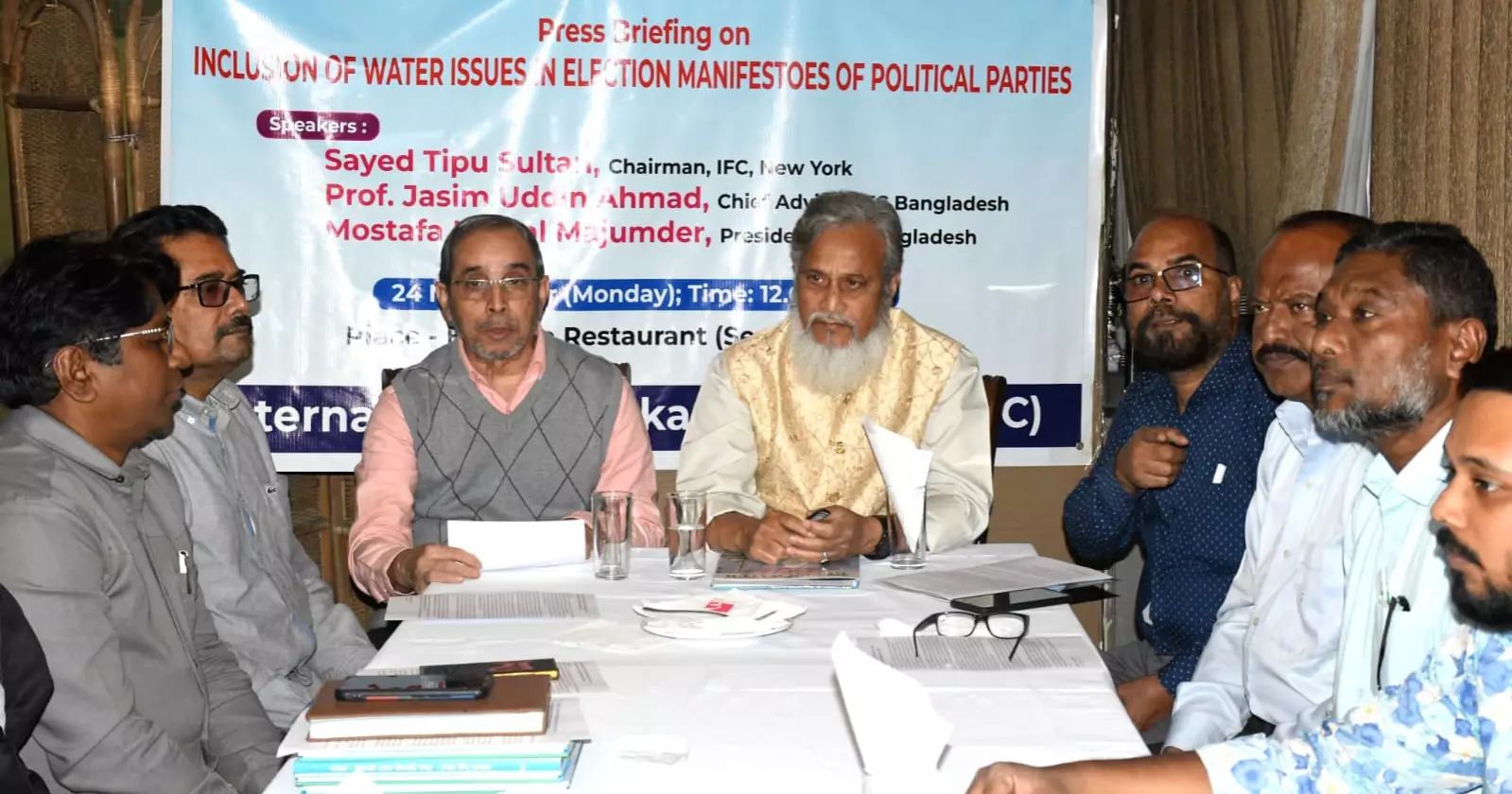
International Farakka Committee (IFC) Bangladesh on Monday called on all the political parties in Bangladesh to include the country’s most pressing water issues in their election manifestos.
They made the call at a press briefing held at a city restaurant.
IFC New York Chairman Sayed Tipu Sultan and IFC Bangladesh president Mostafa Kamal Majumder spoke on the occasion.
At the press conference, the speakers outlined a set of key demands, emphasizing first and foremost the inclusion of river and water rights in the election manifestos of all political parties.
“Parties must clearly articulate their position on ensuring the natural flow of shared rivers and commit to protecting the water rights of the people of Bangladesh,” said Sayed Tipu Sultan.
Urging political leaders to address the water issue with urgency, he said, “A firm national stance against the construction of upstream dams and diversion of water by India should be taken as upstream interventions on 54 of the 57 common rivers have intensified environmental degradation in Bangladesh.”
Highlighting the upcoming expiration of the 30-year Ganga Water Treaty in 2026, the committee demanded necessary reforms to ensure guaranteed water availability for Bangladesh.
The IFC also insisted that the renewed agreement must include an arbitration mechanism to resolve disputes between the countries.
IFC leaders urged the immediate conclusion of the long-pending Teesta Water Treaty, stalled since 2011 and stressed the need to halt the complete withdrawal of dry-season flows at the Gajoldoba Barrage in West Bengal, which severely affects Bangladesh’s northwestern region.
He later stressed the need for a comprehensive, coordinated and equitable water distribution framework for the remaining 52 shared rivers.
Prof Jasim Uddin emphasised the need to protect the environment and biodiversity, particularly in the southwest, where dozens of rivers have already died due to reduced flows.
The IFC leaders finally urged the formation of national consensus among all political parties, groups, and citizens on protecting Bangladesh’s rights over transboundary waters and raising awareness among the countrymen.