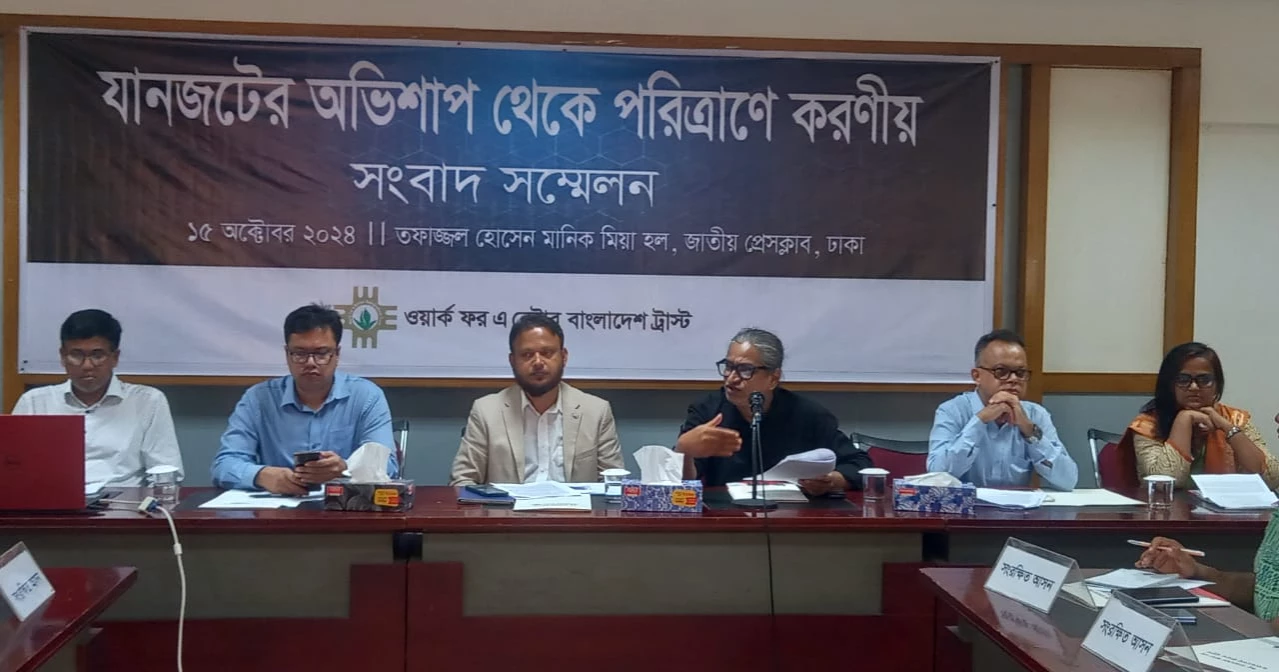
Speakers on Tuesday urged the interim government to play a positive role in building a multimedia integrated and people-friendly communication system by increasing investment in public transport, including buses, railways and waterways.
If steps are not taken to reduce traffic congestion now, the situation will become more dire. We expect that the current interim government will play a positive role in building the system, they said.
The speakers said this at the press conference titled 'What to do to get rid of the curse of traffic jam' organized by the Work for a Better Bangladesh Trust at the Tafazzal Hossain Manik Mia meeting room of the National Press Club.
Presenting an 18-point recommendation for traffic management, they said Dhaka city has become one of the most congested cities in the world due to unplanned urban transport system.
According to a United Nations Development Program report, Bangladesh's population will increase to 230-250 million by 2050, and a large portion of this population growth will occur in urban areas.
Syeda Ananya Rahman, programme head of Work for a Better Bangladesh Trust, conducted the session while organization's executive director Saifuddin Ahmed and traffic signal system researcher and traffic CEO Ashraful Alam Ratan presented two keynote speeches at the programme.
President of Bangladesh Institute of Planners Dr Adil Mohammed Khan, lawyer and policy analyst Syed Mahbubul Alam, Technical Advisor of Vital Strategies Aminul Islam Sujan, Executive Member of Center for Urban Studies Maruf Hossain, and General Secretary of Anti-Narcotics Organization Helal Ahmed spoke at the event. Before the press conference, a sit-in programme was organized in front of the National Press Club demanding fair traffic management.
Saifuddin Ahmed said in his article that in 2007 the average speed of cars in Dhaka was 21 km per hour. Now it has reduced to 4.8 km. About 82 lakh working hours are wasted daily due to traffic congestion in Dhaka. In monetary value which is about TK 139 crores daily and more than TK 50 thousand crores annually.
"Several factors including undisciplined driving, delay of mega projects on various busy roads of the capital, private car dependent planning, weak traffic signals and monitoring system, mismanagement of vehicle registration, lack of scientific and modern methods in overall traffic management are responsible for this problem of traffic congestion. If these issues are properly resolved, speed and order can return to the road," he presented
Ashraful Alam Ratan said in his article, there are various reasons why the traffic system of Dhaka city is ineffective. Among them, hand-stick-based signal system, chaos in the crossing of vehicles at the signal, creating obstacles by parking cars in places that may cause traffic congestion, not respecting and obeying the law, not making regular driver training mandatory, etc. are important.
"To overcome this situation, we propose Customizable Integrated Traffic Management System (CITMS). Through this 24 hours signal operation is maintained throughout the year, the average speed of the vehicle is 25-30 kmph. It will be possible to carry out various activities including bringing back, identifying law breakers and bringing them under law, ensuring a safe environment for pedestrians, coordinating between inter-departmental institutions, identifying polluting vehicles," he also presented.
Speakers at the event said that it is necessary to formulate and implement separate policies, supporting laws for public transport, city services and other services. Working on a project and commercial basis has not succeeded in reducing traffic congestion in most cases.
They also stressed on the long term initiative for traffic management so that they can work together for at least five years. Efforts should be made to solve traffic system problems at low cost through use of indigenous technology. The Road Transport Act is not exhaustive.Amendment of this law needs to be done.