National leaders have demanded that the Interim Government raise Bangladesh's water problem at the UN.
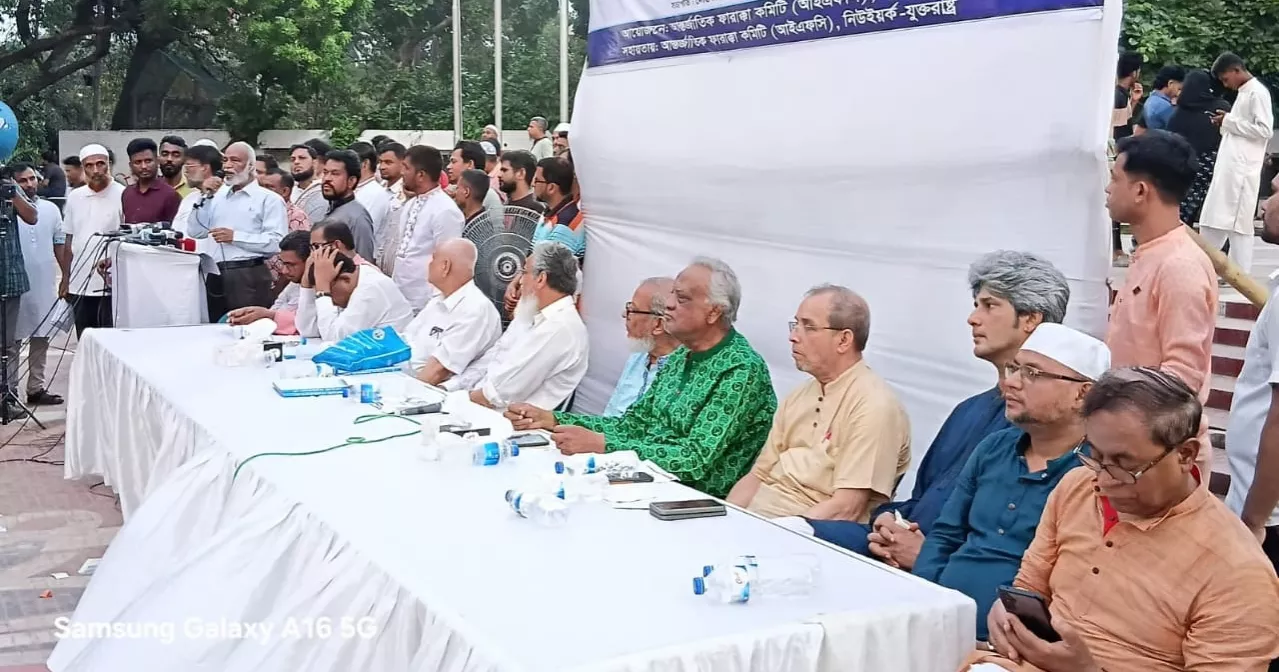
They raised the demand at a mass rally organized on Farakka Long March Day at National Shaheed Minar in the city on Friday afternoon.
The mass rally was organized by IFC Bangladesh in collaboration with the New York-based International Farakka Committee (IFC). iFC Bangladesh chapter President journalist Mostafa Kamal Majumdar presided over the rally.
On 16 May 1996, Moulana Abdul Hamid Khan Bhasani, leader of the toiling masses led the long march and raised a strong voice against unilateral diversion of water of the Ganges.
'Raise voices against India's water aggression': International Farakka Committee
Addressing the mass rally as the chief guest Dr. Abdul Moyeen Khan, member BNP Standing Committee, called for demanding decommissioning of the Farakka Barrage over the Ganges, because it cannot be demolished as is commonly demanded for its adverse impacts on the environment and biodiversity in Bangladesh.
He said the water diversion structures on 54 common rivers created severe problems of desertification, salinity and siltation affecting life and livelihood in Bangladesh.
The speakers in the rally said flows of none of the 54 shared rivers passing through Bangladesh, a land of rivers, is guaranteed even after 54 years of independence.
They mentioned that Bangladesh has suffered a serious environmental disaster due to the construction of dams or reservoirs upstream of all rivers and diversion of water elsewhere.
They also said that the 30-year Ganga bondage Agreement signed by the autocratic government without guarantee and arbitration clauses will expire in December next year. Before that, it is important to renew this agreement with a guarantee of receiving the agreed amount of water and an arbitration clause.
Farakka Long March Day to be observed May 16
Another important river, the Teesta, has been on hold for 14 years despite a promise to sign an agreement in 2011. During the dry season, the entire flow of the river is diverted from the Ghazal Doba Barrage in West Bengal, drying up the northern part of Bangladesh.
On the other hand, during the rainy season, all the water from the hilly slopes of the river is released, causing several devastating artificial floods in Bangladesh. This washes away crops, homes and homesteads and causes death to humans, draft animals and poultry.
Due to the diversion of water through dams upstream of each of the remaining 52 shared rivers, one-third of the country's normal annual flooding is stopped during the rainy season, destroying aquatic biodiversity. Water lilies, snails, algae and native fish species that grow in floodplains have almost disappeared.
Due to the lack of normal flooding, the crop production capacity of floodplain lands has come down by half. This situation is gradually deteriorating.
Among others, IFC New York Chairman Syed Tipu Sultan, Jatiya Party Chairman Mustafa Jamal Haider, former Vice-Chancellor of Jahangirnagar University Professor Jasim Uddin Ahmad, National Ganofront Coordinator Comrade Tipu Biswas, BNP Chairperson's Advisor Abdus Salam, Bangladesh Samajtantrik Dal (BSD) leader Khalequzzaman, Revolutionary Workers Party General Secretary Saiful Haque, Gono Sanghati Andolan Chief Coordinator Jonayed Saki, Bhasani Anusari Parishad convener, Rafiqul Islam Bablu, Bangladesh Labour Party chairman, Mustafizur Rahman Iran, BFUJ Secretary General Quader Gani Chowdhury and DUJ President Shahidul Islam, were also spoke in the rally.
International Farakka Committee Bangladesh forms new executive committee
They said, hundreds of rivers and tributaries have died due to the lack of normal flow during the dry season. As a result, due to the lack of fresh water flow on the southwestern coast of Bangladesh, salinity has penetrated more than 200 kilometers inland, causing serious damage to agriculture, industry, fish, trees and livestock. Due to the increase in salinity in the coastal water, the valuable Sundari trees of the Sundarbans are disappearing.
Bangladesh, the largest delta in the world, formed by rivers for thousands of years, is about to be destroyed due to the lack of normal water flow of rivers. This is a serious existential crisis for Bangladesh. Seeing this situation, foreign environmentalists said that they do not understand why Bangladesh does not cry out.
For the past 16 years, the autocratic government has been protecting the interests of neighboring India by sacrificing Bangladesh's just demands for water in exchange for the assurance of staying in power. This situation cannot be resolved through bilateral diplomacy. Therefore, the speakers said that if Bangladesh's water problem is to be solved, it must be raised at the United Nations.