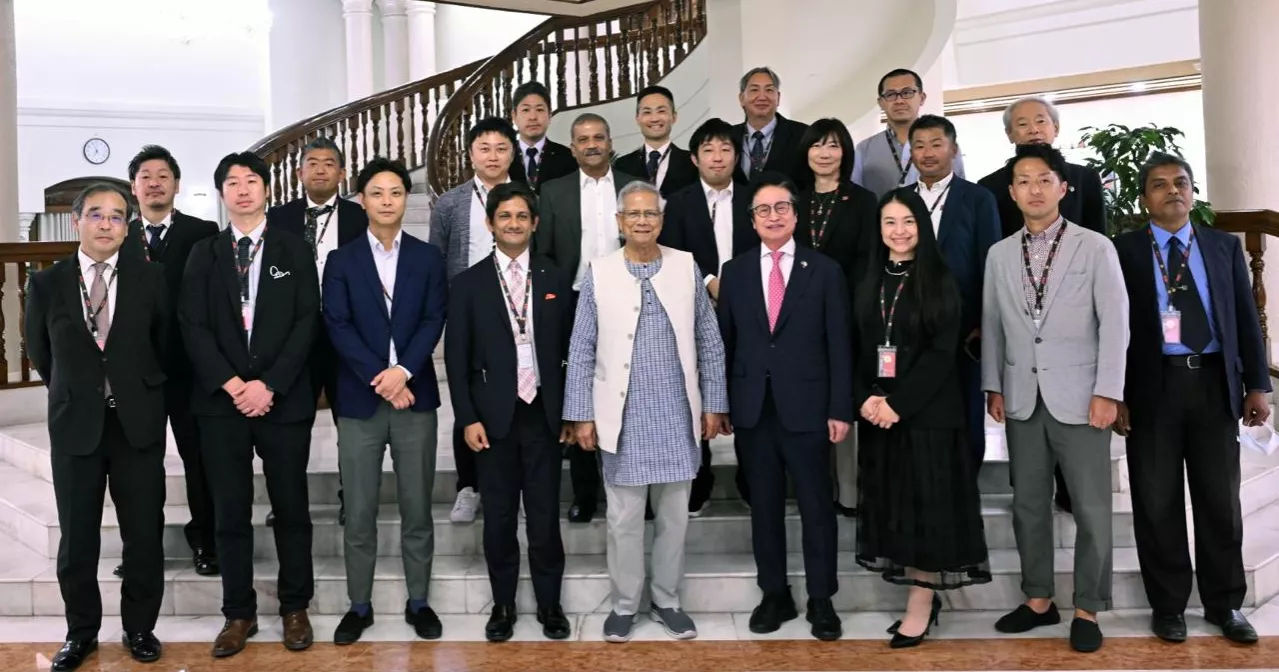
A delegation from Japan’s National Business Support Combined Cooperatives (NBCC) met Chief Adviser Prof Muhammad Yunus on Sunday to brief him on the progress of recruiting 1 lakh skilled workers from Bangladesh.
The 23-member delegation met the Chief Adviser at the State Guest House Jamuna.
NBCC, a Japanese business federation of more than 65 companies, recently signed a Memorandum of Understanding (MoU) with Bangladesh to help recruit skilled Bangladeshi workers.
Under the agreement, a framework has been created for training, certification and employment of Bangladeshi workers in Japan.
More than one lakh workers will be recruited over the next five years through programmes such as the Technical Intern Training Programme (TITP) and Specified Skilled Workers (SSW).
The delegation informed that recruitment of 2,000 skilled workers in the first phase next year is now under process and 6,000 workers will be recruited in 2027 and 18,000 in 2028.
They said Japan has a growing demand for skilled workers in the construction, service, aviation, garments and agriculture sectors.
Besides, more workers will be needed in the driving, automobile and recycling sectors in the coming years, said the delegation.
Top Japanese entrepreneur to establish driving school in Bangladesh
To support recruitment from Bangladesh, training is being provided at two centres — one in Khulna and another in Kapasia, Gazipur.
NBCC representatives have already visited both centres.
The Chief Adviser asked if there were any shortcomings in the training process.
NBCC Chairman Mikio Kesagayama, who led the delegation, said, “I visited the two training centres last March. I was surprised by the progress made in just seven months. We are very satisfied with the training and hopeful that we will be able to recruit 2,000 skilled workers next year.”
He added, however, that the language skills of trainers could still be improved.
The Chief Adviser said acquiring language skills is a big challenge. “For this, virtual classes can be arranged with teachers from Japan. Bringing Japanese trainers here to train our people can also be considered.”
Prof Yunus highlighted the skills and dedication of Bangladeshi women, saying they could play an important role in Japan’s caregiving sector if they receive proper language and professional training.
“Although it may seem difficult at first, once Bangladeshi girls learn, they will be able to teach others. Once they start going to Japan, more will follow,” he said.
The NBCC delegation said Japan will need more than 400,000 skilled nurses in the coming years and they will consider recruiting more nurses from Bangladesh.
Adviser Dr Asif Nazrul said the government is closely monitoring the progress of workers’ recruitment in Japan.
He said a specific roadmap will be prepared and a special cell has already been formed by the ministry to address related issues.