
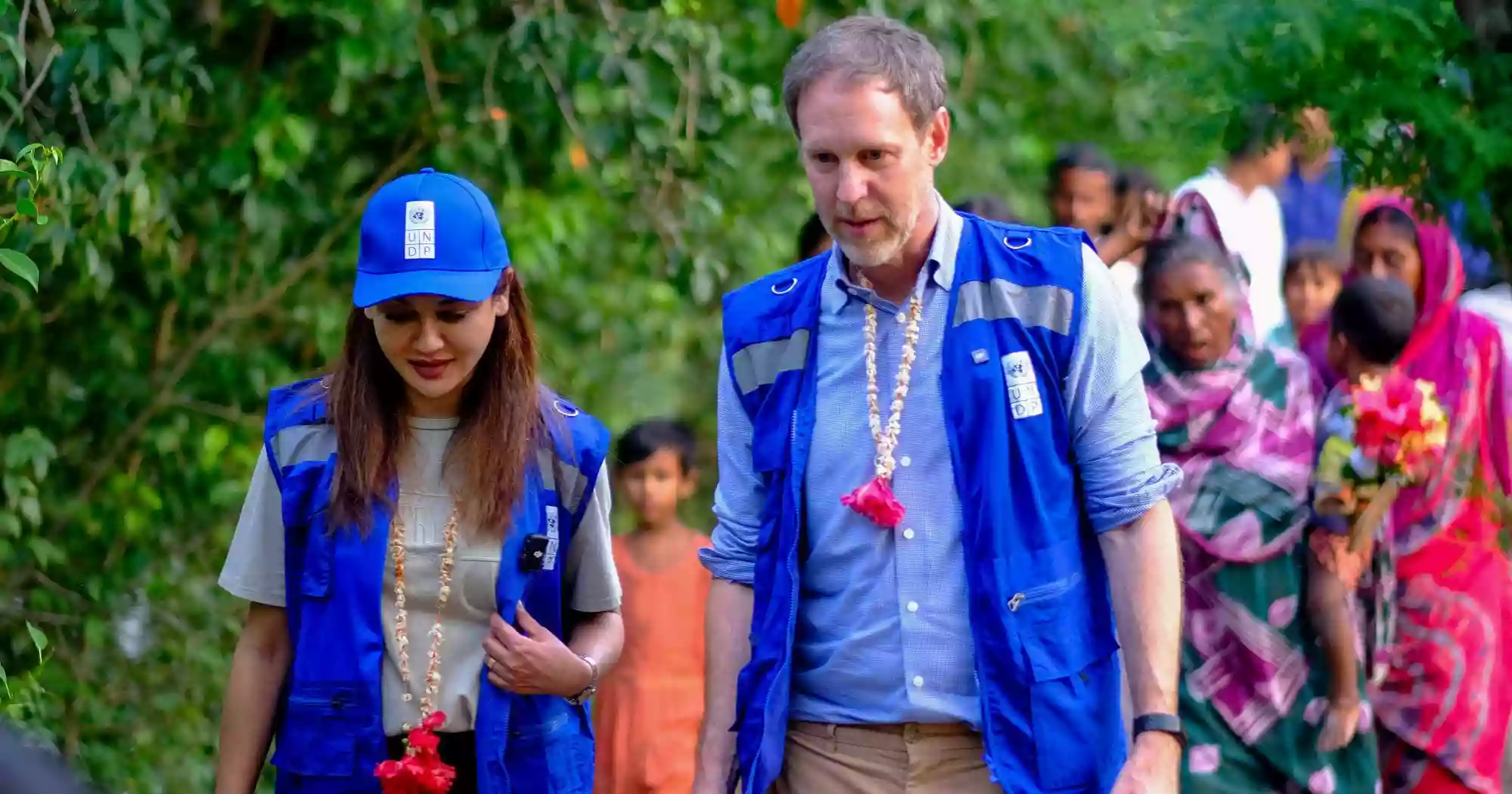
In the lead-up to the UN Climate Conference COP30, UNDP Bangladesh Goodwill Ambassador and acclaimed actor Jaya Ahsan along with UNDP Resident Representative Stefan Liller visited the coastal Dacope upazila in Khulna on Tuesday to witness how climate change is reshaping daily life in some of the country’s most vulnerable communities.
The visit sought to highlight the profound impacts of rising salinity, water scarcity and recurring cyclones on coastal populations, while showcasing how community-driven adaptation efforts are helping people rebuild their livelihoods, according to a press release released on Wednesday.
The overarching message from the visit was a renewed call for urgent global action to protect climate-vulnerable nations like Bangladesh, which are already facing the front lines of the climate crisis.
During the visit, the delegation observed the Local Government Initiative on Climate Change (LoGIC) project, jointly implemented by UNDP and UNCDF, with support from the Government of Bangladesh, Sweden and Denmark.
The initiative focuses on strengthening local governance and enhancing adaptive capacities among climate-affected communities, particularly women, who are emerging as key leaders in resilience-building efforts.
At Tildanga Union, Jaya Ahsan and Stefan Liller spoke with local women who are diversifying income sources, securing access to safe drinking water and developing innovative solutions to withstand changing environmental conditions.
“Here in Dacope, climate change is not just a headline, it is a daily reality,” Jaya Ahsan said during the visit. “Despite hardships, the resilience of these communities is extraordinary. “
“With the support of UNDP and the Government of Bangladesh, people are adapting, rebuilding and continuing to move forward. These are stories of courage and hope that the world needs to hear.”
UNDP Resident Representative Stefan Liller said, “What we see in Dacope is not a distant concern but a daily struggle for survival.”
Yet, the leadership shown by women here demonstrates that with the right support, communities can turn challenges into opportunities. “As we head towards COP30, Bangladesh’s experience stands as a testament to innovation, resilience and community-led solutions, he added.”
END/UNB/FF/FH/