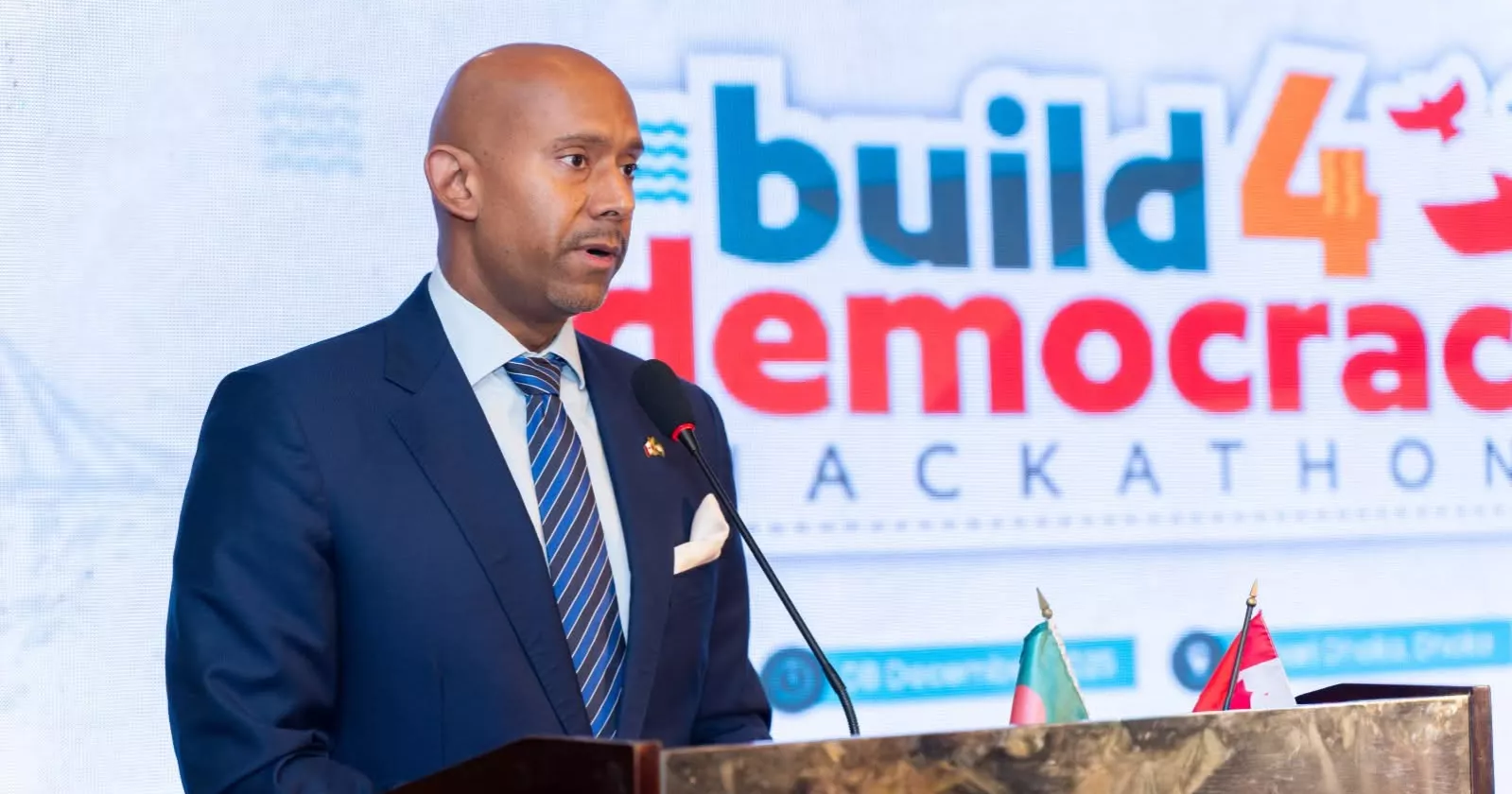
Canadian High Commissioner to Bangladesh Ajit Singh on Monday said with elections coming up, ensuring that the digital space remains safe, inclusive, and open is more important than ever.
“It is a shared responsibility that demands local insight, local leadership, and local innovation,” he said, noting that Bangladesh’s next chapter will be written not only in its cities, towns, and institutions, but also in its digital public sphere.
Speaking at a programme, the High Commissioner said Bangladesh’s digital space is growing fast. Such growth supports participation and transparency, but it also creates challenges, including misinformation, harassment, and weakened public trust.
SecDev, with support from Global Affairs Canada, hosted the Build4Democracy Hackathon 2025 that brought together dynamic young technologists, civil society leaders, researchers, and entrepreneurs to develop innovative tools that strengthen digital resilience in Bangladesh while maintaining information integrity.
“Your work is ambitious, demanding, and necessary for building a strong, prosperous, and vibrant Bangladesh. As you build, I encourage you to remember three principles - first, anchor your work in the lived realities of communities; be guided by ethics and design for sustainability.
This initiative was organized in collaboration with UNDP Bangladesh as the strategic partner; Peace Maker Studio as the implementing partner; Activate Rights as the knowledge partner; and Rupantar and Surge Bangladesh jointly serving as outreach partners, with Film4Peace as the prize partner.
It was a broad coalition with a common goal: strengthening digital resilience nationwide. In particular, the hackathon highlighted the essential role of youth-led innovation in countering misinformation, online harassment, and coordinated digital manipulation.
The hackathon united multidisciplinary teams from across the country to design practical and responsible digital solutions that reinforce information integrity, democratic participation, and online safety ahead of the 2026 national elections. The initiative reflects Bangladesh’s ongoing digital transformation and its commitment to cultivating transparent, safe, and resilient online spaces.
The event was attended by high-level representatives from SecDev and the High Commission of Canada in Bangladesh, who spoke to the importance of protecting democratic processes and diverse civic voices in the lead-up to the elections.
Participating teams were challenged to design technically sound solutions that could function effectively within Bangladesh’s real-world context and be ready for rapid deployment, with credible strategies for reaching users before the election.
To this end, teams collaborated with expert mentors to develop prototype solutions aligned with two core themes - Preserving Diverse Voices and Creating Safe Digital Spaces.
To make the hackathon unique, fun, and challenging, it featured a dynamic “Shark Tank”–style pitch arena, where participants presented their solutions to a distinguished panel of judges from diverse sectors.
Judges engaged teams with rigorous questioning, evaluating both vision and viability under real-world conditions.
These “SHARKS” assessed proposals based on technical soundness, democratic value, sustainability, ethical safeguards, and community impact.
The high-energy pitch rounds—supported by live DJ transitions—created an investment-style atmosphere that challenged teams to refine, defend, and elevate their ideas.
Winning teams will receive targeted support and financial resources to complete a working Minimum Viable Product (MVP) within one month.
Canadian High Commissioner meets Prof Ali Riaz
To maintain momentum and ensure progress, a second Build4Democracy Showcase Event will be held in January 2026, where all participating teams will present the advancements made during the development period.
This showcase will provide an opportunity for partners, stakeholders, and potential adopters to review improved prototypes, identify pathways for piloting, and mobilize further support.
Solutions will then be prepared for testing and deployment with relevant communities and institutions in early 2026, ensuring citizens and stakeholders have access to trustworthy, secure, and actionable digital tools ahead of the national elections.
