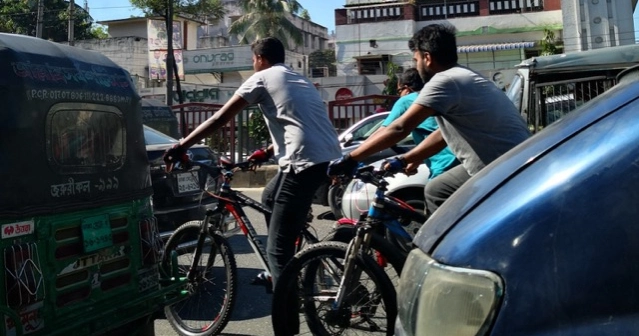
Dedicated cycling lanes on Bangladesh roads still remain more of a distant dream when each year globally, nearly 1.2 million people lose their lives on the roads, more than a quarter of them while walking or cycling.
The country’s urban roads - especially in major cities like Dhaka and Chattogram - are already congested with mixed traffic - cars, rickshaws, buses, trucks and CNGs and with latest presence of growing battery-powered rickshaws.
These roads often lack even proper sidewalks, making the addition of cycle lanes impractical without a significant redesign.
"I didn't see any effective cycle lanes in Dhaka. There is a cycle lane in the city's Manik Miah Avenue, but it largely remains ineffective and occupied by others," Arefin Islam told UNB who mostly travels using bicycle to do his routine works.
There should be dedicated cycle lanes, not just in Dhaka, but across the major cities, he said, adding that he feels the pains - waste of time and other hassles, while travelling by bicycle in Dhaka due to absence of dedicated cycle lanes.
There is another thing, said his friend Sohel, adding that cycling in Dhaka is now highly risky due to the dominance of battery-powered rickshaws.
UGC moves to ensure transparency in use of research funds by private universities
"I remember, the country's first bicycle lane was inaugurated in Agargaon, Dhaka in 2019," Sohel said.
The second lane – with a green layer of cement and white cycle icon marks – was dedicated to bicycles on Manik Miah Avenue.
Safer Cycling and Better Health
As the 8th UN Global Road Safety Week (May 12-18) kicks off around the world under the theme “Make walking and cycling safe,” the World Health Organization (WHO) has launched a new toolkit to help governments promote active mobility – by making it safer.
Only 0.2% of the roads worldwide are equipped with cycle lanes, and far too many communities lack basics like sidewalks or safe pedestrian crossings.
“Walking and cycling improve health and make cities more sustainable. Every step and every ride help to cut congestion, air pollution and disease,” said Dr Tedros Adhanom Ghebreyesus, WHO Director-General. “But we must make walking and cycling safe, so more people choose these healthier, greener options.”
Despite their benefits, fewer than one-third of countries have national policies to promote walking and cycling. WHO’s new toolkit aims to fill that gap with practical, evidence-based guidance for policymakers, urban planners, health advocates and civil society.
The toolkit calls for bold action including: integrating walking and cycling into transport, health, environmental and education policies; building safe infrastructure like sidewalks, crossings and protected cycle lanes; setting and enforcing safer speed limits aligned with global best practices; promoting safe road use through public awareness and behaviour change campaigns; and using financial incentives to encourage active mobility.
While global pedestrian deaths dropped slightly and cyclist deaths plateaued between 2011 and 2021, regional trends show growing danger:
In the WHO South-East Asia Region, pedestrian deaths rose by 42%.
In the European Region, cyclist deaths surged by 50%.In the Western Pacific Region, cyclist deaths soared by 88%.
Local investors emerging as game changers in Bangladesh’s economic landscape
This week, WHO joins hundreds of organisations and governments worldwide to demand urgent action on road safety.
The Global Alliance of NGOs for Road Safety is mobilizing over 400 member organizations in 100 countries to support the campaign.
“It is urgent to make, what should be our most natural means of transport, safer. This is paramount for road safety, but also health, equity and climate,” said Etienne Krug, Director of the WHO Department for the Social Determinants of Health.
“We’re calling on all sectors – transport, health, education and beyond – to make walking and cycling safe and accessible for everyone.”
Road traffic injuries are a leading cause of death and disability worldwide, with nearly 1.2 million people killed and as many as 50 million people injured each year.
They are the leading killer of young people aged 5-29 years. Globally, more than 1 of every 4 deaths occur among pedestrians and cyclists.
The 8th UN Global Road Safety Week offers an opportunity to spur action at national and local levels to make walking and cycling safe, by highlighting concrete and specific interventions that can be taken by different stakeholders – governments, international agencies, civil society, businesses and schools, according to the WHO.
These actions will help promote and facilitate a shift to walking and cycling, which are more healthy, green, sustainable and economically advantageous modes of transport, said the UN agency.
This will also contribute, directly and indirectly, to the attainment of many Sustainable Development Goals.