
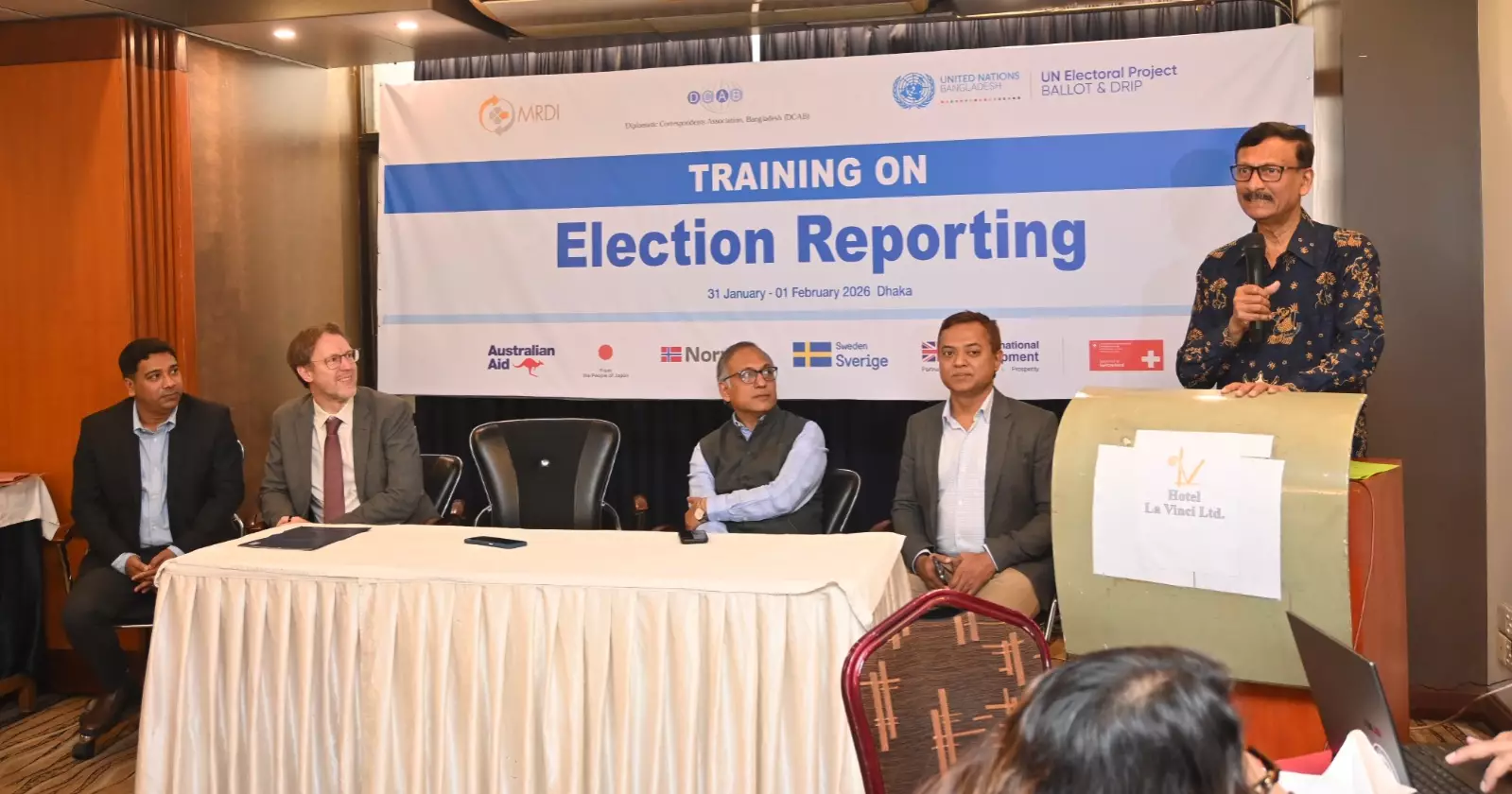
Apparently expressing displeasure over the way minority-related issues are reported, Foreign Affairs Adviser Md Touhid Hossain on Sunday said minorities are citizens of Bangladesh and it is the government’s responsibility to take action if any atrocities are committed against them.
“One point I have made very clear is that minorities in Bangladesh are Bangladesh citizens, and it is the responsibility of the Bangladesh government to take action if any atrocities have been committed against them,” he said while speaking at the closing session of a training programme on election reporting.
Hossain made the remarks while referring to an interview he gave to the BBC earlier in the day.
The Foreign Adviser said the voter turnout in the upcoming national election will be higher than 55 percent, which is more than that of the 1991 election.
Elections to be largely peaceful, hopes Foreign Adviser Touhid Hossain
Hossain acknowledged that incidents do occur from time to time but stressed that what matters most is that immediate action is taken against the perpetrators.
“This applies to all countries of the world. Minorities face challenges everywhere. Today’s issue is not specifically about minorities; I raised it only to demonstrate how the media can either make or break an issue through its reporting,” the Foreign Affairs Adviser said.
He clarified that this does not mean atrocities are acceptable, emphasising that any such acts are absolutely unacceptable.
Referring to his BBC interview, Hossain said the issue of a particular atrocity against a member of a minority community was raised.
He said similar or even worse incidents occur on the other side of the border (Bangladesh shares borders with India and Myanmar).
“Do those incidents become global issues in the same way? They do not. Ultimately, it is the media that amplifies these issues, and the media is often selective. This is something that cannot be changed overnight,” he said.
Hossain said he posed a counter-question during the interview, asking whether the prompt action taken by the government is reported with the same prominence.
An atrocity may receive widespread publicity, but the immediate actions taken by the government against the perpetrators often do not receive comparable media attention, he said.
Highlighting the media's role, he added, “The same incident can have very different effects - within communities and beyond - depending on how it is presented. Presentation is extremely important.”
Hossain said it is not uncommon for newspapers to acknowledge errors in reports through rejoinders, but such corrections are often published on inside pages in a single column. “That makes all the difference.”
Hossain said the government shares concerns over election-related violence and is trying to address them.
However, such concerns existed before every election in the past and the government always tried to prevent escalation.
“You know that elections in our country are highly competitive, and even if parties do not officially instigate violence, individual-level incidents can occur. This is not new; it happens in every election. We will continue trying to minimise such incidents and ensure a proper election,” he added.
Dhaka calls for early FTA talks with EU to attract more investment
Diplomatic Correspondents Association, Bangladesh (DCAB) in cooperation with the UNDP and Media Resources Development Initiative (MRDI) hosted the training where former Bangladesh Bureau Chief of the Associated Press (AP) Farid Hossain was the facilitator of the two-day session.
UNDP Resident Representative in Bangladesh Stefan Liller, MRDI Executive Director Hasibur Rahman and DCAB President AKM Moinuddin also spoke at the event conducted by DCAB General Secretary Emrul Kayesh.