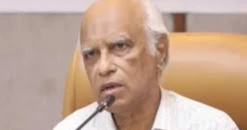
The working women will get legal rights to take their children to the workplace, said Planning Adviser Wahiduddin Mahmud on Monday.
“The working women will soon have the legal right to bring their children to the workplace and the interim government is actively working to implement it,” he said while speaking at an event titled ‘Recognition: A First Step Towards Gender Equality’, held at a hotel in the capital.
He also said that allowing working mothers to bring their children to the workplace would be a transformative step for the future.
"This would create a pressing need for mandatory daycare facilities in every office," he added.
Manusher Jonno Foundation (MJF) organised the programme.
The women in Bangladesh are not only shouldering the burden of unpaid domestic work but also increasingly surpassing men in various workplaces, said speakers at the event.
Findings from the Household Production Satellite Account (HPSA) report by the Bangladesh Bureau of Statistics (BBS) were presented for deliberation
According to the report, the economic value of unpaid domestic work amounts to Tk 6,70,000 crore which is 18.9% of the GDP, with women contributing 85% equivalent to 16.14% of the GDP.
The adviser said that women are making relatively greater contributions than men in the workforce.
“Development becomes truly meaningful only when women’s roles are fully acknowledged,” he added.
MJF Executive Director Shaheen Anam reflected on the organisation’s advocacy efforts spanning over a decade.
“We envisioned a society where women are respected at home and are free from domestic violence. Recognising unpaid domestic work was a key part of that vision. Today’s government recognition is a milestone in the journey of advancing women's rights,” she said.
Asma Akhtar, Deputy Director of Bangladesh Bureau of Statistics (BBS) expressed hope for more frequent data updates in the future.
Presenting the keynote, Banshree Mitra Neogi, Director of Rights and Governance Programs at MJF, said many crucial surveys are often funded by international development partners.
“They may not always be able to do so. The government should step up and take ownership of such initiatives,” she said.
Nusrat Aman, CEO of Ayat Foundation, said that men’s participation in caregiving should not be seen as commendable but rather as shared responsibility.
Nasiba Selim, Principal Social Development Specialist at the Asian Development Bank (ADB), said that society often assumes that women will automatically take on domestic responsibilities. “This mindset must change and we must establish gender-balanced roles,” she said.
Additional Secretary of the Department of Women Affairs, Kazi Golam Tausif, said, “Men and women must work together for the welfare of society. That is our shared principle.”
Geetanjali Singh, Country Representative of UN Women Bangladesh, said, “Joint efforts by men and women in unpaid care work could be a game-changer.”
Stéphanie St-Laurent Brassard, Second Secretary (Development – Gender Equality) at the Canadian High Commission in Bangladesh, said, “Today we reaffirm that household work is not an expense, but an investment—an investment in potential, equality and a prosperous, just future.”
Katharina Koenig, Deputy Team Leader of the CEF Citizenship Project, said, “We give utmost importance to the issue of women’s unpaid care work and will continue to run advocacy and awareness campaigns in the future.”
Chairperson of MJF’s Governing Board, Parveen Mahmud FCA, said that recognizing women’s unpaid care work is a significant achievement, reflecting the long-standing advocacy of MJF.
Stakeholders across society must change their mindset regarding gender equality, she added.
This achievement marks an important milestone for MJF’s campaign “Morjaday Gori Somota” (Dignity for Equality), launched in 2013, which aims to increase recognition of women’s contributions, enhance their dignity in families and society and reduce violence and discrimination.