
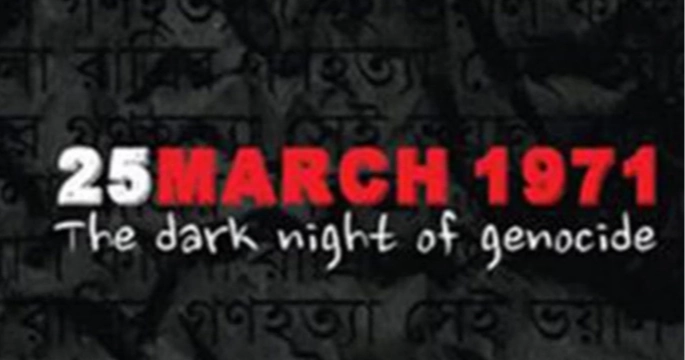
‘Genocide Day’ will be observed in the country on Wednesday, to commemorate brutalities of the Pakistan army during Operation Searchlight, launched on the night of March 25 in 1971, as a last resort to try and suppress the will of the people of what would become, in less than nine months, an independent Bangladesh.
On the Black Night of March 25 in 1971, the Pakistani military junta resorted to mass killings and arson in Dhaka to implement their blueprint to thwart the Awami League's assumption of office following the election mandate of 1970.
In the attack dubbed 'Operation Searchlight', the Pakistani forces mercilessly killed the Bangalee members of the East Pakistan Rifles and police, students, teachers and common people.
They killed people indiscriminately, set fire to the houses and property and looted business establishments, leaving a trail of destruction.
The night also witnessed Bangabandhu Sheikh Mujibur Rahman’s proclamation of independence before he was arrested by the Pakistani troops and subsequently flown to West Pakistan.
On the day, discussion programmes on the March 25 genocide and the Liberation War will be held at all educational institutions across the country, including schools, colleges, madrasas, and technical institutions, with the participation of distinguished persons and valiant freedom fighters.
Besides, from 12:00 pm on March 25, exhibitions of rare and authentic photographs and documentaries on the genocide will be organised at mini poles in all city corporation areas, including Dhaka.
To mark the day, a one-minute symbolic blackout will be observed from 10:30 pm to 10:31 pm on March 25, 2026.
A seminar will also be organised at 10:00 am on March 25, or at a convenient time, under the arrangements of the Ministry of Foreign Affairs and the Liberation War Museum.
Different cultural organizations are holding seminars, cultural programmes lyrical drama on genocide.
Bangladesh Betar and Bangladesh Television as well as private television channels and radio stations are airing special programmes while national dailies published supplements marking the day.
Meanwhile different religious organizations arranged special prayers and doa mehfil seeking peace for the eternal souls of the deceased.
President Mohammed Shahabuddin and Prime Minister Tarique Rahman issued separate messages on this occasion.
In a message, the President said a long-cherished right to vote has been restored after many years through a free, fair, and credible election. A democratic government has been established based on the people’s mandate.
The government has begun taking various programmes and initiatives to build a non-discriminatory, democratic, humane, and self-reliant Bangladesh.The martyrs of the Liberation War had the hope, aspirations, and dream of establishing a humane, democratic, and justice-based state—one free from discrimination, deprivation, misrule, corruption, injustice, and oppression, he said.
“Let us all, regardless of religion, caste, party, or opinion, work together to fulfill their spirit and expectations. Let us be inspired by patriotism,” he said.
In his message, the Prime Minister said to convey the value and significance of independence to the present and future generations, it is essential to know about the genocide of 25 March as well.
“Let us all strive to honour the sacrifices of the martyrs by establishing in the state and society the spirit of the great Liberation War - equality, human dignity and social justice. Let us work together to build a just, developed, prosperous, self-reliant and democratic Bangladesh,” he said.
He also prayed to the almighty Allah for forgiveness and eternal peace to the departed souls of all the martyrs and wish every success to all the programmes organised to observe the day.