
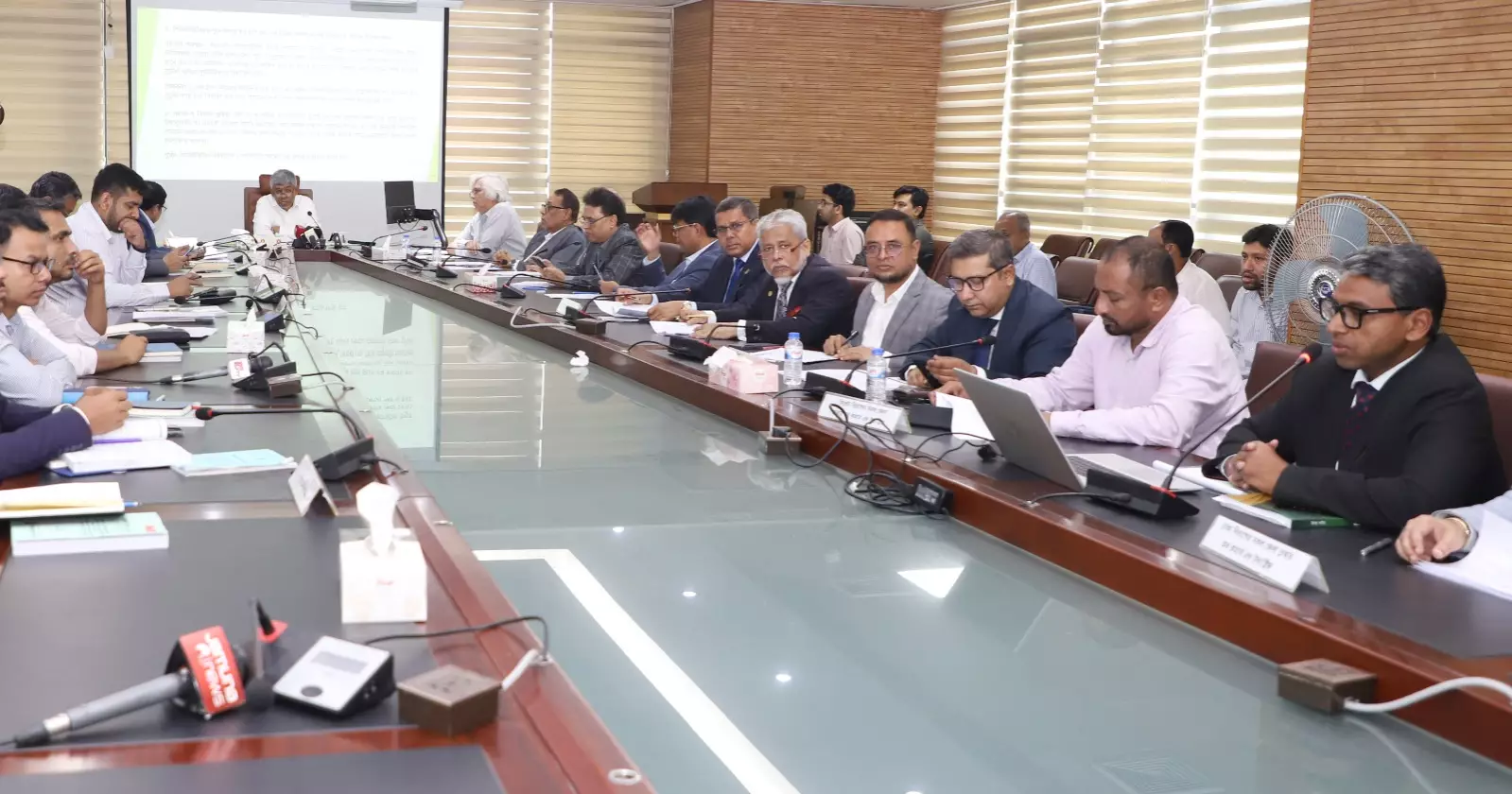
National Board of Revenue (NBR) Chairman Md. Abdur Rahman Khan on Wednesday said the upcoming national budget will focus more on removing non-tariff barriers rather than reducing tariff rates to lower the cost of doing business and revitalise the country’s macroeconomic environment.
The NBR chairman made the remarks while speaking at a pre-budget discussion held at the NBR conference centre where Dhaka Chamber of Commerce & Industry (DCCI) and Bangladesh Chamber of Industries (BCI) placed their budget proposals for FY2026-27.
Aligning with many of the proposals put forward by the business bodies, the NBR chairman said easing non-tariff barriers would help bring relief to entrepreneurs and support business expansion without significantly affecting revenue collection.
He emphasised that the revenue authority would remain firm in identifying tax evaders and bringing them under the tax net, while ensuring that compliant taxpayers are not subjected to unnecessary harassment. “There will be no leniency in identifying tax evaders. At the same time, we will work to reduce the burden and harassment on compliant taxpayers.”
Abdur Rahman also reiterated the government’s commitment to expanding the Value Added Tax (VAT) base and sought all-out cooperation from the business community in this regard.
Highlighting recent policy changes, he said the VAT threshold has been reduced from Tk 3 crore to Tk 50 lakh last year to widen the tax base.
However, he noted that the number of VAT-registered businesses currently remains below 8 lakh, which is not satisfactory considering the size of the country’s economy. “Given the size of the economy, the number of VAT-registered entities should be at least 10 lakh.”
The NBR chairman further said the corporate tax rate has already been significantly reduced over time, from 50 percent to 27.5 percent, leaving limited scope for further reduction.
However, he assured that the revenue authority would remain cautious so that the effective tax rate does not increase.
He also informed that the submission of corporate tax returns will be made fully online from next year, marking a significant step towards automation in the tax administration system.
According to the NBR chairman, the process of ensuring an online tax refund system is nearly complete, which is expected to improve transparency, reduce delays and enhance taxpayer confidence.
Abdur Rahman noted that expanding the VAT base, strengthening compliance and improving automation will remain key priorities for the revenue authority in the coming fiscal year.
Earlier, DCCI and BCI leaders placed a set of proposals aimed at expanding the tax net, reducing the cost of doing business and enhancing revenue mobilisation through automation and policy reforms.
The business chambers also stressed improving the investment climate and boosting employment through supportive fiscal measures.
The NBR chairman said constructive recommendations from the private sector would be considered in preparing the upcoming national budget, reiterating that the goal is to strike a balance between revenue mobilisation and business growth.