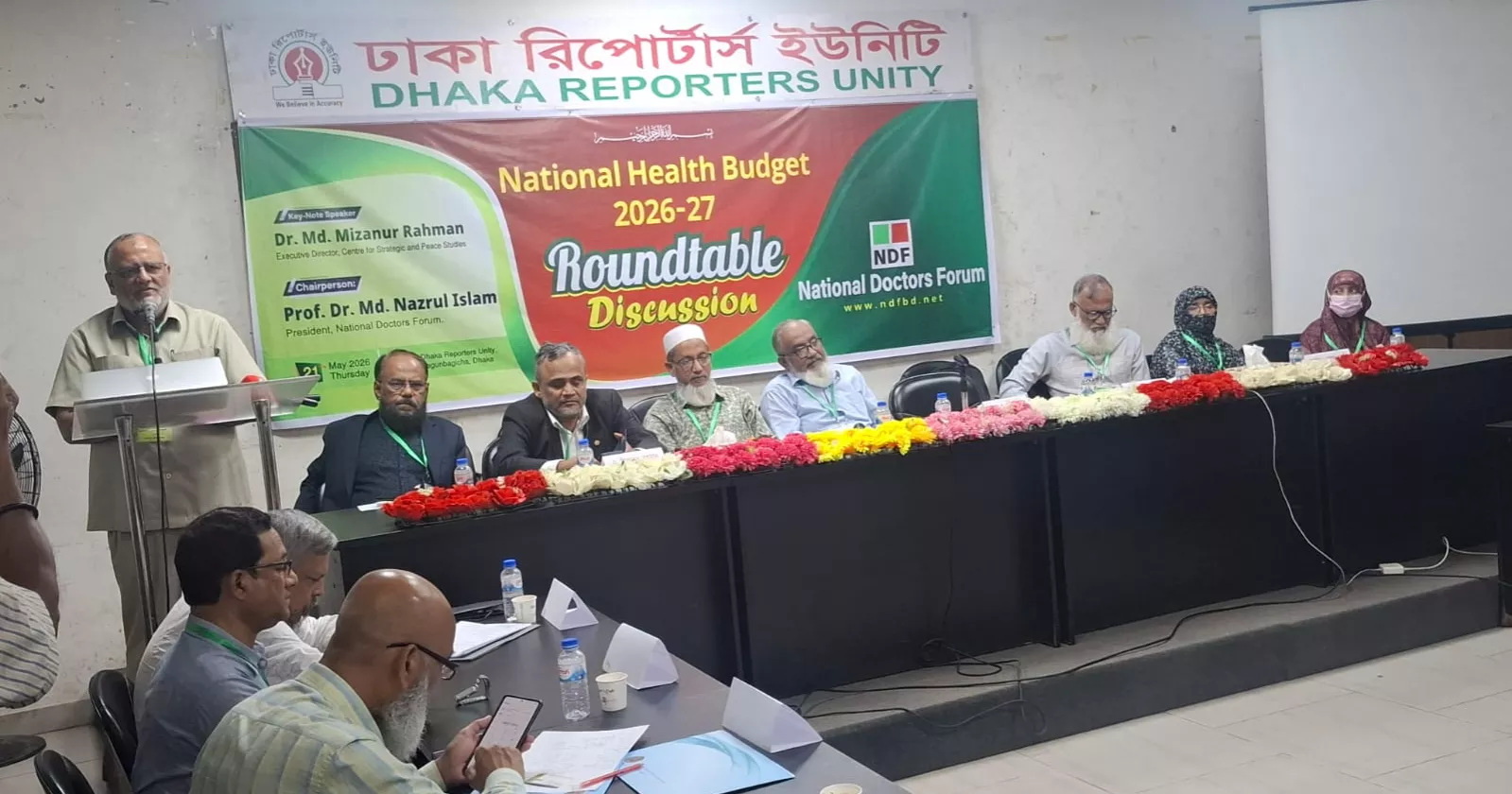
National Doctors' Forum (NDF), a platform of doctors, on Thursday demanded a phased increase in government spending on the health sector to 5 percent of the Gross Domestic Product (GDP) in the upcoming national budget Of FY2026-27.
The leaders of the organization pointed out that the current allocation for the country's health sector stands at a mere 0.7 percent of the GDP, which is highly inadequate compared to the
healthcare needs of the population. Consequently, healthcare disparities are widening, forcing citizens to bear the lion's share of medical expenses out of their own pockets.
The NDF raised these demands and recommendations during a roundtable discussion titled "National Health Budget 2026-27" held at the Dhaka Reporters' Unity (DRU) in the capital's Segunbagicha on Thursday.
NDF President Professor Dr. Nazrul Islam presided over the roundtable, while General Secretary Professor Dr. Mahmud Hossain moderated the session.
Presenting a keynote paper, economist and researcher Dr. Mizanur Rahman stated that although the World Health Organization (WHO) recommends spending at least 5 percent of the GDP on the health sector, Bangladesh currently spends only 0.7 percent. Furthermore, citizens have to bear around 70 percent of total health expenditures out of their own pockets, which poses a severe financial risk for low-and middle-income groups.
"Sustainable development and human resource optimization are impossible without adequate investment in health. The health sector must be viewed as a long-term state investment, not an expense," Dr. Rahman added.
Speaking as the guest of honour Member of Parliament from Jessore-2 constituency, Dr. Moslehuddin Farid, highlighted the low allocation and existing disparities in the country's healthcare system compared to other nations. He emphasized the importance of reforming the health sector at zero cost, cutting disparities, and establishing an accountable, people-oriented healthcare system alongside increasing budget allocations.
Other speakers noted that the country's healthcare system is currently mired in a "Low Resource, High Demand" crisis. Due to shortages of doctors, nurses, and health workers, a lack of modern treatment facilities at the district level, centralized healthcare in the capital, and administrative weaknesses, ordinary people are being deprived of desired medical care.
Against this backdrop, the NDF urged the government to raise the per capita health allocation to 100 US dollars alongside the 5 percent GDP allocation. It also recommended transforming districts into medical hubs by expanding intensive care units (ICU), neonatal intensive care units (NICU), dialysis, cancer, and cardiac treatment centers at the district level.
The organization further proposed introducing National Health Insurance, increasing allocations for medical education and research, offering special incentives for rural healthcare providers, boosting medicine supplies at government hospitals, and expanding digital healthcare and telemedicine services.
Member of Parliament from the reserved seat, Advocate Sabikunnahar Munni, also spoke at the event.
Health economist Professor Dr. M A Sabur, Professor Dr. Shadrul Alam, Professor Dr. Khorshed Ali Miah, and Professor Dr. Mohsin Ahmed, among others, participated in the panel discussion.
They observed that Bangladesh could build a sustainable healthcare system like Thailand, Sri Lanka, and Malaysia if effective health insurance and robust primary healthcare are ensured.