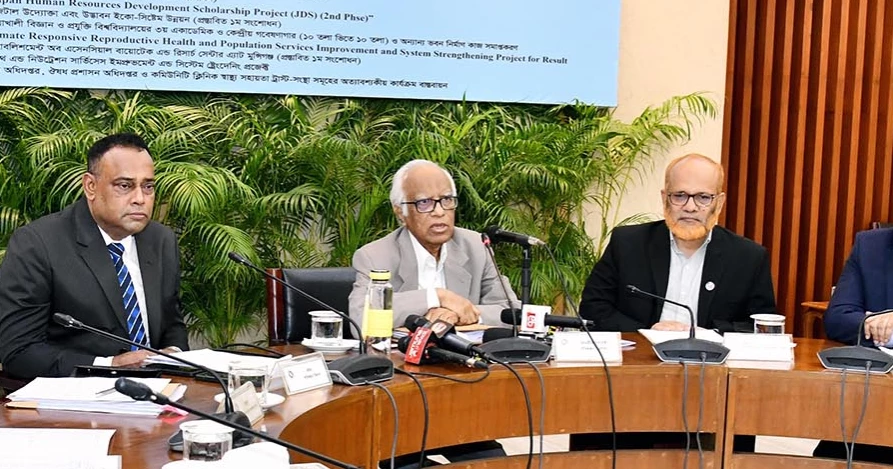
Planning Adviser Dr Wahiduddin Mahmud on Monday said that confusion and hesitation within various ministries and implementing agencies have caused a pile-up of development projects ahead of the upcoming national election.
Speaking to reporters after an ECNEC meeting on Monday, he noted that many officials assumed that project approvals would slow down once the election schedule was announced. “There was a perception that nothing would move because the election schedule was imminent. But that is entirely incorrect,” he said.
Dr Mahmud emphasised that the Executive Committee of the National Economic Council (ECNEC) will continue operating as usual and that ongoing development projects will not come to a halt.
“Development projects do not stop. ECNEC does not stop. Only the government becomes a caretaker government during the election period. I was in charge of finance and planning during the first caretaker government in 1996. Even then, ECNEC continued to function normally,” he recalled.
He added that although routine development activities proceed uninterrupted, the government must remain cautious in approving new constituency-based schemes. “We must scrutinise projects to ensure none are designed to benefit a particular constituency or individual. These types of projects should not be approved during this period,” the adviser said.
Dr Mahmud pointed out that the unusually high number of pending proposals this time is partly due to ministries becoming increasingly inactive over recent months. “Many felt that with the election approaching, it was better to hold back. That is why so many projects have accumulated,” he said.
He also noted a surge in lobbying for new constituency-focused projects as the election draws near. “Requests have increased significantly—‘Sir, approve this project for this area, that project for that constituency.’ But we will not approve such projects. Our focus is on national priorities, not local political gains,” he asserted.
The adviser stressed that ECNEC’s role is to ensure that all development initiatives align with broader economic and social goals.
“We must make sure that projects are justified, transparent, and beneficial for the country as a whole,” he added.