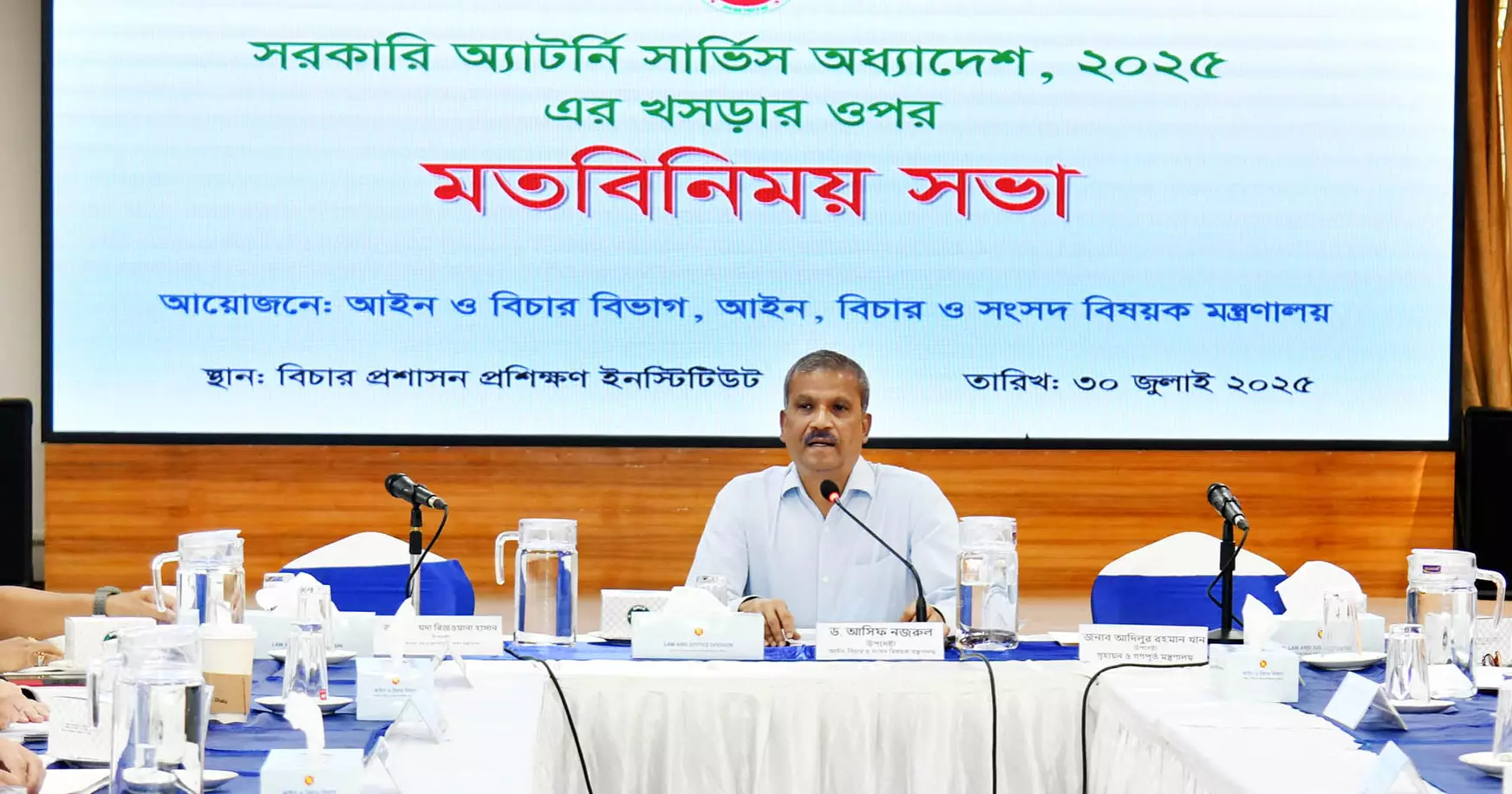
Law, Justice and Parliamentary Affairs Adviser Asif Nazrul on Wednesday said that Bangladesh must not squander the present opportunity to reform the state, establish good governance, and uphold human rights, warning that such a moment may not return for decades.
“If we miss the opportunity to repair the state, establish good governance and human rights, we may not get it again in the next few decades,” he said while presiding over a view-sharing meeting on the draft of the "Government Attorney Service Ordinance, 2025," held at the Judicial Administration Training Institute in the capital.
The adviser mentioned that the people of Bangladesh have never endured so much hardship and sacrifice for reforms. “In the history of the subcontinent, such an event has not occurred elsewhere. We had many chances — after the Liberation War, in 1991, and again in 2008 — but we failed to utilise them honestly. This time, we cannot afford to let it pass.”
Political consensus on women’s representation; presidency empowerment idea floated: Ali Riaz
Addressing the draft law, he said more discussions would be held to refine the ordinance and that public input would be incorporated to build a strong and effective Government Attorney Service Act.
He expressed hope that, with cooperation, appointments under the ordinance could be initiated during the current government’s term.
He also took aim at previous political practices, noting that the Awami League government repealed several progressive ordinances upon taking office in 2009.
He suggested that the next government may not find it as easy to reverse reforms made now, given the public’s sacrifices and expectations for change.
“The next government will come riding on the aspirations of the people who have bled for reform. Ignoring this will not be possible”, he added.
July Charter a social contract, no party to break this agreement: Salahuddin
Regarding corruption and irregularities in the judiciary, he said, “It’s not just court staff or judges. Government lawyers also play a role. Research shows public prosecutors earn very little, yet many are eager to join. Some, unfortunately, accept money from opposing parties despite being government lawyers — though not all are like that.”
Dr. Asif Nazrul also reflected on the failure of the 2008 Career Prosecution Service Ordinance, calling it overly ambitious. The new draft, he said, allows for both career-based and contractual appointments, making it more practical.
He added that while lawmaking is not inherently difficult, meaningful laws require consultation with stakeholders — something that is often absent in parliamentary processes. “The quality of ordinances made under caretaker governments was often better than laws passed in parliament,” he remarked.
CA urges Fisheries Ministry to focus more on deep-sea fishing
Housing and Industries Adviser Adilur Rahman, Law and Justice Secretary Sheikh Abu Taher, Special Prosecutorial Assistant of the Ministry of Home Affairs Ehsanul Haque Samaji, Chief Prosecutor of the International Crimes Tribunal Tajul Islam, and Supreme Court lawyer Barrister Ruhul Quddus Kajal, also shared their key insights on sections of the draft ordinance.