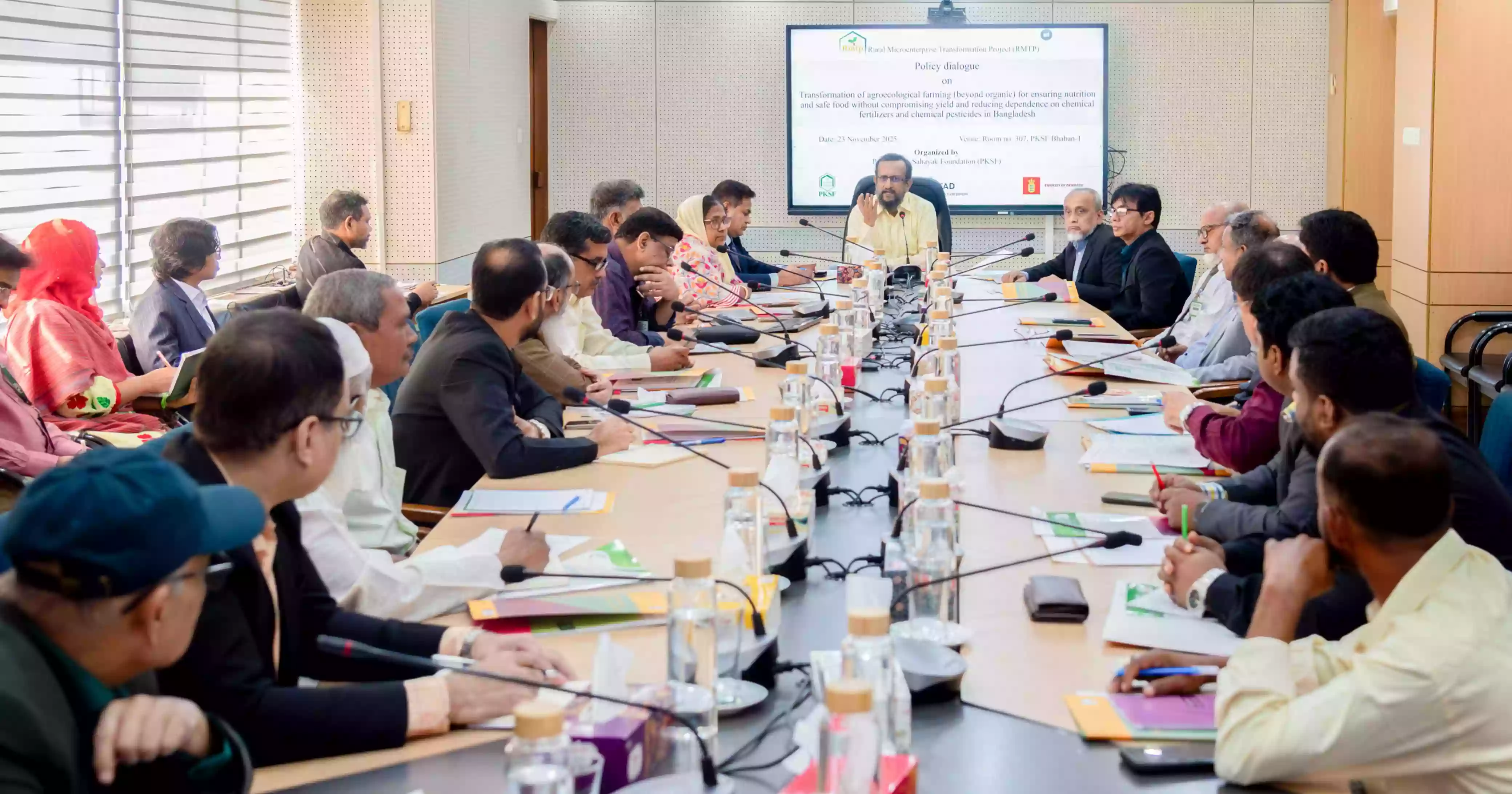
Bangladesh’s heavy reliance on chemical fertilisers and pesticides has created long-term risks for soil health, the environment, and public safety, prompting renewed calls for a large-scale transition to agroecological farming.
These concerns were highlighted at a policy dialogue titled “Transforming Agroecological Farming (Beyond Organic) for Ensuring Nutritious and Safe Food Without Compromising Yield and Reducing Input Subsidies and Chemical Fertilisers and Pesticides in Bangladesh”, organised by the Palli Karma-Sahayak Foundation (PKSF) on Sunday in Agargaon, Dhaka.
Chairing the dialogue, PKSF Managing Director Md Fazlul Kader said farmers across Bangladesh routinely apply excessive amounts of chemical inputs in an attempt to maximise yields. Changing this behaviour, he stressed, is essential for improving soil quality and protecting human health.
He noted that agroecological practices do not necessarily lead to lower production. “In some cases, yields may even increase,” he said, adding that although demand for organic and nature-friendly farming is rising, a comprehensive roadmap is required to scale it up. “Such a transition cannot happen overnight,” he cautioned.
Speaking as the Chief Guest, Department of Agricultural Extension (DAE) Director General SM Sohrab Uddin said farmers became dependent on chemical fertilisers to boost production, particularly during the Green Revolution era. However, this approach is no longer sustainable, he said. “There is no alternative to agroecological farming for long-term sustainability in agriculture.”
Special Guest Dr Begum Samia Sultana, Director General of the Soil Resource Development Institute (SRDI), highlighted the role of PKSF’s Partner Organisations (POs) in improving soil health management. Farmers supported by these organisations can now access soil testing services at SRDI laboratories and receive fertiliser recommendation cards tailored to their land’s needs, she said.
Presenting the keynote paper, agricultural scientist Dr Shaikh Tanveer Hossain warned that decades of indiscriminate chemical use have placed Bangladesh’s soil and environment under severe threat. Last fiscal year, the government provided Tk 24,000 crore in agricultural subsidies, of which 75 percent went to chemical fertilisers, he noted.
He further said the “hidden” environmental, health, and social costs of the current food production system amount to nearly 13 percent of the country’s GDP. To tackle these challenges, he recommended revisiting the National Agriculture Policy, addressing inconsistencies among relevant regulations, and designing an agroecology-friendly policy framework. He also called for greater investment in organic fertiliser production.
During the open discussion, ESDO Executive Director Shahid Uz Zaman argued that meaningful progress in agroecology would be impossible without land reform, while Mohsin Ali, Executive Director of WAVE Foundation, emphasised the importance of strengthening the capacities of farmers and other stakeholders to preserve indigenous biodiversity.
Chuadanga farmer Mohammed Ali shared a practical example of success, reporting that agroecological farming increased his crop production by nearly 50 percent while reducing costs by about 25 percent.
Speakers also underscored the need for incentives for organic fertiliser manufacturers, simplified registration procedures for commercial organic fertilisers, waste-to-compost initiatives, and wider adoption of modern technologies to improve efficiency and sustainability in agriculture.
The dialogue was attended by academics from agricultural universities, researchers, private sector representatives, and senior PKSF officials including Deputy Managing Director Dr Akond Mohammad Rafiqul Islam, and Professor Dr Md Golam Rabbani of Bangladesh Agricultural University.