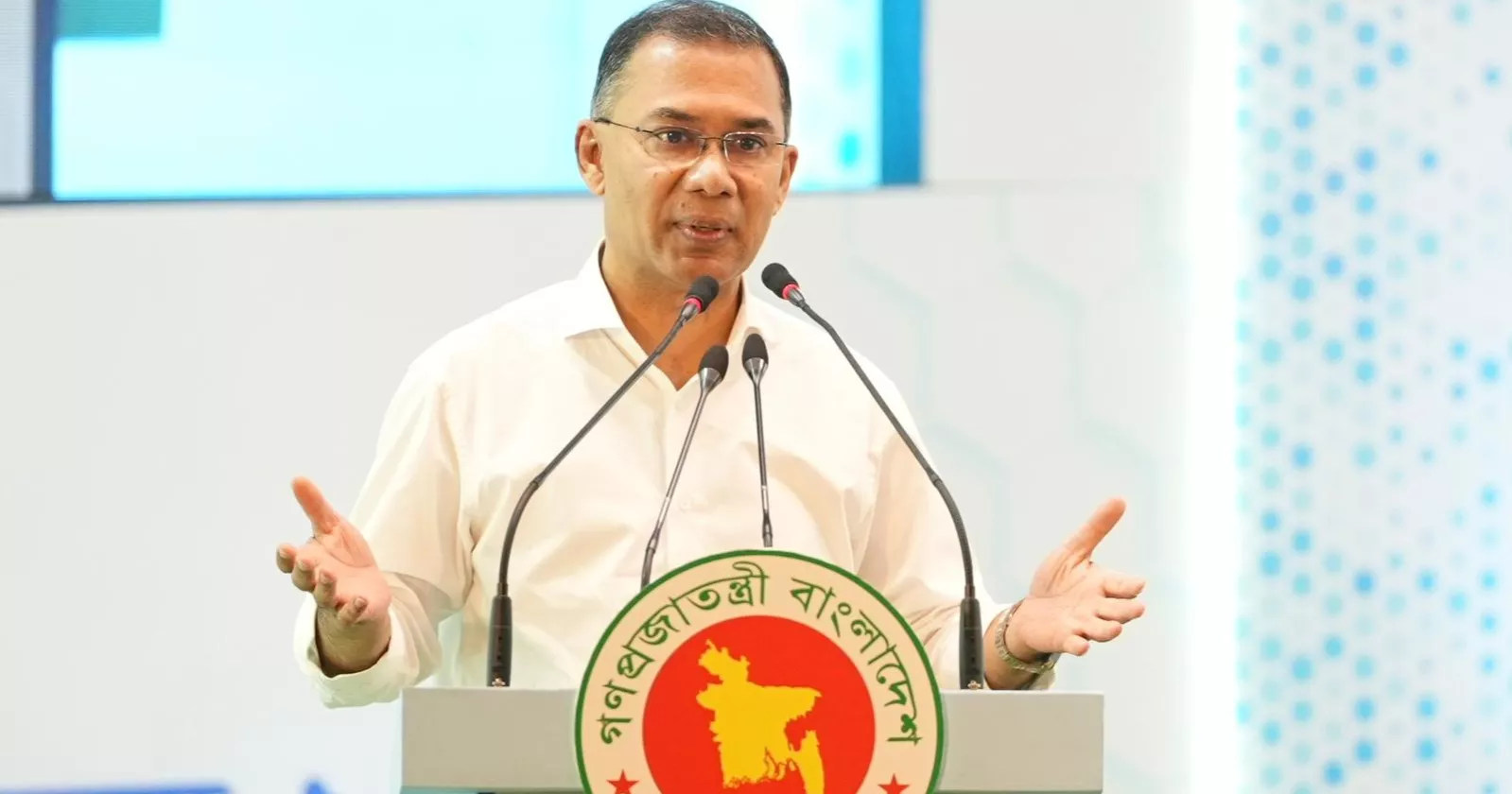
Outlining government's plans to raise the health sector allocation to 5 percent of GDP, Prime Minister Tarique Rahman on Saturday urged physicians working at the grassroots to lead efforts to build an accessible, affordable, effective and humane healthcare system.
“You are the main drivers in turning our dream of a healthy nation into reality. We together with all want to build a healthcare system that is accessible, affordable, effective and humane for everyone,” he said while addressing the Upazila Health and Family Planning Officers (UHFPO) Conference-2026 at the Osmani Memorial Auditorium in Dhaka.
The Prime Minister said he firmly believes that the physicians will be able to establish an accountable, sustainable and people-centric health service.
PM says Fatema Begum now a member of their family
“We expect each of you to turn your respective workplaces into model healthcare service centres in your own areas,” he told the health officers.
The Health Services Division under the Ministry of Health and Family Welfare organised the conference.
Over 500 UHFPOs from across the country participated in the event where the Prime Minister also handed over awards to the best-performing officers in six categories.
The Prime Minister said the ideas he presented reflect the government’s manifesto, plans and overall vision for the health sector.
He stressed that the government alone cannot achieve everything and called for active cooperation from healthcare professionals. “The government cannot do it alone. We need your support. Everyone has to come forward,” said.
Tarique Rahman said even small, collective efforts can bring meaningful change. “I am not saying one person will do everything. But if all of us contribute a bit, change will surely come. If people in other countries can do it, we can do it too,” he added.
Urging doctors to stand beside people, he said, “As a citizen of this country, I request you to support the government and the people so that they can receive at least basic healthcare services without difficulty.”
Reassuring the health professionals, the Prime Minister said the government is committed to addressing their challenges and improving the overall system.
Among immediate concerns, he said, the government will prioritise ensuring security for doctors working in rural areas, and consider providing vehicles and drivers for them.
Highlighting long-term plans, Tarique Rahman said the government aims to gradually increase the health sector allocation to 5 percent of GDP.
He said the government plans to recruit 100,000 new health workers, 80 percent of whom will be women.
The Prime Minister urged all healthcare officials to work together with dedication to strengthen public health services and ensure better care for citizens across the country.
Sharing his personal experience, he referred to the United Kingdom’s National Health Service, widely known as NHS, to highlight the challenges of running a universal healthcare system.
Tarique Rahman noted that the NHS, established in 1948, has been serving people for over 75 years in a country that is economically stronger and has a much smaller population than Bangladesh.
“Even then, the UK government often struggles to manage the system and ensure services for all, with frequent discussions about increasing budgets and support,” he said.
Drawing the comparison, the Prime Minister said it is natural for Bangladesh’s healthcare system to face challenges and acknowledged that doctors working at the grassroots often encounter various difficulties delivering services.
Appreciating the participants for raising their problems during the conference, he called it a constructive and necessary step.
Tarique Rahman, however, reminded the doctors that they are all part of the same country and society, and understand the realities on the ground.
He said the government is working to ensure healthcare as a basic right, guided by the principle-- prevention is better than cure.
The Prime Minister also pledged to improve the dignity, safety and living standards of healthcare workers.
He said steps will be taken to address structural and manpower shortages in the health sector and to modernise upazila health complexes with technology-based services.
Tarique Rahman stressed the need to build a corruption-free and accountable healthcare system and called on officials to play an active role in local-level leadership, vaccination, maternal health and disease prevention.
He said those who are present at the programme are, in one way or another, more privileged than most citizens of the country.
The Prime Minister also stressed the importance of ensuring comprehensive maternal and child healthcare services.
“All upazila health complexes must be turned into centres capable of providing full maternal care, safe childbirth and quality newborn and child healthcare,” he said.
Referring to recent measles outbreaks, Tarique Rahman termed the failure to vaccinate children in the past as a serious lapse.
He said the government has taken emergency steps to inoculate children against measles nationwide, which has helped prevent further deterioration of the situation.
The Prime Minister thanked doctors and health workers for their efforts in protecting children, and expressed deep sympathy to families who lost their children.
He said it is time to bring all hospitals and health centres under accountability to ensure proper services for citizens.
“Healthcare is not a favour or charity by the state. Ensuring proper treatment is the duty of the state, and receiving healthcare is a fundamental right of every citizen,” Tarique Rahman said.
He said the government is planning to introduce an integrated e-health card system, which will digitally store health information of every citizen. “This will allow people to access treatment easily at any hospital in the country when needed.”
The Prime Minister also said the government is considering introducing a national health insurance system in phases to reduce the financial burden of medical expenses on citizens.
“Our goal is to further improve upazila health complexes, ensure necessary manpower and make healthcare more accessible and effective through technology,” he added.
State Minister Dr MA Muhit, Health Services Division Secretary Md Quamruzzaman Chowdhury and Director General of the Directorate General of Health Services Prof Dr Pravath Chandra Biswas, among others, spoke at the conference with Health and Family Welfare Minister Sardar Md Sakhawat Husain in the chair.