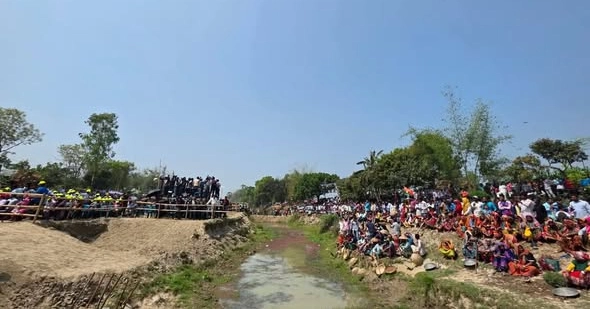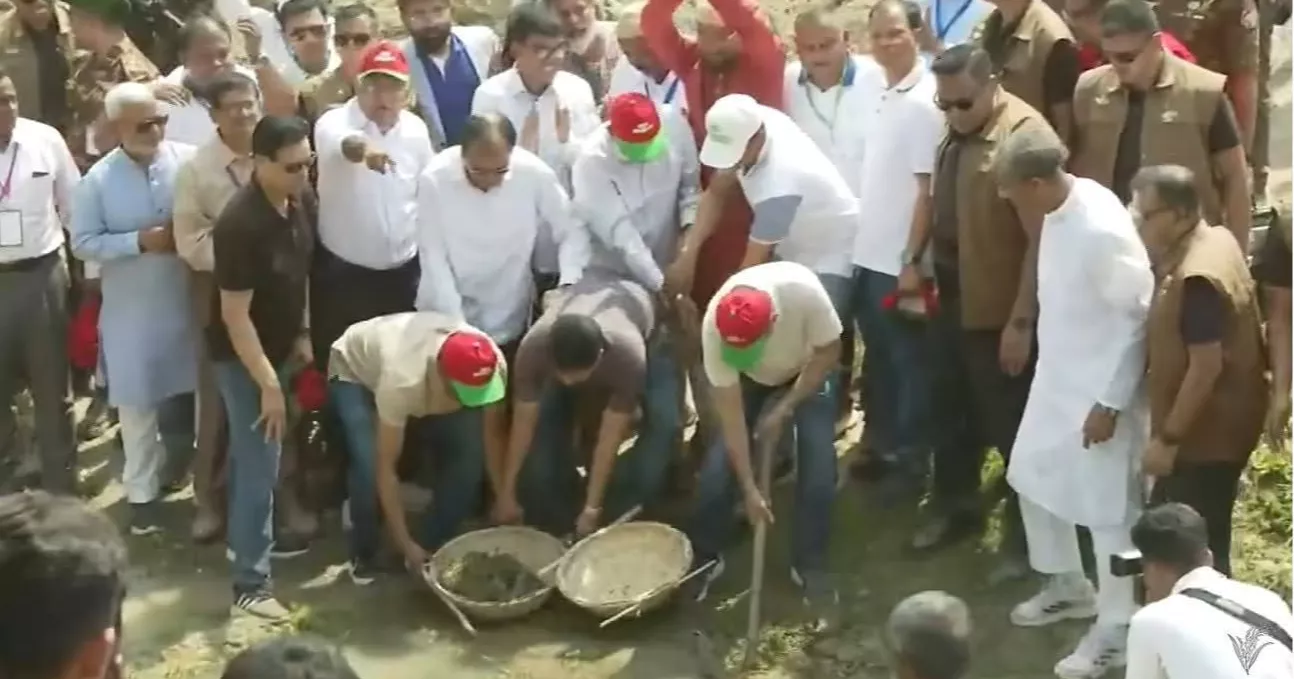
Prime Minister Tarique Rahman on Monday inaugurated a nationwide canal excavation and re-excavation programme by cutting soil with a spade at Sahapara canal in Kaharol upazila of Dinajpur.
The programme was launched at around 12:27pm at Balrampur village under Ramchandrapur union of Kaharol upazila.
After reaching the canal bank, the Prime Minister first looked at a map of the canal and then moved forward to cut the soil of the canal.
The Prime Minister also inaugurated the excavation of 54 canals across the country by launching the digging of the 12-kilometre Sahapara canal in the district. Later, he planted a tree sapling on the bank of Sahapara canal.
The initiative brings back a programme first introduced by BNP founder and former president Ziaur Rahman who started canal excavation work across the country.
After introducing the Family Card programme earlier, the Prime Minister launched the canal revival initiative to fulfil another election pledge made by the BNP ahead of the 13th parliamentary election.
Accompanied by ministers and BNP leaders, Tarique Rahman personally began re-excavating the Sahapara canal cutting soil with a spade. By cutting the first soil from the canal, he formally launched the nationwide programme, marking the start of similar activities across the country.
By digging the canal with his own hands, the Prime Minister evoked the memory of his father, BNP founder and former President Ziaur Rahman.
Nearly five decades ago, he had taken a similar initiative by personally digging canals to improve irrigation and increase agricultural production.
Several thousand local people enthusiastically watched as the head of government himself dug the canal, following in the footsteps of his late father.
The Prime Minister arrived at Syedpur Airport from Dhaka by air at 10:15am. From there, he travelled by road to the Balrampur Sahapara area in Dinajpur. Leaders and activists stood along both sides of the road to greet him as his motorcade passed.
This is Tarique Rahman’s first visit outside the capital since assuming office as Prime Minister on 17 February.
He also addressed a public meeting near the canal at Sahapara. The programme was jointly organised by the Water Resources Ministry and the Bangladesh Nationalist Party (BNP).
BNP Secretary General and Local Government Minister Mirza Fakhrul Islam Alamgir, Social Welfare and Women and Children Affairs Minister Professor AZM Zahid Hossain, Water Resources Minister Shahid Uddin Chowdhury Annie, Disaster Management Minister Asadul Habib Dulu and State Minister for Water Resources Farhad Hossain, among others, spoke at the programme.
The Sahapara canal is about 12.2 kilometres long and is connected with the Punarbhaba River.
According to local leaders, the canal was first excavated in 1977 by then president Ziaur Rahman with the participation of local villagers and party activists.
PM Tarique’s canal re-excavation drive in Dinajpur evokes memories of Zia
Speaking to journalists before the inauguration, Social Welfare and Women and Children Affairs Minister and Dinajpur-6 MP Professor AZM Zahid Hossain said once the entire canal re-excavation is completed, around 31,000 farmers in the region will benefit directly while nearly 350,000 people will gain overall benefits.
He said the re-excavation would help solve the area’s waterlogging problem, increase crop production and improve the local economy.