
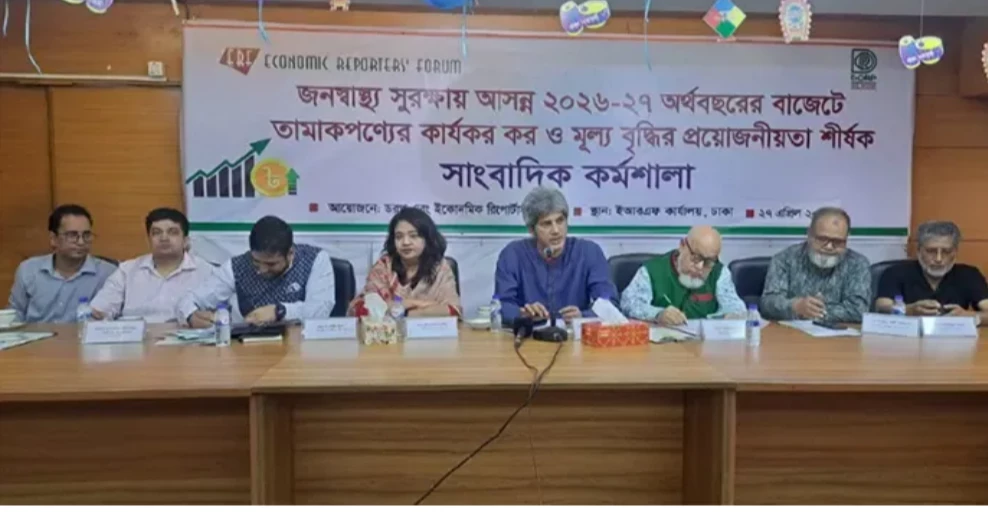
State Minister for Planning Md. Junaid Abdur Rahim Saki on Monday emphasized the need to strengthen national budget by increasing internal revenue, identifying higher taxes on tobacco as a top priority for both fiscal stability and public health.
Speaking as the chief guest at a seminar titled ‘Necessity of Effective Tobacco Tax and Price Hikes in the Upcoming FY 2026-27 Budget to Protect Public Health,’ the state minister stressed that reducing debt dependency is essential for the country’s true development.
Youth demand effective tobacco tax and pricing in upcoming budget
The event was jointly organized by the Economic Reporters' Forum (ERF) and the Development Organisation of the Rural Poor (DORP) at the ERF auditorium in the capital.
Saki expressed sharp dissatisfaction with the current state of digitalization at the National Board of Revenue (NBR). "Although Tk 400 crore has been spent on NBR digitalization, it is not functioning effectively. Paying for maintenance year after year without results has turned into a process of draining state resources rather than collecting them," he said.
He argued that without genuine institutional capacity, relying on loans for the Annual Development Programme (ADP) would not lead to sustainable progress.
State Minister Saki called for setting the base price and taxes of tobacco products at a level that significantly discourages consumption.
However, he balanced this by advocating for the rights of tobacco farmers and workers.
"Tobacco companies keep product prices low by underpaying workers and farmers. If we ensure fair wages for laborers, the price of these products will naturally rise, which will indirectly help reduce tobacco use," he noted.
The state minister also highlighted the issue of "fake bandrolls" being smuggled from abroad to evade taxes. He directed the NBR to establish a specialized monitoring system to close these loopholes, which cause massive revenue losses for the government every year.
Special Guest Md. Mashiur Rahman, First Secretary (VAT Policy) of the NBR, informed the session that cigarette supply has seen a decline following the tax measures taken in 2024.
He recommended a licensing system for retail cigarette sales and a more robust "tracking and tracing" system in coordination with the Health Ministry.
Presenting a research paper, Professor Dr. Shafiun Nahin Shimul of the Institute of Health Economics, Dhaka University, noted that 90 percent of the cigarette market in Bangladesh is dominated by low and medium-tier products.
He proposed merging these two tiers and imposing significantly higher supplementary duties.
The seminar concluded with a warning from former Secretary Md. Azhar Ali Talukdar, who noted that while the government earns revenue from tobacco, it spends more than double that amount addressing the resulting health and environmental damages.
ERF president Doulat Akter Mala and General Secretary Abul Kashem also spoke at the event.