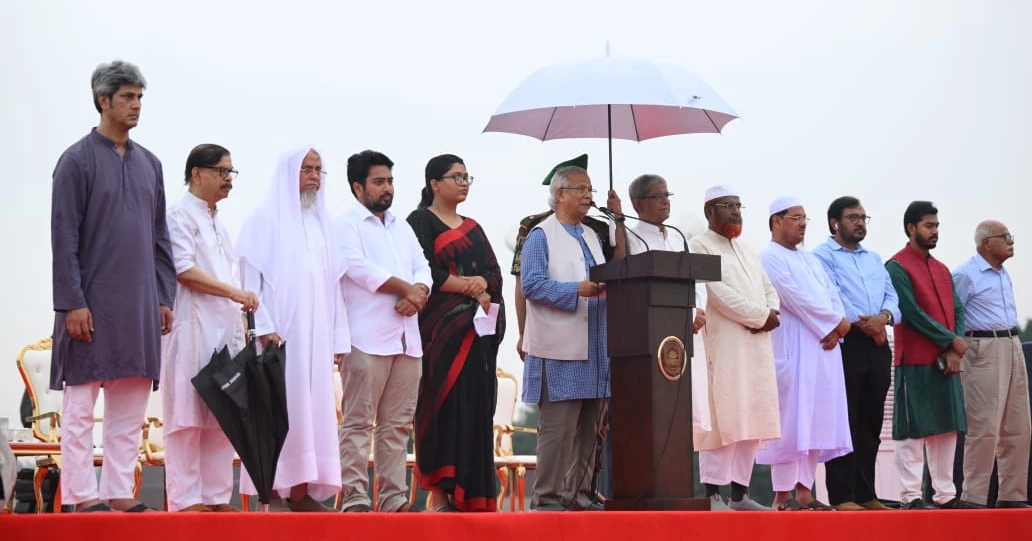
Unveiling the ‘July Declaration’, a crucial political document, Chief Adviser Prof Muhammad Yunus on Tuesday said the people of Bangladesh expressed their expectations to protect the rights of the present and the future generations through an environmental friendly, climate resilient, sustainable and inclusive development strategy.
“Therefore, the people of Bangladesh express their desire that the student-people uprising of 2024 will get proper state and constitutional recognition and that the July Declaration will feature in the schedule of the reformed constitution as framed by the government formed through the next national election,” he said while reading out the 28-point July Declaration.
Prof Yunus said the document of the declaration is written to reflect the aspirations of the people of Bangladesh at the event of the victory in the mass uprising of August 5, 2024.
Finalised by the interim government, Prof Yunus started reading it out at 5:21 pm in presence of all political parties.
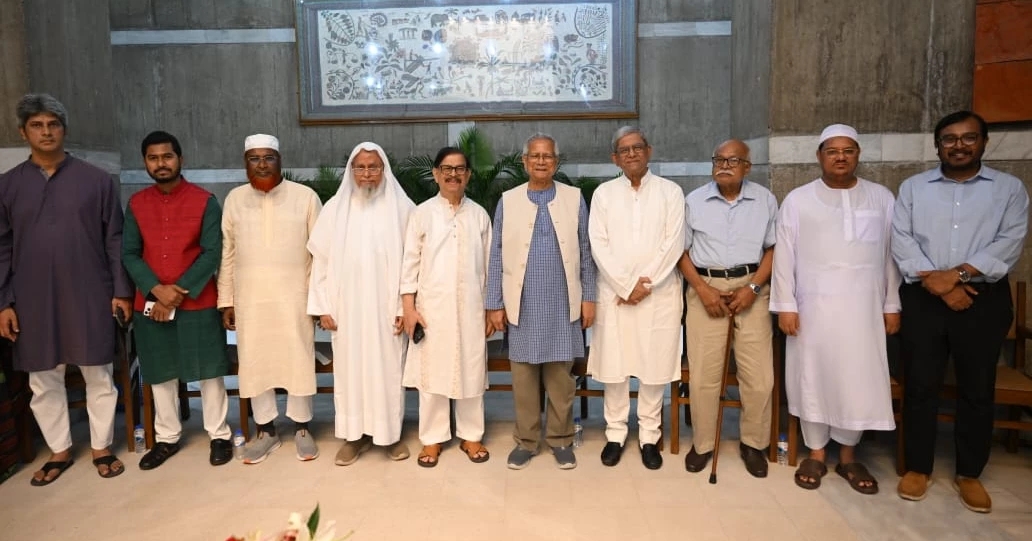
Top leaders from the major political parties, including BNP, Jamaat and National Citizen Party (NCP), joined the event at the South Plaza of the Jatiya Sangsad.
BNP Secretary General Mirza Fakhrul Islam Alamgir, BNP standing committee members Salahuddin Ahmed and Dr Abdul Moyeen Khan, Secretary General of Bangladesh Jamaat-e-Islami is Professor Mia Golam Parwar, NCP convener Nahid Islam and representatives from other political parties were present.
The programme began with the playing of the national anthem. A video documentary was also screened.
Prof Yunus starts reading out ‘July Declaration’
The rest of the text of ‘July Declaration’ is given below
1. Whereas, in continuation of the historical struggle against colonialism, the people of this land rose against the deprivation and exploitation inflicted by the authoritarian Pakistani regime, and established the state of Bangladesh through a bloody liberation war following the Declaration of Independence made on 26 March, 1971 for achieving freedom;
And
2. Whereas, the people of Bangladesh made utmost sacrifice through a long struggle to materialise a liberal democratic state in this land based on equality, human dignity and social justice as proclaimed in the Declaration of Independence;
And
3. Whereas, the post-independence Awami League government failed to materialise the people’s aspirations because of the weaknesses in the procedures of drafting and in the structure of the constitution along with its inappropriate application;
And
4. Whereas, the post-independence Awami League government established constitutionally a one-party government named BAKSAL in place of a democratic order, the much aspired goal of independence, and thereby took away the freedom of expression and of the judiciary, in reaction to which, on November 7, 1975, there was an uprising in the army ranks and file joined by common people, and later the way was laid for reintroducing multi-party democracy, freedom of expression and of the freedom of judiciary in place of the BAKSAL system.
And
5. Whereas, in the 1980s, there was a long nine-year relentless struggle against an autocratic military regime resulting in the mass uprising of 1990, and a parliamentary democratic system was reestablished in 1991;
And
6. Whereas, the democratic way of regime change was disrupted through domestic and external intrigues, thus laying the way in Bangladesh for the paramount power, domination and fascism of Sheikh Hasina through the conspiratorial arrangement of so-called 1/11;
And
7. Whereas, illicit and undemocratic changes were made in the constitution, driven by extremely fierce desire to establish a one-party state along with a fascist, undemocratic and anti-people governance system during the last sixteen year long period.
And
8. Whereas, all state and constitutional institutions were destroyed by the last Awami League regime of Sheikh Hasina through governance malfeasance, abduction and murder, unlawful killings, suppression of freedom of speech and constitutional changes in the interest of the ruling party;
And
9. Whereas, during the rule of Sheikh Hasina, under her very leadership, an extreme force that was anti-people, autocratic and against human rights turned Bangladesh into a fascist, mafia and failed state and thereby tarnished Bangladesh’s international image;
And
10. Whereas, in the name of so-called development, the fallen Awami League government under the fascist leadership of Sheikh Hasina jeopardised the immense economic prospects of Bangladesh through rampant corruption, looting of banks, fund transfers abroad by money laundering, and also pursued policies adversely affecting the environment, ecology and climate;