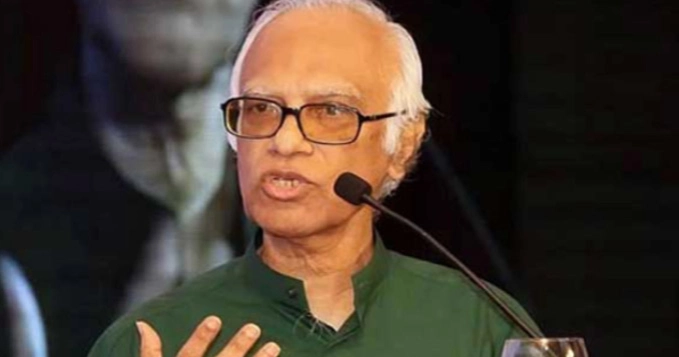
Planning Adviser Dr Wahiduddin Mahmud on Monday called for a long-term, comprehensive master plan for the Bangladesh Secretariat and urged policymakers and the public to engage in a wider national conversation on whether the country’s administrative hub, or capital, should eventually be shifted out of central Dhaka.
He made the remarks while speaking to reporters after the meeting of the Executive Committee of the National Economic Council (ECNEC), during which a major proposal to construct a new 21-storey office building at the Secretariat was withheld from approval.
Dr Mahmud said the proposed project, estimated at between Tk 600-700 crore, could not be endorsed at this stage because the entire Secretariat zone has grown in an “unplanned, haphazard and aesthetically unpleasant manner,” making piecemeal construction difficult to justify without a broader development plan.
Describing the Secretariat area as heavily congested and structurally vulnerable, he said many of the existing office structures were decades old, in poor condition, and in some cases damaged by recent fire incidents caused by ageing electrical connections and outdated infrastructure.
According to him, ministers and senior civil servants now work in buildings that often lack proper road access, organised parking or coherent architectural design.
He added that only a few of the older structures along the front side of the Secretariat road—such as the cabinet and home ministry buildings—retain architectural appeal, while newer additions have been erected without coordination, resulting in a cluttered skyline and cramped public spaces.
The Planning Adviser stressed that constructing another major high-rise in such a setting would lock the government into existing inefficiencies.
For any future development, he said, a complete master plan must be prepared, identifying what types of buildings are needed and how the precinct should evolve as a functional administrative zone.
Dr Mahmud, however, went further, raising a much larger question: whether the Bangladesh Secretariat should remain in its current location at all.
He said the existing complex was built during the Pakistan era, when the wider administrative belt—from the Secretariat to the Planning Commission to Chandrima Udyan and the Parliament area—was designed as the “second capital” of then East Pakistan.
The question today, he noted, is whether Dhaka still needs to carry this administrative burden at its congested core.
Citing examples from around the world, he recalled how cities like Islamabad, Putrajaya in Malaysia, and newly developed administrative capitals in Indonesia and South Korea were built to reduce pressure on the primary metropolis and to ensure efficient public administration.
He said Bangladesh should not consider itself an exception and should be willing to think beyond historical constraints.
Dr Mahmud suggested that future governments could explore the idea of shifting the national administrative headquarters to a new site outside Dhaka—possibly in areas near Gazipur, Shreepur, or other suitable locations.
While he emphasised that such a move would be a long-term undertaking requiring political consensus, public consultation, and extensive feasibility studies, he argued that the discussion should begin now.
He clarified that his suggestion was not tied to any immediate relocation effort but reflected the need for strategic thinking. The Planning Ministry’s own offices, he said, would remain in their current location, but the broader concept of a relocated Secretariat warranted serious public debate.
According to him, any decision on the future of the administrative capital must involve opinions from citizens, experts, journalists and civil society, as the implications would be national in scale.
The adviser said Bangladesh cannot ignore the reality that central Dhaka is saturated, heavily built-up, and increasingly ill-suited for hosting the nation’s core administrative machinery in the decades ahead.
Dr Mahmud concluded that ECNEC had therefore deferred approval of the proposed 21-storey Secretariat building until a coherent master plan is prepared and wider consultations are held on the long-term future of the country’s administrative capital.