Public spending on education in Bangladesh has fallen to about 1.7 % of GDP, far below global recommendations, raising concerns about the country’s future human capital development.
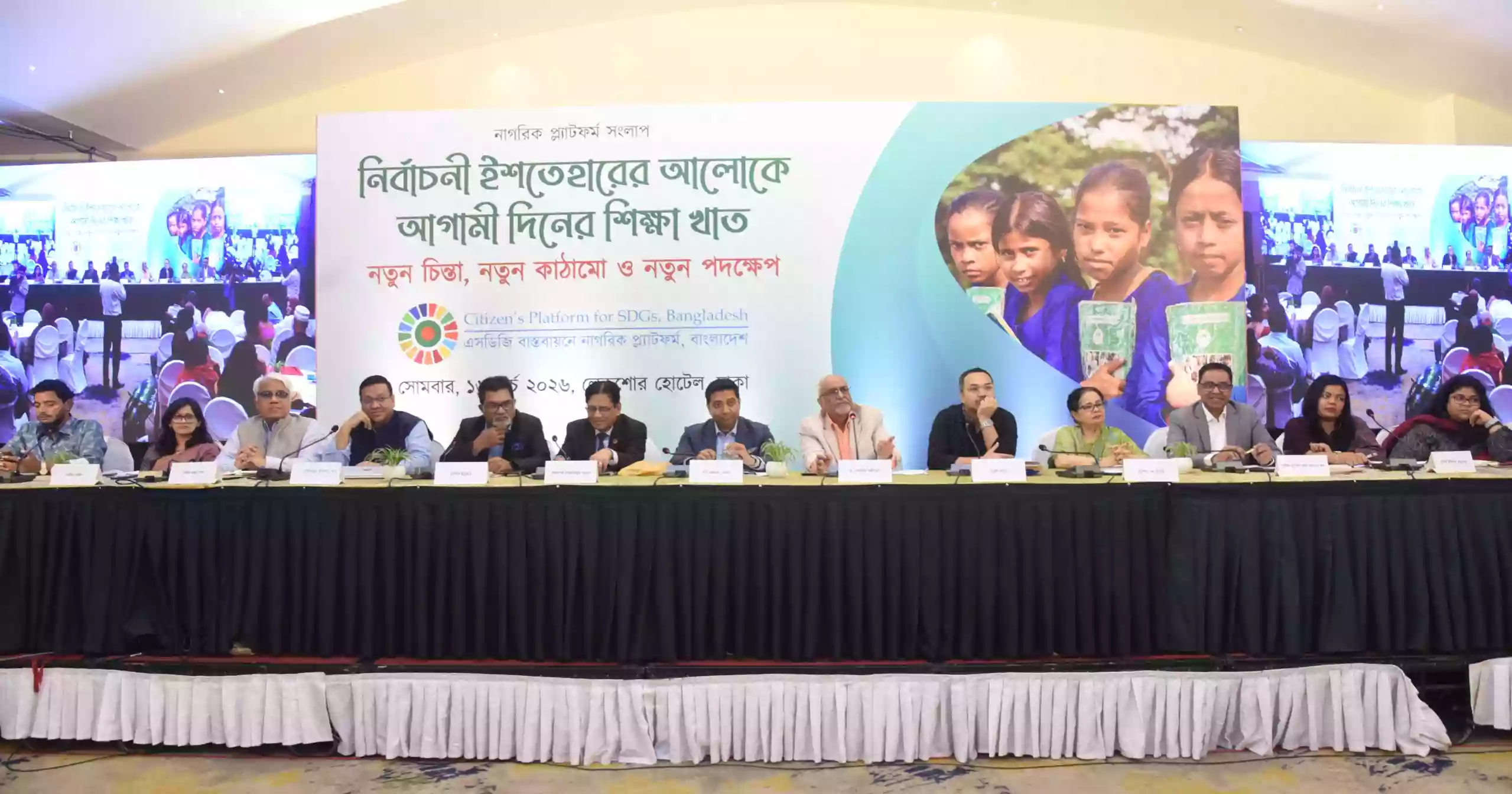
The findings were presented by Towfiqul Islam Khan, Additional Director (Research) at the Centre for Policy Dialogue (CPD), at an event of the Citizens’ Platform for SDGs, Bangladesh titled ‘Education for Tomorrow in Light of the Election Manifesto: New Thinking, New Structure and New Initiatives.’
No question of relaxing qualifications for school managing committee heads: Education Minister
According to the analysis, actual utilisation of education spending dropped further to around 1.3 percent of GDP in FY2025, which is significantly lower than the 4–6 percent benchmark recommended by UNESCO.
Although government policy documents have long identified education as a national priority ambition regarding budget allocation has weakened over time, it said.
The Sixth Five-Year Plan had set a target to raise education spending to 4 percent of GDP by 2015.
However, later policy frameworks pushed that target further into the future, with the current Perspective Plan setting the 4 percent target for 2041.
The study identified limited fiscal space and weak revenue mobilisation as major obstacles to increasing public investment in education.
Bangladesh’s tax-to-GDP ratio stood at only 6.8 percent in FY2025, one of the lowest in the region which has constrained the government’s ability to increase spending on education.
The analysis also found that development expenditure in the education sector has declined sharply in recent years while operating expenditure now dominates the budget structure.
According to the study, strengthening the education system will require stronger domestic resource mobilisation, better spending efficiency and improved programme management.
It recommended gradually increasing education spending to around 5 percent of GDP by 2031 through improved budget execution and enhanced resource mobilisation.
The report warned that without significantly higher investment in education, Bangladesh may face difficulties in developing the skilled workforce needed for a rapidly changing labour market.