
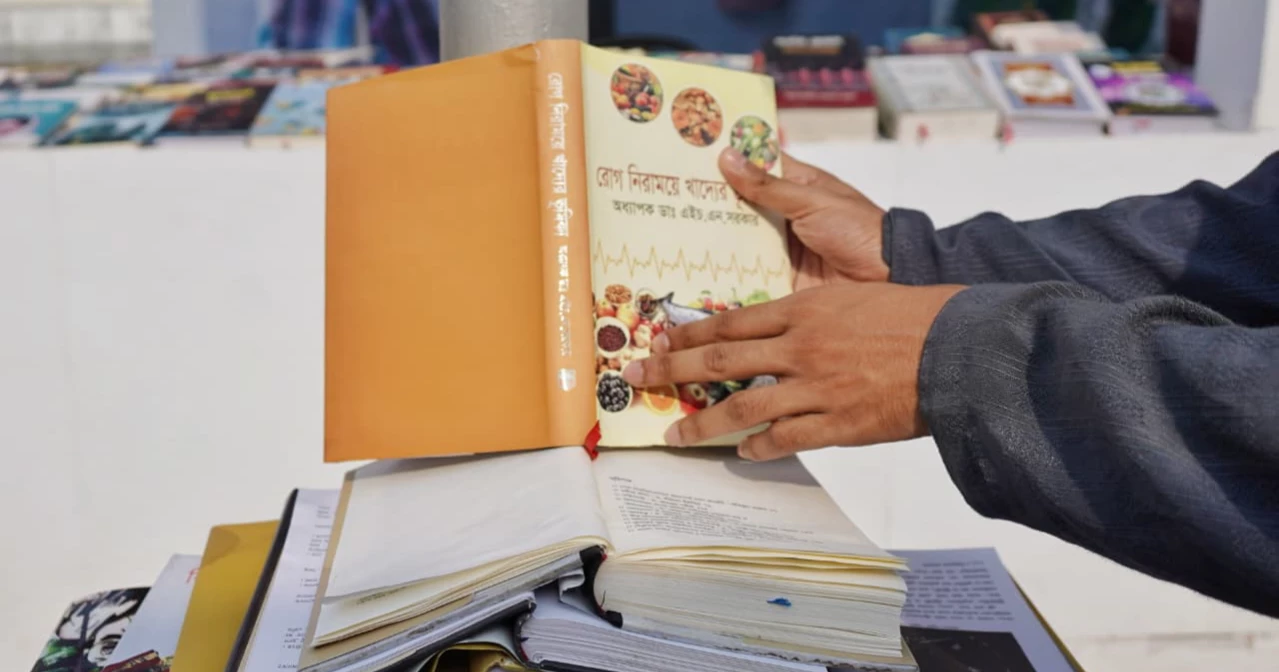
The business situation at this year’s Amar Ekushey Book Fair has been described as even worse than the pandemic-affected fair of 2021, with around 90 percent of participating publishers failing to recover even their initial stall construction costs.
The information was revealed on Saturday afternoon at an emergency press conference organized by the publishers’ platform Prokashok Oikko at the Poet Shamsur Rahman Seminar Room of the Bangla Academy.
Publishers said that nearly 30 percent of the participating publishers could not sell books worth even Tk 5,000 during the fair.
A total of 549 publishing houses took part in this year’s book fair—81 at the Bangla Academy premises and 468 at the Suhrawardy Udyan. Compared to last year, overall book sales have dropped by around 80 percent, they claimed.
Reading out a written statement, Managing Director of University Press Limited, Mahrukh Mohiuddin said publishers participated in the fair despite anticipating financial losses.
“We joined the fair as a message of support and cooperation for the newly elected government, even though we knew it could result in business losses due to the post-election situation and the observance of the holy month of Ramadan,” she said.
“Unfortunately, our initial fears have turned into a harsh reality,” she added.
Mohiuddin said publishers dream of turning the book fair into a Tk 100 crore event. “In a country of 180 million people, selling 5 to 10 million books is not an unrealistic dream. With proper management, coordinated initiatives, and a dedicated marketing budget of Tk 5–10 million, this goal could be achieved within three to five years,” she noted.
She also emphasized that the fair could undergo significant transformation if publishers are placed in the driving seat of the overall organisation, with authorities providing necessary support.
“If book sales continue to decline and publishers keep suffering losses, the fair may eventually turn into a ‘dead tradition,’ which nobody wants,” she warned.
Describing the current sales situation as a “disaster,” Mahbub Rahman of Adarsha Prokashoni presented five recommendations to overcome the crisis.
These include an urgent initiative to purchase 300 to 500 copies of at least one quality book from each severely affected publisher, formulating a realistic government budget for book procurement, and arranging government-sponsored training programs to enhance professional and creative publishing skills.
He also called for upgrading school and college libraries, reopening closed libraries, and making library classes mandatory in educational institutions.
Rahman further suggested that the date for next year’s book fair should be decided immediately after the current fair ends through discussions with stakeholders. He also urged authorities to reach a rational decision on stall rents in consultation with publishers and to implement the national book policy.
Publisher of Ananya Prokashoni, Monirul Haque said none of the stakeholders in the publishing sector—Bangla Academy, the publishers’ association, or Prokashok Oikko—should see each other as opponents.
“We must focus on realistic planning that protects the interests of writers, readers and publishers. Personal ego or interests should never take precedence over collective interests,” he said.