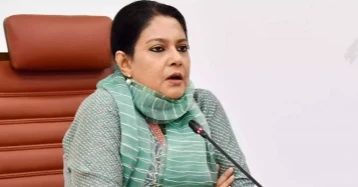
Environment Adviser Syeda Rizwana Hasan on Wednesday asked global stakeholders to embrace nature-based solutions while holding developed countries accountable for their climate responsibilities.
"The development discourse of the globe has to change. It has to be less hostile, less wealth-driven, and more nature-centric,” she said.
The adviser was speaking virtually from Dhaka at the Meghna Knowledge Forum II (MKF II) hosted by the Asian Institute of Technology (AIT) in Bangkok.
She also emphasised the urgent need for a more inclusive, justice-driven development model.
The forum, themed “Building Community and Ecosystem Resilience to Climate Change,” resonated with Advisor Rizwana’s message of environmental justice, regional cooperation and ecological rights.
Emphasising the deep-rooted relationship between rivers and Bangladesh’s identity, she said, “Bangladesh is a country often defined by its rivers. River ecosystems make us who we are as Bangladeshis. A river is something that's totally inseparable from our existence and entities.”
She called for stronger regional collaboration with neighbouring countries—Nepal, India, and China—on transboundary river management.
Noting that all four major river basins of Bangladesh are shared, she stressed the urgency of moving beyond national egos and towards cooperative ecosystem governance.
A key highlight of her speech was the recognition of the "rights of rivers." She said, “We should protect our rivers not only for our survival but also by recognising that rivers and river systems have inherent rights.” She praised the growing trend of courts in various countries acknowledging these rights and urged international forums like MKF II to create space for such crucial discussions.
Speaking with heartfelt connection, Rizwana described the Haor ecosystem—a vast wetland region in northeast Bangladesh where she hails from—as a unique ecological and economic asset.
Supporting millions of livelihoods through agriculture, fishing and tourism, the Haor also serves as a critical habitat for migratory birds and native flora.
However, she warned of increasing threats from pollution, sand mining, and unregulated development, compounded by frequent flash floods and the absence of a transboundary early warning system.
She appealed to the youth of South Asia to help bridge information gaps, especially in developing local early warning mechanisms that could prevent disaster and protect lives and livelihoods.
Advisor Rizwana also spotlighted Bangladesh’s regional leadership, being the first South Asian country to accede to the UN Convention on the Protection and Use of Transboundary Watercourses and International Lakes.
Yet, she expressed concern that regional bodies like SAARC still fail to treat rivers as multilateral concerns, often reducing them to bilateral negotiations.
“When governments struggle to agree on ecosystem management, forums like this must elevate community voices and knowledge. The path to climate resilience lies in cooperation, not competition,” she said.
She thanked the Asian Institute of Technology, South Asian University and the knowledge partners for organising MKF II and creating a space where communities, scholars and governments can reimagine climate action rooted in justice and sustainability.