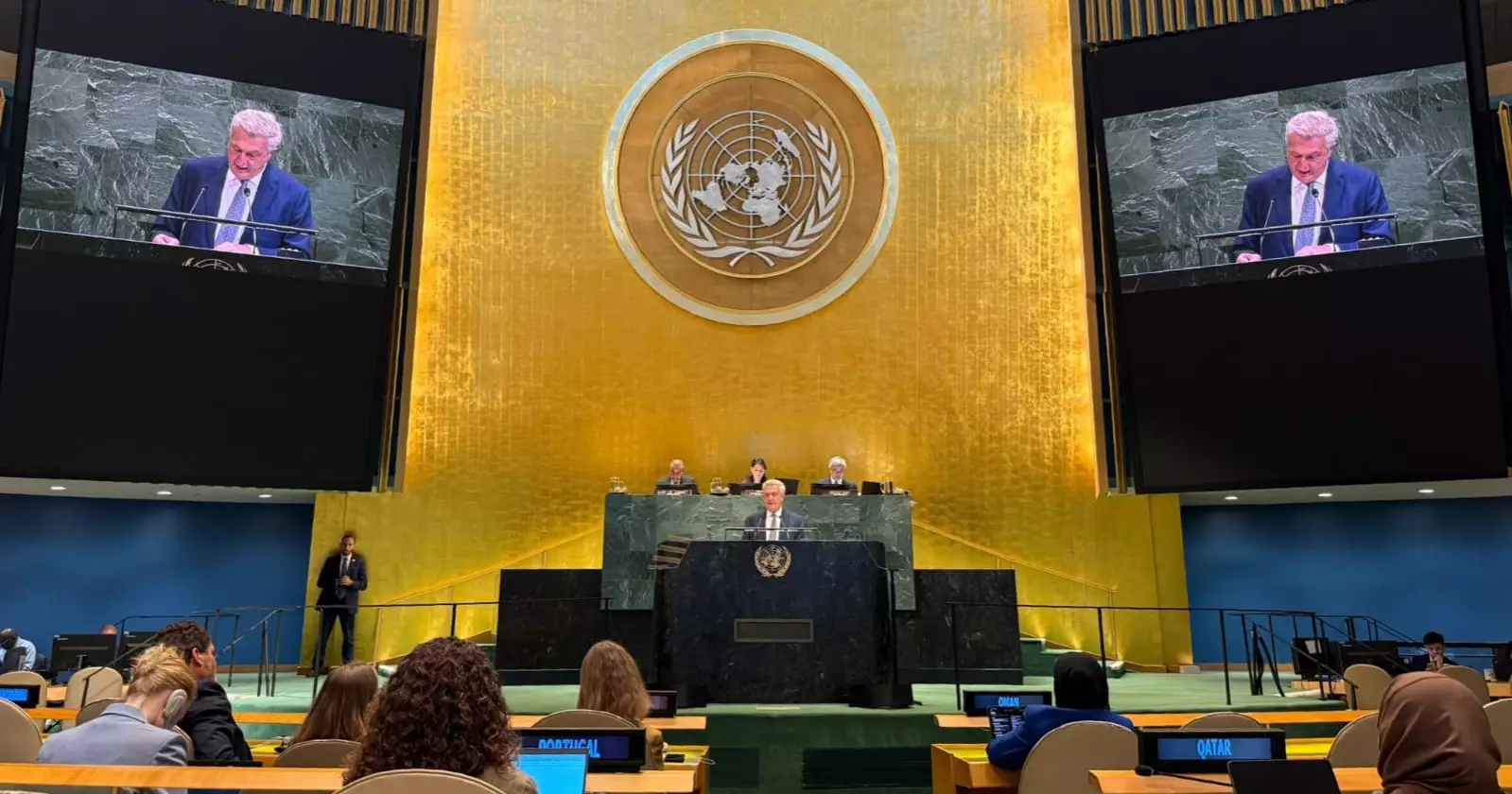
UN High Commissioner for Refugees Filippo Grandi has said they will continue to work with Member States, regional bodies, civil society, and refugee-led organizations to raise resources and advance protection, resilience, and solutions for all displaced people within and from Myanmar.
"We have no other choice if we want to chart a new course for the people of Myanmar — one that is principled, pragmatic, and forward-looking and if we want to bring a lasting solution to the plight of the Rohingya people," he said, stressing that the UNHCR stands ready to support.
Grandi made the remarks while delivering his statement at the high-level conference on "Rohingya Muslims and Other Minorities in Myanmar" held at the United Nations General Assembly on Tuesday.
Chief Adviser Prof Muhammad Yunus, Special Envoy Julie Bishop, global stakeholders and the Rohingya representatives also spoke.
"The prospects for funding next year are grim. Unless further resources are forthcoming, despite the needs, we will be forced to make more cuts, while striving to minimize the risk of losing lives: children dying of malnutrition, or people dying at sea as more refugees embark on dangerous boat journeys," he said.
"We must do more, please. I call on all of you. And in addition to funding, it is critical to offer solutions, in line with the pledges made at the last Global Refugee Forum. Solutions such as resettlement as well as other pathways to hope, through education or labour mobility," Grandi added.
He said no assistance is too small, especially when the alternative leads to more instability in the region and to more costly measures further down the line.
"The most important however is not to forget that this crisis originates in Myanmar. And that, Madam President, is where the solution lies," he said.
Grandi recently visited Myanmar and saw how a country already dealing with a devastating humanitarian crisis was still reeling from the aftermath of the recent earthquake.
Julie Bishop spoke about the political challenges.
"As in other crises and given the way conflicts are conducted by parties across the country — too often disregarding the rules of war — civilians, as we heard this morning, are killed, wounded, and deprived of the basics," Grandi said.
More than 5 million are displaced, of whom more than 1.5 million have taken refuge in neighbouring countries.
In his own discussions with the de facto authorities in Naypyidaw, he has reiterated the requests of humanitarian agencies on the ground — they need safe and unhindered access to people impacted by the fighting.
"I have received some assurances, but these urgent and vital asks must be continuously conveyed by all those who can do so," he said.
Grandi focused in particular on the situation of the Rohingya population which his organization, UNHCR, has worked with for many, many years.
Their plight is somehow unique — not only do they continue to be discriminated, deprived of rights and abused, a situation they have endured for decades, but they are also caught in one of several ethnic conflicts affecting the country — except it is not their own: the one pitching the Arakan Army in Rakhine State against the de facto authorities.
The Rohingya people have faced challenges for a long time - not just in the past eight years -but eight years ago, were confronted with unspeakable violence at the hands of Myanmar’s military, 750 thousand fled to Bangladesh. Others became or remained displaced in Rakhine State.
With the advances of the Arakan Army, which now controls almost all the state, their situation has not improved. Discrimination, the burning of their villages, the exclusion from work and services, the continuous denial of their very identity.
"The Rohingyas live with the threat of arbitrary arrest and detention, with restricted access to healthcare and education. They cannot move freely. They are subjected to forced labour and forced recruitment. Their lives are defined everyday by racism and fear," Grandi said.
He reiterated his gratitude to countries in the region that for years have hosted refugees from Myanmar, and especially Rohingya refugees, such as Malaysia, Indonesia and Thailand.
"In particular, I wish to pay tribute to the people and the leadership of Bangladesh — the Chief Adviser, Prof Yunus, is here — for hosting close to 1.2 million Rohingya refugees," Grandi said.
Since the fighting re-ignited in Rakhine in 2024, another 150,000 individuals arrived in Bangladesh seeking safety.
And yet — despite enormous challenges — Bangladesh continues to host them, setting an example to the rest of the world.
"Showing us that compassion is still possible at a time when indifference and inaction are, sadly, fast, fast becoming the norm. Showing that giving asylum to refugees saves lives," Grandi said.
He appreciated that hosting such a large refugee population however is a burden.
Devise roadmap for Rohingya repatriation, act together to stabilise Rakhine: Prof Yunus
"Therefore let me praise countries which are taking positive steps to enact policies that allow refugees to build self-reliance. International financial institutions — the World Bank and the Asian Development Bank in particular -– have also played a critical role, providing over $1.25 billion to invest in programmes aiming to strengthen both refugee and host community resilience," he said.
"The private sector too is playing its part. And we hope that much more can be done, especially in the critical sectors of education, skills development and livelihoods," Grandi said.
But host countries, as has been repeated many times this morning, cannot shoulder that responsibility alone.
The humanitarian response in Bangladesh remains chronically underfunded including in key areas like food and cooking fuel.
Geandi said the recommendations of the Rakhine Advisory Commission remain as relevant as ever and must inform their engagement towards the voluntary, safe and sustainable return of Rohingya refugees to their homes - as is their right - and with the full involvement, by the way, of refugees themselves.
"But without taking bolder actions, the situation is unlikely to change. And these are issues that humanitarians cannot resolve alone," he said.
Foreign Affairs Adviser Md Touhid Hossain, National Security Adviser Dr Khalilur Rahman, SDGs Affairs Principal Coordinator Lamiya Morshed, Bangladesh Permanent Representative to the UN Ambassador Salahuddin Noman Chowdhury, visiting political leaders- National Citizen Party (NCP) member secretary Akhter Hossen and first senior joint member secretary of National Citizen Party Dr Tasnim Jara Refugee Relief and Repatriation Commissioner (RRRC), Mr. Mohammed Mizanur Rahman were, among others present at the high-level conference held at the General Assembly Hall of the United Nations Headquarters.