
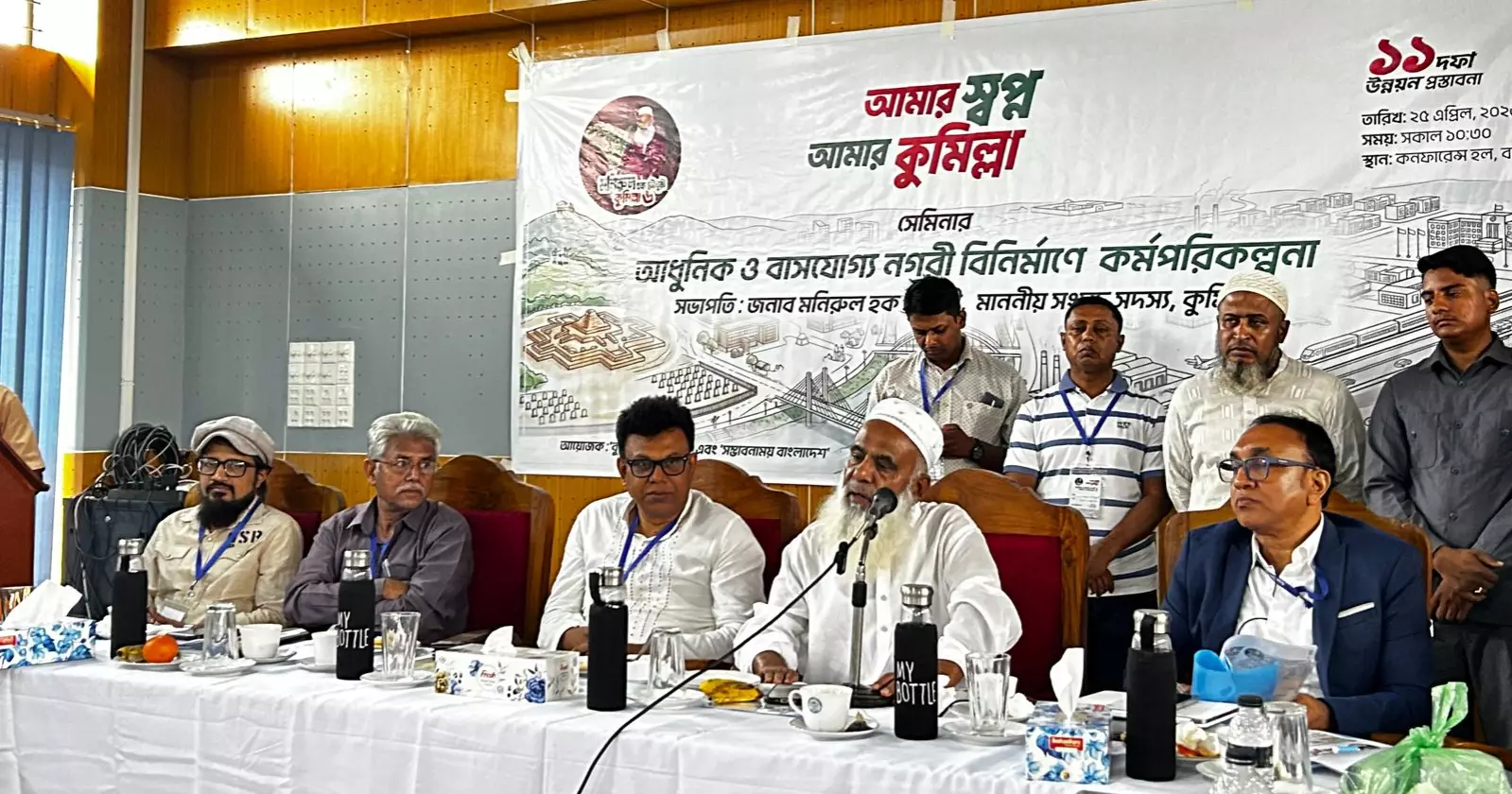
Speakers at a seminar on Saturday urged the government to ensure planned expansion of urban centres, warning that existing city corporations are struggling to deliver proper services due to unplanned urbanisation.
They made the call at a discussion titled “Amar Swapna, Amar Cumilla: Action Plan for Building a Modern, Livable City,” held at the Bangladesh Academy for Rural Development (BARD) in Kotbari. The event was organised by Cumilla Bachao Mancha and Somvabonamoy Bangladesh.
Speakers said redesigning Cumilla as a modern alternative city could be a “game changer” for Bangladesh, given its strategic importance in the country’s economy, transportation, and regional connectivity.
Highlighting longstanding civic challenges including traffic congestion, waterlogging, unplanned urbanisation, environmental pollution, and weak communication systems, they stressed the need for a coordinated and forward-looking development approach.
At the event, Cumilla-6 lawmaker Monirul Haque Chowdhury presented an 11-point long-term development plan aimed at transforming Cumilla into a divisional, commercial, and communication hub.
The keynote presentation was delivered by masterplan development expert and JICA consultant Md Mehedi Hasan. The session was moderated by Prof Dr MM Shariful Karim, while the lawmaker delivered the concluding remarks.
Among others, Asian Development Bank’s Senior Transport Specialist Mohammad Nazrul Islam and architect Muhaimin Shahriar, a member of the environment and urbanisation committee of the Institute of Architects Bangladesh, also spoke at the programme.
The proposed plan includes the development of a “Dr Akhter Hameed Khan Satellite City” centring BARD, Kotbari, and Kalir Bazar areas to ease population pressure on the main city and promote planned urbanisation. It also proposes establishing a modern eco-tourism park in the Lalmai hill area.
To address traffic congestion, the speakers emphasised introducing a modern mass transit system, constructing a direct rail link between Dhaka and Cumilla, building an elevated expressway on the Dhaka–Chattogram highway, and developing flyovers, underpasses, and service lanes at key intersections.
They also proposed constructing a new bridge over the Gomti River and developing alternative road networks to improve connectivity.
As part of broader urban governance reforms, the speakers called for upgrading Cumilla into a full-fledged division, expanding the city corporation area, and establishing a Cumilla Development Authority and WASA serving the municipality.
They further proposed reopening the British-era Cumilla airport with international cargo facilities, which could transform Cumilla into a major commercial hub in the southeastern region.
Environmental protection also featured prominently in the discussion, with calls for effective effluent treatment plants (ETPs) in EPZ areas to control industrial waste and safeguard farmers and aquatic resources.
The speakers expressed optimism that with planned urbanisation, improved transport systems, and environmentally sustainable development, Cumilla could emerge as one of the country’s most modern and economically vibrant metropolitan cities in the future.
Shaikh Muhammad Mehedi Ahsan, Vice President Bangladesh Institute of Planners (BIP), Md. Nurullah, former chief engineer, Dhaka South City Corporation and ABM Sertajur Rahman, Project management expert, Asian Development Bank spoke at the event