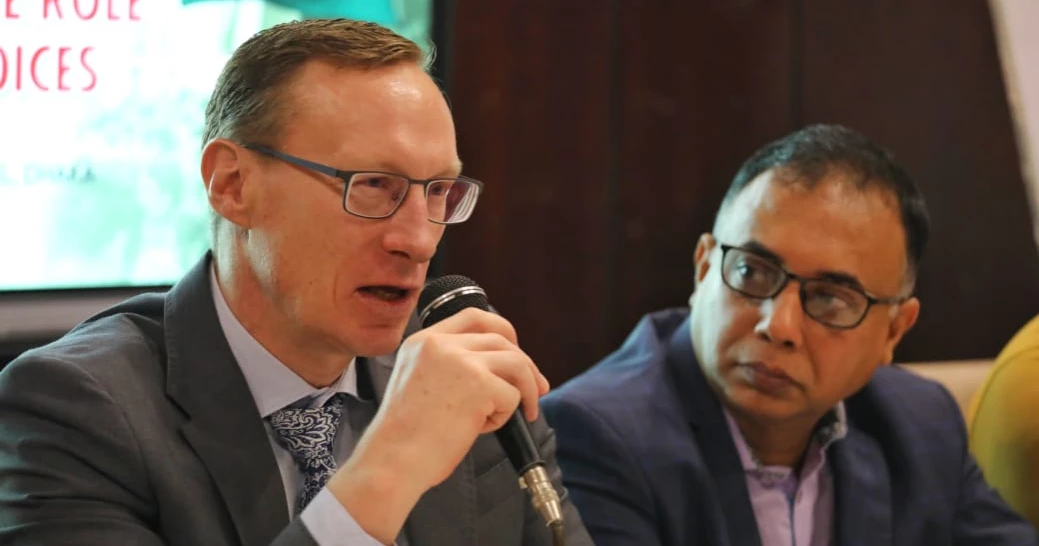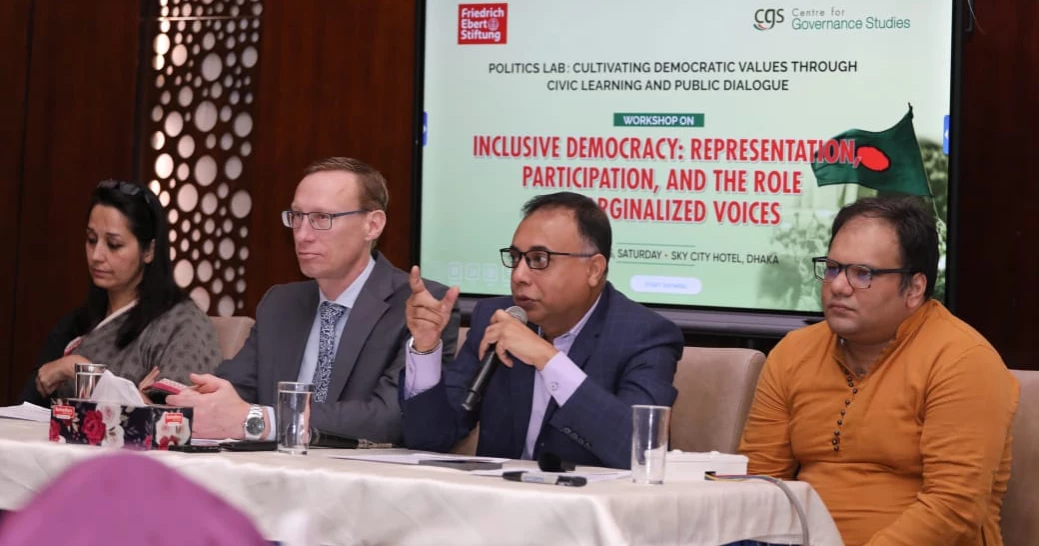
Speakers at a discussion on Saturday laid emphasis on an ‘inclusive democracy’, hoping that the people of the country will experience a ‘just and fair’ process ensuring both political and economic stability.
The event titled ‘Inclusive Democracy’ was organised by the Centre for Governance Studies (CGS) in collaboration with Friedrich-Ebert-Stiftung (FES) to encourage ideological dialogue and democratic practice among young politicians.
This initiative is part of CGS’s ongoing efforts to foster democratic engagement.
The primary objective of the initiative is to promote ideological dialogue among young political activists and strengthen democratic coexistence and pluralism in Bangladesh.
The discussion began with opening remarks from CGS President Zillur Rahman.
Executive Director of CGS Parvez Karim Abbasi, and FES Bangladesh Program Adviser Sadhan Kumar Das also addressed the participants.
Zillur Rahman said when they talk about democracy or politics, public perception plays a vital role. "An election alone does not guarantee democracy, but without elections, the democratic process cannot begin," he said.
Zillur said Bangladesh is heading toward a national election, and it remains to be seen how that process unfolds. "The question of who is marginalized in this country is a complex one," he said.
"Data shows that although there are around 55 registered political parties, only 18 have signed the ‘July Charter.’ Women make up nearly 50 percent of the population, yet their representation, along with that of other minorities, has been notably limited in this historic process," Zillur said.
Therefore, he said, how this consensus was reached remains a matter of reflection.
Parvez Karim Abbasi, in past electoral processes, those who came to power, or had the potential to often become immensely powerful after the elections, while those who lost would almost disappear from the scene.
"When we discuss political minorities, the issue of religious minorities naturally comes up. Economic marginalization is also a major challenge, where the same groups continue to enjoy privileges repeatedly," he said.
At the same time, Parvez said cultural marginalization has become increasingly evident, often imposed through coercion and, at times, with the support of the state.