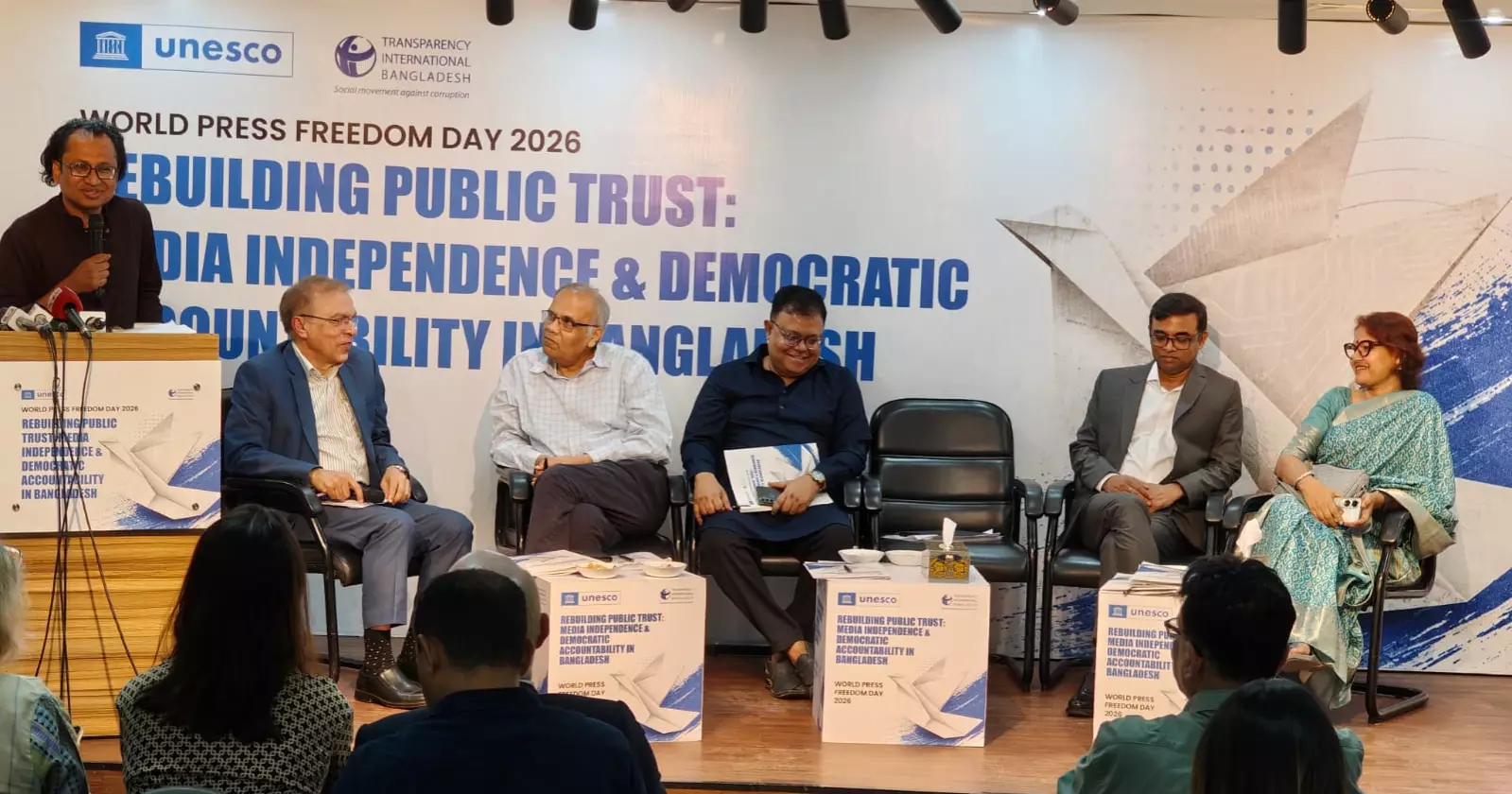
Media leaders, editors and rights advocates on Sunday stressed the urgent need for self-regulation, institutional reform and greater accountability to rebuild public trust in Bangladesh's media.
They made the observations at an interactive discussion organised by UNESCO and Transparency International Bangladesh (TIB) at Meghomala Auditorium of MIDAS Centre in Dhanmondi, marking the World Press Freedom Day 2026.
The event was convened under the theme, "Rebuilding Public Trust: Media Independence and Democratic Accountability in Bangladesh."
TIB Executive Director Iftekharuzzaman moderated the programme.
Speaking at the event, Iftekharuzzaman said self-regulation is a fundamental and indispensable component of a free and responsible media and self-regulation can only function effectively within a supportive political and governance framework.
Without such an environment, he said self-regulation risks becoming a tool for control and surveillance rather than a mechanism for genuine independence.
He also expressed concern over existing digital regulations, describing some as draconian and questioning whether they would be used to support or suppress media self-regulation.
The media must develop and enforce its own code of conduct in an environment conducive to freedom, he said
Iftekharuzzaman further warned that self-regulation can be misused as a slogan to justify political control over the media. When partisan political interests dominate the media landscape, the very concept of self-regulation becomes deeply compromised, he added.
Referring to past controversies involving The Daily Star and Prothom Alo, he said those incidents were not solely the result of mob pressure or government failure."There were inspirers and rejoicing institutions within the media sector itself," he said, urging the industry to confront its internal shortcomings and ensure accountability.
Kamal Ahmed, Consulting Editor of The Daily Star and head of the Media Reform Commission under the interim government, emphasised that self-regulation is essential to restoring public confidence in the media.
"The sooner we establish effective self-regulation, the sooner public trust will return," he said.
He called for a comprehensive code of ethics covering newspapers, television, radio and online platforms.
Such standards should be enforced by an independent regulatory or facilitative body, ideally a media commission, he said.
Kamal also spoke of "malicious actors" who exploit media ownership for personal, financial or political gain.
Some individuals invest in media outlets not to serve the public but to conceal wrongdoing or secure unlawful advantages, said Kamal.
Such actors must eventually be removed to create a healthier, more disciplined media environment.
He added that the government's role should be to provide legal recognition, policy support and institutional backing to media organisations that comply with ethical standards and directives issued by an independent media commission.
Reaz Ahmad, Editor of Dhaka Tribune, stressed the importance of establishing autonomous and functional institutions to protect press freedom.
He said that even government-affiliated bodies should operate independently with their own budgets.
If Bangladesh's existing institutions prove ineffective, he suggested considering successful international models.
He also proposed that press councils could be established through initiatives led by the media community itself.
World Press Freedom Day, proclaimed by the United Nations General Assembly in 1993, is observed globally to reaffirm press freedom and freedom of expression as essential pillars of democratic governance and sustainable development.