
A special committee formed to review the 133 ordinances issued during the interim government's tenure has not approved around 20 ordinances, including the Anti-Corruption Commission Ordinance, the National Human Rights Commission Ordinance, the Police Commission Ordinance, the Prevention and Remedies of Disappearances, and the Referendum Ordinance.
Of these, four ordinances, including the Supreme Court Judge Appointment Ordinance and the Supreme Court Secretariat Ordinance, have been recommended to be allowed to lapse.
For the remaining 16 ordinances, it has been recommended to submit new bills in parliament that lawmakers can examine and further legislate.
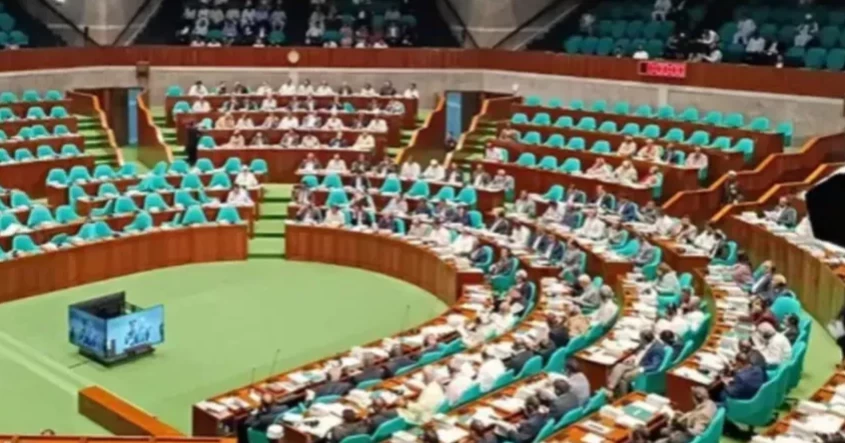
Committee chairman Zainul Abedin placed the report on all 133 ordinances in the Parliament on Thursday.
The 133 ordinances issued during the interim government's tenure were presented in the first meeting of the 13th Sangshad (March 12) as per the rules. Later, the parliament formed a special committee comprising members of the government and opposition parties to examine them and submit a report. The committee submitted its report on Thursday.
Out of the 133 ordinances issued during the interim government, the special committee has recommended that 98 ordinances be passed in their entirety and 15 ordinances be introduced in the parliament through the relevant ministry in amended form.
Out of the remaining 20 ordinances, 16 ordinances should not be introduced in the parliament as bills now, but should be further strengthened and revised later. It has been recommended that a bill be introduced in the parliament now for the repeal and preservation of 4 ordinances.
That is, 20 ordinances issued during the interim government are not being approved by the parliament. As a result, their effectiveness will lapse after the specified period. The constitution states that if an ordinance is not approved within 30 days of its introduction in the parliament, its effectiveness will lapse.
Of these, three members of the opposition party Jamaat-e-Islami have given notes of dissent to the special committee regarding a total of 20 ordinances.
The four ordinances that have been recommended for repeal
It has been recommended to bring bills for repeal and custody in the case of four ordinances. Which include— National Parliament Secretariat (Interim Special Provisions) Ordinance, 2024. Supreme Court Judges Appointment Ordinance, 2025. Supreme Court Secretariat Ordinance, 2025 and Supreme Court Secretariat (Amendment) Ordinance, 2026.
Although the Constitution is supposed to make a law for the appointment of judges, this has not happened so far. In 2025, the interim government issued the Supreme Court Judges Appointment Ordinance for the first time.
The interim government issued the Supreme Court Judges Appointment Ordinance to select suitable persons for the appointment of Supreme Court judges and advise the President through the Chief Justice.
It states that the ‘Supreme Judicial Appointment Council’ will select suitable persons for the appointment of judges in the Appellate Division and High Court Division of the Supreme Court. This independent council, headed by the Chief Justice, will recommend the name of a qualified person to the President.
On the other hand, the Supreme Court Secretariat Ordinance was enacted to establish an independent secretariat to carry out the matters related to supervision, control and discipline of subordinate courts and to effectively implement the independence of the judiciary.
According to this ordinance, if the Supreme Court Secretariat is established, this secretariat will perform all administrative and secretarial duties related to the supervision and control of subordinate courts and administrative tribunals.
According to the ordinance, all decisions regarding the appointment, promotion, transfer, discipline and leave of judges engaged in judicial work and other related matters will be in the hands of this secretariat.
The overall control of the Supreme Court Secretariat will be vested in the Chief Justice and the Secretary of the Secretariat will be the administrative head.
Jamaat-e-Islami has a note of dissent regarding the repeal of these two ordinances. Three members of the party gave a note of dissent in the special committee.
The report said that out of the 133 ordinances, 16 ordinances were not proposed in the parliament as bills now, but were recommended to be further strengthened and presented as new bills after scrutiny and selection. Out of which, the opposition party has given a note of dissent (objection) to 11.
The 16 ordinances include the National Human Rights Commission (Amendment) Ordinance, 2024, Revenue Policy and Revenue Management Ordinance, 2025. Revenue Policy and Revenue Management (Amendment) Ordinance, 2025. National Human Rights Commission Ordinance, 2025. Referendum Ordinance, 2025. Prevention and Remedy of Disappearances Ordinance, 2025. National Human Rights Commission (Amendment) Ordinance, 2025. Anti-Corruption Commission (Amendment) Ordinance, 2025. Prevention and Remedy of Disappearances (Amendment) Ordinance, 2026. Microfinance Bank Ordinance, 2026. Right to Information (Amendment) Ordinance, 2026.
The ordinances that the opposition party did not object to are—Value Added Tax and Supplementary Duty (Second Amendment) Ordinance, 2025. Customs (Amendment) Ordinance, 2025. Income Tax (Amendment) Ordinance, 2025. Civil Aviation (Amendment) Ordinance, 2026. Bangladesh Travel Agency (Registration and Regulation) Amendment Ordinance, 2026.
In the meantime, the Referendum Ordinance was issued to hold a referendum on the implementation of the July National Charter.
The Anti-Corruption Commission (Amendment) Ordinance was issued in 2025, increasing the investigation and secret investigation powers of the ACC. It provides for direct filing of complaints, bringing serious financial crimes, including crimes committed abroad, under the law, and increasing the members of the commission.
The interim government issued the Revenue Policy and Revenue Management Ordinance. In this, the existing structure has been restructured and revenue policy formulation and revenue collection activities have been separated.
Provision has been made to establish two separate departments under the Ministry of Finance, namely the Revenue Policy Department and the Revenue Management Department. Officials have started a movement regarding this.
On January 28, 2026, the government issued the Microfinance Bank Ordinance. This was done to establish a microfinance bank. It has not been implemented yet.
Among the ordinances that have been recommended for passing in full, there are some ordinances of local government institutions.
Provision has been made for appointing administrators in special situations and in the public interest. In this regard, Jamaat has objections.
Apart from this, there are the Bangladesh Bank Amendment Ordinance 2024, the Bangladesh Energy Regulatory Commission (Amendment) Ordinance, the Special Security Forces (Amendment) Ordinance, the Security of Family Members of the Father of the Nation (Repeal) Ordinance, and the Certain Laws (Amendment) Ordinance relating to Universities (change of names like Bangabandhu, Bangamata, Sheikh Hasina, etc. mentioned in the laws of various universities). Grameen Bank (Amendment) Ordinance, International Crimes (Tribunes) (Second Amendment), National Assembly Delimitation (Amendment) Ordinance, Cyber Security Ordinance, Government Service (Amendment) Ordinance, July Uprising Martyrs' Families and July Fighters Welfare and Rehabilitation Ordinance, July Uprising Memorial Museum Ordinance, July Uprising (Protection and Determination of Liability) Ordinance. There are many laws that are related to name change.
Some 15 ordinances have been recommended to be brought up in amended form. However, the special committee report did not mention where and what amendments will be brought.
These are the Women and Children's Repression (Amendment) Ordinance of 2025, the Public Procurement (Amendment) Ordinance, the Bank Resolution Ordinance, the Anti-Terrorism Ordinance, the Code of Criminal Procedure (Second Amendment), the National Data Management Ordinance, the Bangladesh Labor (Amendment) Ordinance, the Human Organ Transplantation Ordinance, the Police Commission Ordinance, the Smoking and Tobacco Products (Control) (Amendment) Ordinance, the Prevention and Suppression of Human Trafficking and Migrant Smuggling Ordinance of 2026, the Land Use Control and Agricultural Land Protection Ordinance, the Bangladesh Telecommunication Regulation (Amendment) Ordinance, the Non-Government Educational Institution Teachers and Employees Retirement Benefits (Amendment) Ordinance, and the Non-Government Educational Institution Teachers and Employees Welfare Trust (Amendment) Ordinance.
Among these, the Anti-Terrorism Ordinance was amended to ban the political activities of the Awami League. This ordinance includes a provision to prohibit the activities of a specific entity and includes provisions on the activities that can be prohibited, including processions, meetings, publications, etc. of the entity whose activities are prohibited.
It has been recommended to be passed in parliament in an amended form. However, it has not been mentioned what amendments will be made.
The interim government issued the Police Commission Ordinance to form a police commission through a selection committee and recommend the appointment of an inspector general of police, and to work on citizen complaints and internal police grievances. It has been recommended to be passed in parliament in an amended form. However, Jamaat-e-Islami has a note of dissent in this regard.
The government has proposed to repeal the Supreme Court Secretariat Ordinance. In the note of dissent, Jamaat-e-Islami said that this ordinance is an important and groundbreaking step in ensuring the administrative independence of the judiciary. Under this ordinance, an independent secretariat called "Supreme Court Secretariat" has been formed with the Chief Justice as the administrative head, which provides an institutional framework for conducting the activities of the judiciary.
The main objective of this secretariat is to provide effective support to the Supreme Court in conducting judicial administration. Under this, this secretariat will perform all the necessary administrative and secretarial duties related to the supervision and control of subordinate courts and administrative tribunals. This is considered an important milestone in establishing an independent judiciary.
In addition, the power to take decisions on various administrative matters including posting, promotion, transfer, discipline and leave of judges of subordinate courts has been entrusted to this secretariat.
This will end the control or influence exerted on judges by the executive branch. Judges will be able to perform their duties more independently and impartially, which is very important for the establishment of justice.
To ensure the independence of the judiciary, the ordinance is in favor of passing it unchanged.
The Jamaat's note of dissent states that this ordinance, which is made with the aim of ensuring transparency, accountability and institutional structure in the process of appointing judges of the Supreme Court, provides for the formation of a 7-member council called the "Supreme Judicial Appointments Council".
This council will include judges from both divisions of the Supreme Court, the Attorney General and a professor or expert in law.
As a result, there will be a combination of experience, expertise and professional discretion in the process of appointing judges, which will help ensure an acceptable and impartial process.
It is further said that the independence of the judiciary will be consolidated and public confidence will increase.
A groundbreaking step in making the judiciary stronger and more impartial. The judicial appointment process will be conducted in a more transparent, systematic and accountable framework.
Overall, this ordinance can be considered an important initiative to make the judicial appointment process modern, well-organized and acceptable.
The government proposed to repeal this ordinance. Expressing its dissent, Jamaat members told the committee that several important changes have been made to increase the effectiveness of the commission, strengthen the investigation process and ensure accountability.
Through this ordinance, the investigation and secret search powers of the ACC have been significantly expanded.
New provisions have been added for filing direct complaints. Serious financial crimes, including crimes committed abroad, have been brought under the law.
The selection committee has been expanded and the number of members of the commission has been increased in order to develop the structure of the commission.
This ordinance can be considered an important step in making the anti-corruption activities more effective, transparent and accountable.
As a result, the opposition members said that they stand in favor of passing the ordinance unchanged in the interest of the country to prevent corruption and establish justice.
The National Human Rights Commission Ordinance, 2025 states that several fundamental changes have been made to establish the commission as a truly independent and effective organization.
In order to make the commission an independent institution, it is said to form a selection committee for the appointment of the chairman and members of the commission.
The commission has been given the power to investigate allegations of human rights violations against state institutions and law enforcement agencies.
At the same time, the commission has been given the power to investigate and investigate cases of crimes related to disappearances.
The government's argument for the cancellation is that since the commission is not under any ministry, how will supervision be done? Government permission will be required before investigating the security forces. Government permission will be required instead of court permission for arrests.
More government representatives should be added to the selection committee. Two names should be proposed for each position.
The opposition members in the special committee have objected to the government's argument. Their argument is that the ACC, Election Commission, and the Office of the Auditor General are not under any ministry.
The appointment of the Human Rights Commission through the President and the power to remove them has been given. Investigation with permission is immunity. Arrest with permission of the government instead of the court is interference of the executive branch in the judiciary.
The Prevention and Remedy of Disappearances Ordinance defines disappearance as an ongoing crime. It provides for the appointment of a public prosecutor in the tribunal on the recommendation of the Human Rights Commission.
In addition, the complainant or victim has the power to appoint a private lawyer. In addition, provisions have been made for treatment, rehabilitation and compensation for victims of disappearance.
The government's argument regarding the lapse of the ordinance is that the government's prior permission will be required for investigations against the security forces.
Detention for reasons of national security should be excluded from the definition of disappearance.
However, the opposition party is adding that in the last 15 years, the families of the victims of disappearances have not received justice from the government. Permission is never granted when they ask for permission from the government. Requesting permission is immunity.