
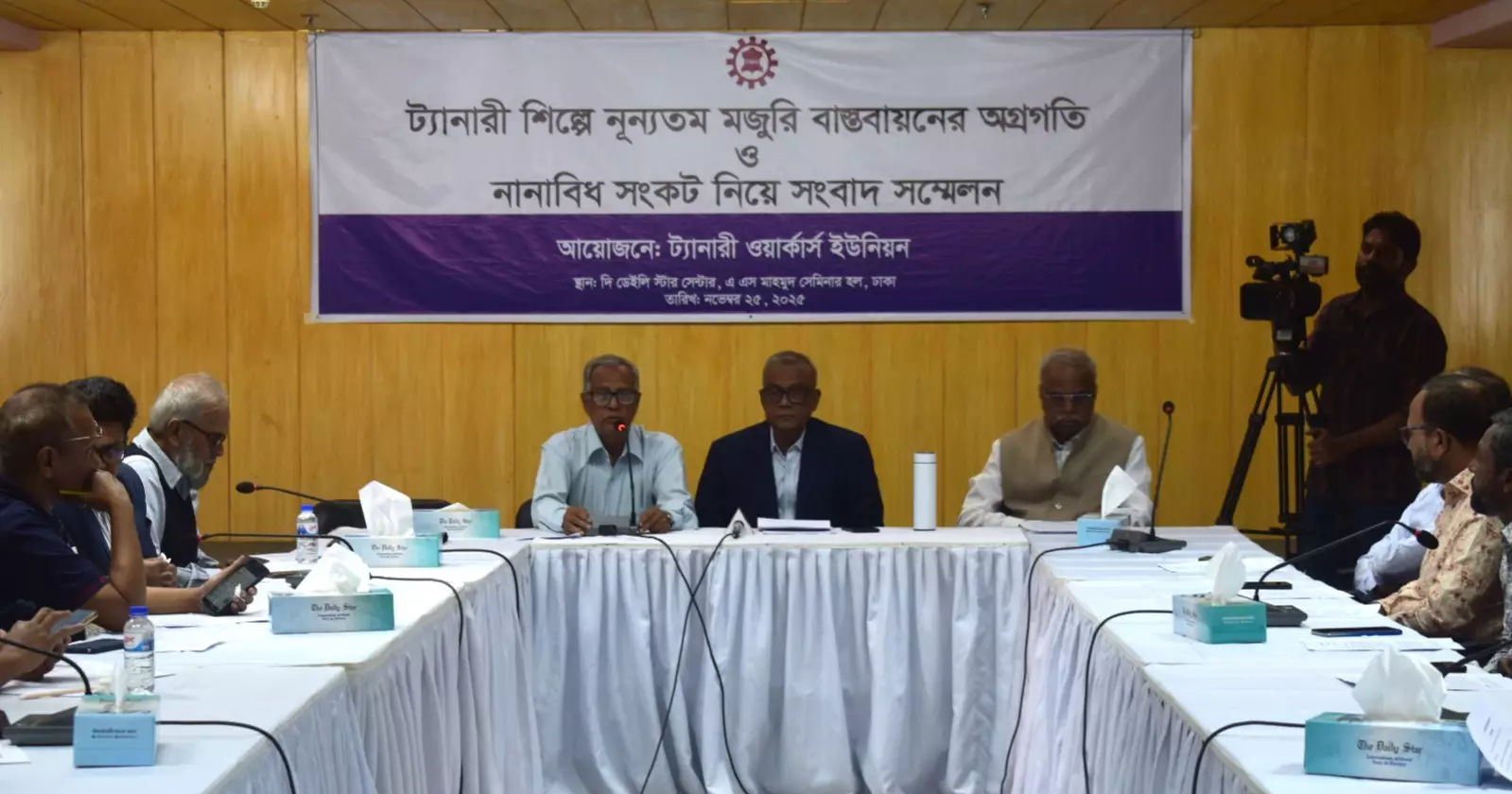
Bangladesh’s tannery sector is struggling with a severe crisis, with workers expressing mounting frustration over the failure of owners to implement the government-declared revised minimum wage even a year after its announcement.
In response, the Tannery Workers Union (TWU) has warned of potential strict agitation.
The union also alleged that widespread layoffs, the expansion of an illegal contractor system and a government initiative to bring the leather industry under the Bangladesh Export Processing Zones Authority (BEPZA) have created extreme uncertainty in the sector.
The TWU highlighted these concerns at a press conference on Tuesday at The Daily Star Centre in Dhaka.
TWU President Abul Kalam Azad and General Secretary Abdul Malek stated that the revised minimum wage, gazetted on November 21 last year and subsequently declared by the ministry, has yet to be implemented in the tannery industry.
Despite nearly two years of discussions, tripartite meetings and a final decision from the ministry, the owners have taken no effective steps toward its implementation.
The leaders alleged that owners are attempting to deny the announced wage to long-term employees by labelling them as ‘temporary’, a clear violation of labor law.
Besides, discussions for the renewal of bilateral agreements—which were supposed to follow the wage board's final decision—have been delayed by the owners, putting other worker benefits at risk.
The union also expressed deep concern over not being consulted about the interim government's initiative to bring the tannery industry under BEPZA’s jurisdiction.
Union leaders reported that skilled and experienced workers and machine operators are being deliberately laid off and replaced by contract workers.
The laid-off employees are reportedly not receiving their legal dues. The union noted that this process is pushing a formal sector toward an informal labor system.
Advocate AK M Nasim, a member of the Labour Reform Commission, said, “The owners' procrastination in implementing the minimum wage despite the gazette publication and the inaction of government agencies are alarming. According to the law, all workers—permanent, temporary, or contract-based—are entitled to equal wages, but reluctance to implement this is visible everywhere.”
Govt okays proposal not to implement CETP project at Tannery Estate
Criticising the plan to shift the sector to an EPZ, he warned, “If the tannery sector is transferred under the EPZ, the freedom of association for workers could be severely harmed.” He also noted that under the recently amended labor law’s enterprise cluster framework, while 20 workers can form a union, the maximum is limited to five, which will weaken workers’ organizational power.
Syed Sultan Uddin Ahmed, Chairman of the Labour Reform Commission, said, “Despite the tannery industry being important for Bangladesh, hazardous conditions still persist. Keeping workers temporary for extended periods, delaying the announced minimum wage implementation, and creating uncertainty under the guise of review weakens the foundation of trust, the impact of which will eventually fall on the entire industry and the national economy.”
He emphasised that ensuring a dignified work environment for laborers is the joint responsibility of the state and owners to restore stability in the industry.