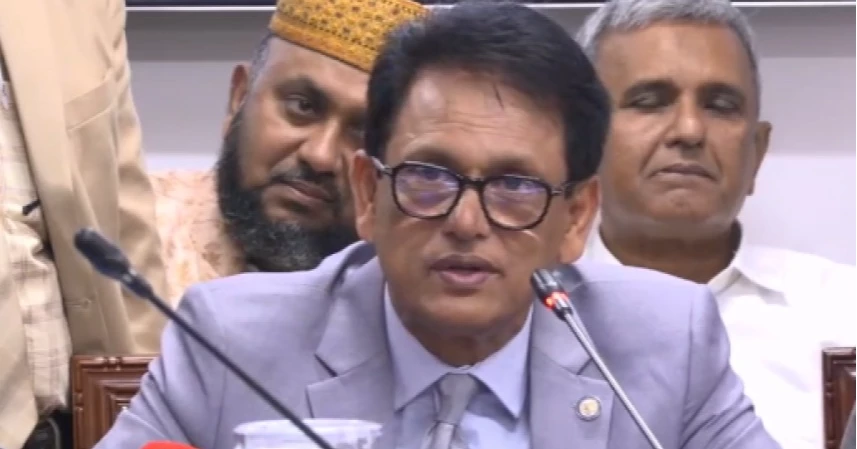
Education Minister ANM Ehsanul Hoque Milon on Wednesday underscored the need to modernise and align technical and vocational education with market demands to transform Bangladesh’s vast population into a skilled workforce.
“Technical and job-oriented education must be updated in line with contemporary needs and global labour market trends,” he said at a view-exchange meeting with officials at the conference room of the Directorate of Technical Education.
“To strengthen the technical education system, we need to reinforce public-private partnerships, build stronger linkages between industry and academia, and modernise curricula and syllabuses,” he said.
The minister said key performance indicators (KPIs) and other performance metrics of the technical education sector have been reviewed initially and deeper analysis would be conducted to bring necessary reforms.
The minister said there are gaps in public-private partnership, coordination between industries and educational institutions, and the formulation of market-driven curricula, which must be addressed promptly.
Urging officials to take proactive initiatives, Milon said they should identify development priorities within their respective departments, projects and institutions and act with creativity and innovation instead of waiting for directives from the ministry.
Describing the Education Ministry as one of the country’s most important ministries, Milon said, “It is from here that the nation’s human resources are developed. Building a skilled workforce for nearly 180 million people is a major responsibility.”
If Bangladesh’s large population can be properly transformed into skilled human capital, it could become a key driver of the country’s economic and social development, he added.
No auto-pass, stricter monitoring for SSC 2026: Minister Milon
Milon said technical institutions including vocational and polytechnic institutes should prioritise hands-on and job-oriented training over excessive theoretical instruction.
“A comprehensive review of curricula and training systems is necessary in this regard,” he added.
He also stressed the importance of strengthening coordination with the Ministry of Expatriates’ Welfare and Overseas Employment and other relevant bodies to expand opportunities for sending skilled workers to international labour markets.
“While many developed countries are facing population decline, Bangladesh remains demographically strong. If we can convert this manpower into skilled human resources, Bangladesh can establish itself globally as a nation rich in skilled workforce,” Milon said.
Calling for a departure from conventional work practices, Milon urged officials to work with renewed energy, enthusiasm and speed, setting clear goals and action plans in their respective areas.
The minister also called for collective efforts from the technical education sector to help realise the employment generation target announced by Prime Minister Tarique Rahman.