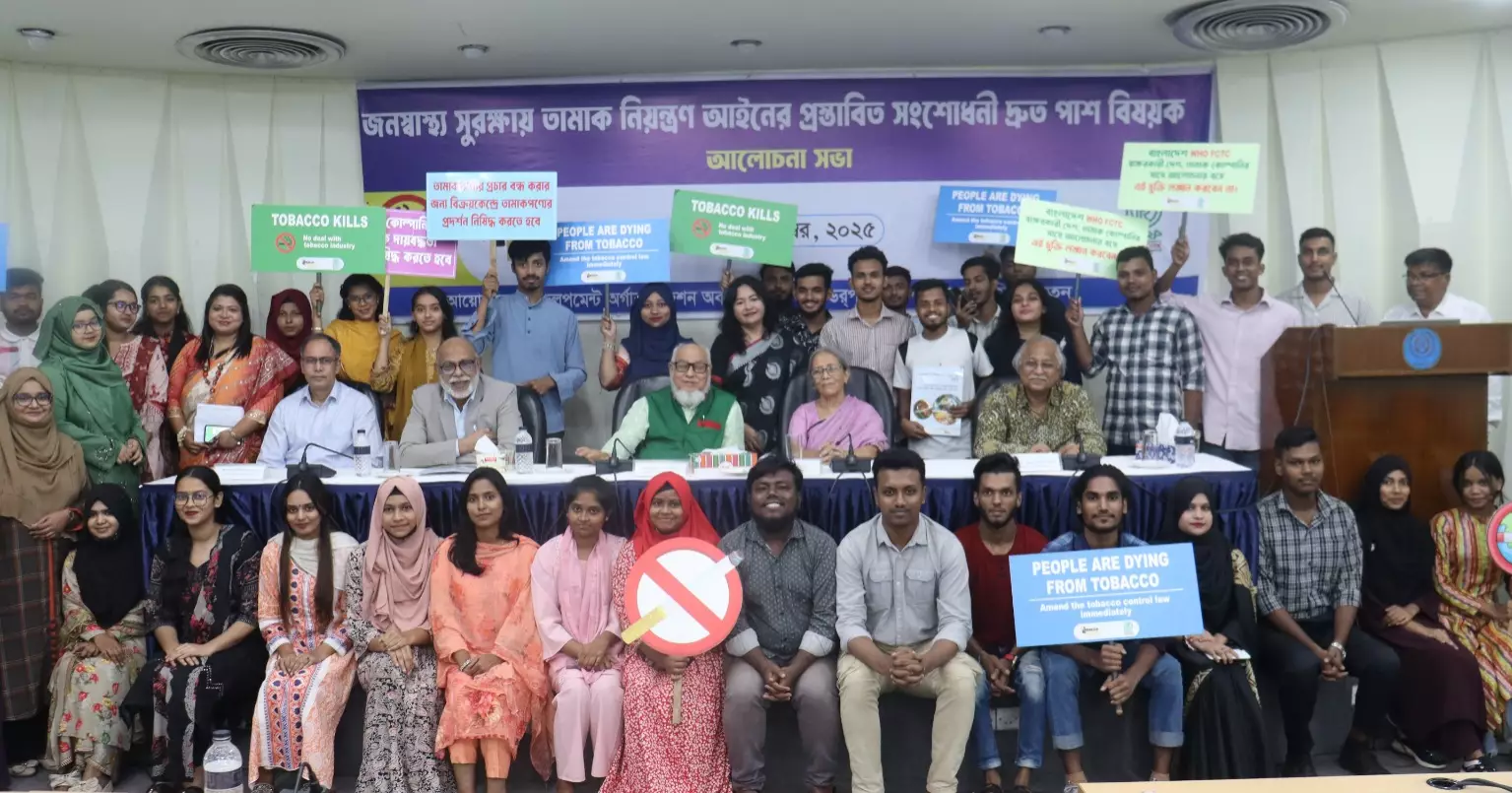
Tobacco companies must not be allowed to act as stakeholders in amending the Tobacco Control Law, said Fisheries and Livestock Adviser Farida Akhter on Wednesday.
Farida Akhter made the remarks while addressing a discussion organised by the Development Organisation of the Rural Poor (DORP) at the CIRDAP auditorium in Dhaka.
She said the government would never take such an anti-people step.
She said tobacco industry interference has already delayed the amendment process for too long. “No further delay is acceptable.”
The session opened with welcome remarks from A.H.M. Noman, DORP’s founder and chief executive while Zeba Afroza, the organization’s project coordinator, presented the keynote paper, outlining six key proposals aligned with the WHO Framework Convention on Tobacco Control (FCTC).
These included abolishing designated smoking areas in public places and transport, banning tobacco product displays at points of sale, prohibiting corporate social responsibility activities by tobacco companies, restricting e-cigarettes to protect youth, ending loose and retail sales of tobacco products, and expanding pictorial health warnings on packaging from 50 percent to 90 percent.
Speaking as special guest, Akhtaruzzaman, Director General of the National Tobacco Control Cell, rejected claims by tobacco companies that the amendments would lead to major revenue losses.
“In reality, after the law was enacted in 2005 and amended in 2013, government revenue from tobacco increased 12.5 times in 18 years, even as tobacco use fell by 18 percent between 2009 and 2017. This proves reduced tobacco use does not harm government revenue,” he said.
Professor Dr. Golam Mohiuddin Faruq, President of the Bangladesh Cancer Society, criticised a July 13 decision by a review committee that announced plans to invite tobacco industry representatives to stakeholder discussions.
Youth advocates Ayesha Akhtar Shilpi and Niemur Rahman Emon also spoke at the event calling for the swift passage of the proposed amendments to protect public health.
They demanded that the government refrain from including tobacco industry voices in the lawmaking process.