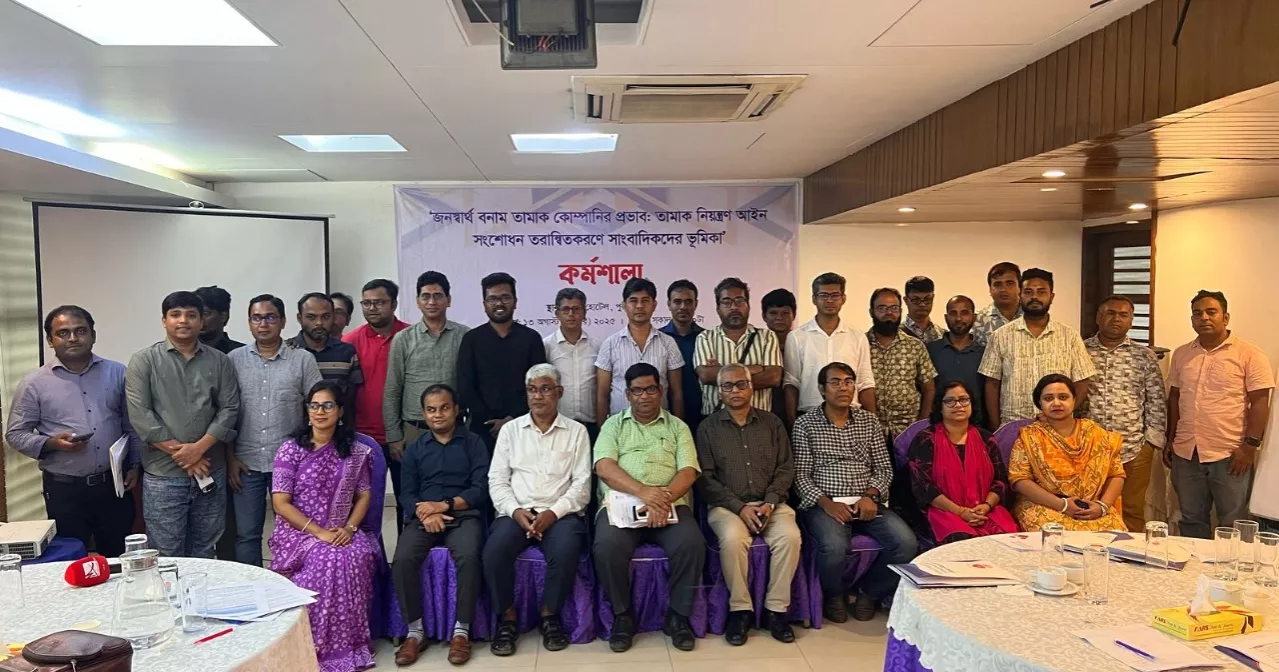
Bangladesh Health Reporters Forum on Wednesday declared that no form of opinion from tobacco companies is acceptable in the process of amending the Tobacco Control Act.
According to the forum, such a move is a direct violation of Article 5.3 of the World Health Organization’s Framework Convention on Tobacco Control (WHO FCTC) and poses a severe threat to public health. The organisation has, therefore, demanded that the government immediately withdraw its decision to seek tobacco company opinions under the guise of stakeholder meetings.
The demands were raised on Wednesday at a workshop titled "Public Interest vs. Tobacco Industry Influence: The Role of Journalists in Expediting Tobacco Control Law Amendment", organised by the Bangladesh Health Reporters Forum with the support of the National Heart Foundation of Bangladesh.
Rashed Rabbi, president of the Bangladesh Health Reporters Forum, delivered the welcome address, while the keynote presentation was made by Prof. Dr. Sohel Reza Choudhury, head of the Department of Epidemiology and Research at the National Heart Foundation Hospital and Research Institute.
Choudhury said tobacco is one of the leading causes of heart disease, cancer, and various respiratory illnesses. In Bangladesh, more than 161,000 people die each year from tobacco-related diseases, and over 400,000 people become disabled (WHO). Additionally, nearly 38.4 million adults are exposed to secondhand smoke every day in public places and public transport.
“To address this alarming situation, it is urgent to amend the existing Tobacco Control Act without delay,” he stated. “Unfortunately, the government has decided to take opinions from tobacco companies in stakeholder meetings, which is a direct violation of WHO FCTC Article 5.3. We demand that the government immediately withdraw this decision and approve the proposed amendment in the advisory council meeting of the Ministry of Health.”
He further added that the current interim government came to power with promises of reforms in various sectors. “But in the past year, we have seen no effective steps toward amending the tobacco law. Instead, influenced by the propaganda of tobacco companies, the government has decided to collect their opinions under the name of stakeholder meetings. This is a clear violation of the WHO FCTC. The government must withdraw this decision immediately and approve and implement the amended Tobacco Control Act proposed by the Ministry of Health.”
Amend Tobacco Control Act to protect future generations from malign effects
Journalists participating in the workshop said that, according to Article 5.3 of the WHO FCTC, tobacco companies must not be involved in the formulation or amendment of any policy. However, in the July 13 meeting of the advisory committee, a decision was made to seek tobacco company opinions on the draft amendment of the Tobacco Control Act — a move they described as completely unacceptable.
They also noted that the only aim of tobacco companies is profit, not public health. Accepting their opinions means ignoring public interest. They pledged to continue publishing regular reports on the issue to draw the attention of the authorities concerned.
The six key amendments proposed by the Ministry of Health to the existing law include: Eliminating Designated Smoking Areas (DSA) to make all public places and public transport completely smoke-free; Banning tobacco product displays at points of sale to prevent attraction among youth and potential users; Completely prohibiting tobacco companies’ Corporate Social Responsibility (CSR) activities; Protecting adolescents and young people from e-cigarettes and all emerging tobacco products; Increasing the size of pictorial health warnings on tobacco packets and containers from 50% to 90%; and Prohibiting the sale of single sticks of bidis and cigarettes, as well as unwrapped and unpackaged smokeless tobacco products.
The workshop was also attended by Naimul Azam Khan, adviser to the Tobacco Control Project of the National Heart Foundation Hospital and Research Institute; Dr. Aruna Sarkar, project coordinator; Senior Communications Officer Abu Jafor; and Mainul Hasan Sohel, general secretary of the Dhaka Reporters Unity, along with representatives from various media outlets.