
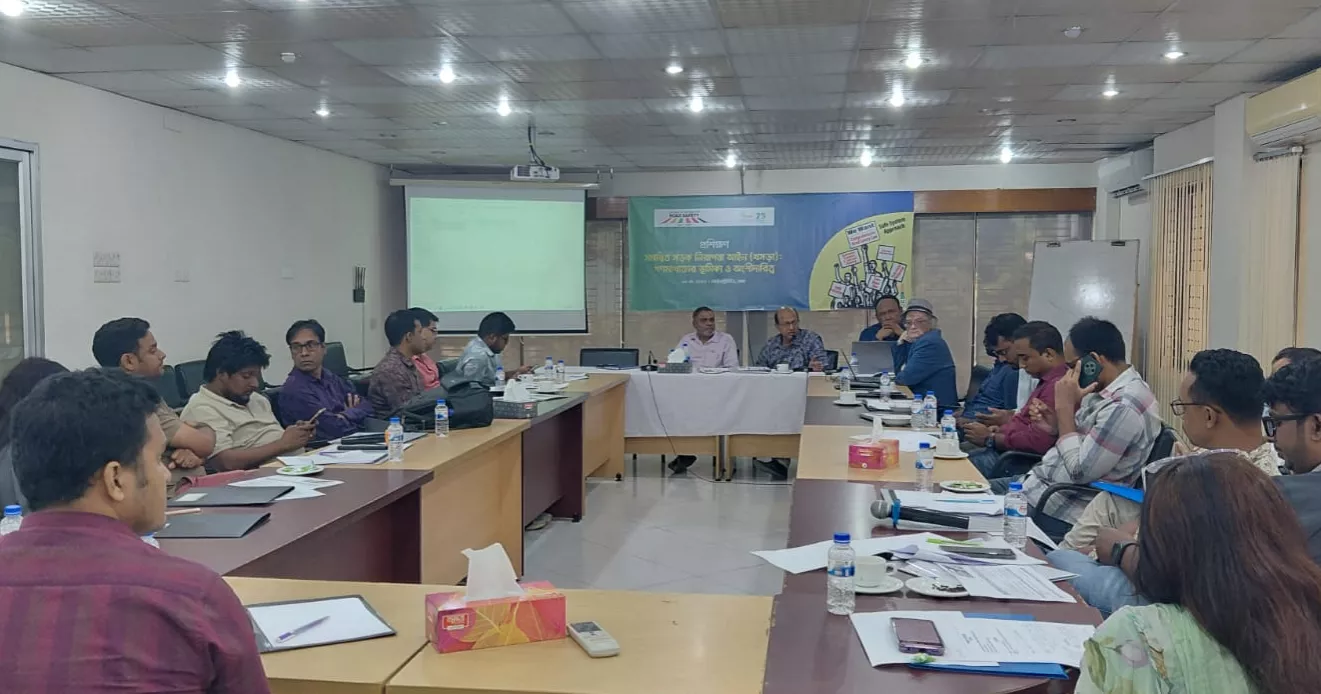
A day-long training programme for journalists on the draft Comprehensive Road Safety Law, the Safe System Approach and the role of the media in promoting road safety was held in Dhaka.
The training, titled “Draft Comprehensive Road Safety Law: Role and Partnership of the Media,” was organised by the Bangladesh NGOs Network for Radio and Communication (BNNRC) at the YWCA Training Room in Mohammadpur.
A total of 20 journalists from print, television, online news portals and news agencies took part in the programme.
The sessions focused on national and global road safety issues, the Safe System Approach, progress on the draft Comprehensive Road Safety Law, behavioural risk factors, the media’s role in policy advocacy, and techniques for producing evidence-based and analytical reports.
The resource persons included Khalid Mahood, programme manager of the BRAC Road Safety Programme; Dr Shariful Alam, country coordinator of the Global Health Advocacy Incubator; and AHM Bazlur Rahman, chief executive officer of BNNRC.
Speakers said road safety in Bangladesh is no longer only a transport-sector issue but has become an urgent development concern linked to public health, urban governance, rule of law, the economy, social protection and citizens’ rights.
They noted that road crashes not only cause deaths and injuries but also lead to disability, financial hardship for families and loss of productivity, which affect national development.
The speakers referred to Sustainable Development Goal (SDG) target 3.6, which aims to halve global deaths and injuries from road crashes by 2030, and SDG target 11.2, which calls for safe, affordable, accessible and sustainable transport systems for all.
The training highlighted that although the Road Transport Act 2018 has contributed to some improvements in road management, there is now a growing need for a more comprehensive and integrated road safety law.
Participants discussed that reducing road crashes requires coordinated efforts in road engineering, safe vehicles, responsible road users, speed management, law enforcement, public awareness and post-crash emergency response.
Speakers also stressed that road safety cannot be ensured without coordination among the transport, health, police, education, local government, infrastructure and media sectors.
They said a comprehensive road safety law could help establish clear responsibilities, coordination and accountability among all relevant sectors.
The speakers further said media coverage of road crashes should go beyond reporting incidents and also examine causes, behavioural risks, policy and legal gaps, road infrastructure weaknesses, speed management, helmet and seatbelt use, child safety, pedestrian rights and post-crash care.
AHM Bazlur Rahman said road safety has become an important issue in global development discussions.
He noted that the United Nations High-Level Meeting on Improving Global Road Safety, scheduled to be held in New York on July 20–21, 2026, will also be significant for Bangladesh.
Ahead of the meeting, he said effective national dialogue is needed on road safety law, policy, financing, institutional coordination and the role of the media.
He added that the media can play an important role in raising public awareness, encouraging behavioural change, supporting evidence-based policy dialogue and ensuring accountability of the relevant authorities.
BNNRC, a member of the Road Safety Coalition Bangladesh, has been working on road safety issues since 2022.