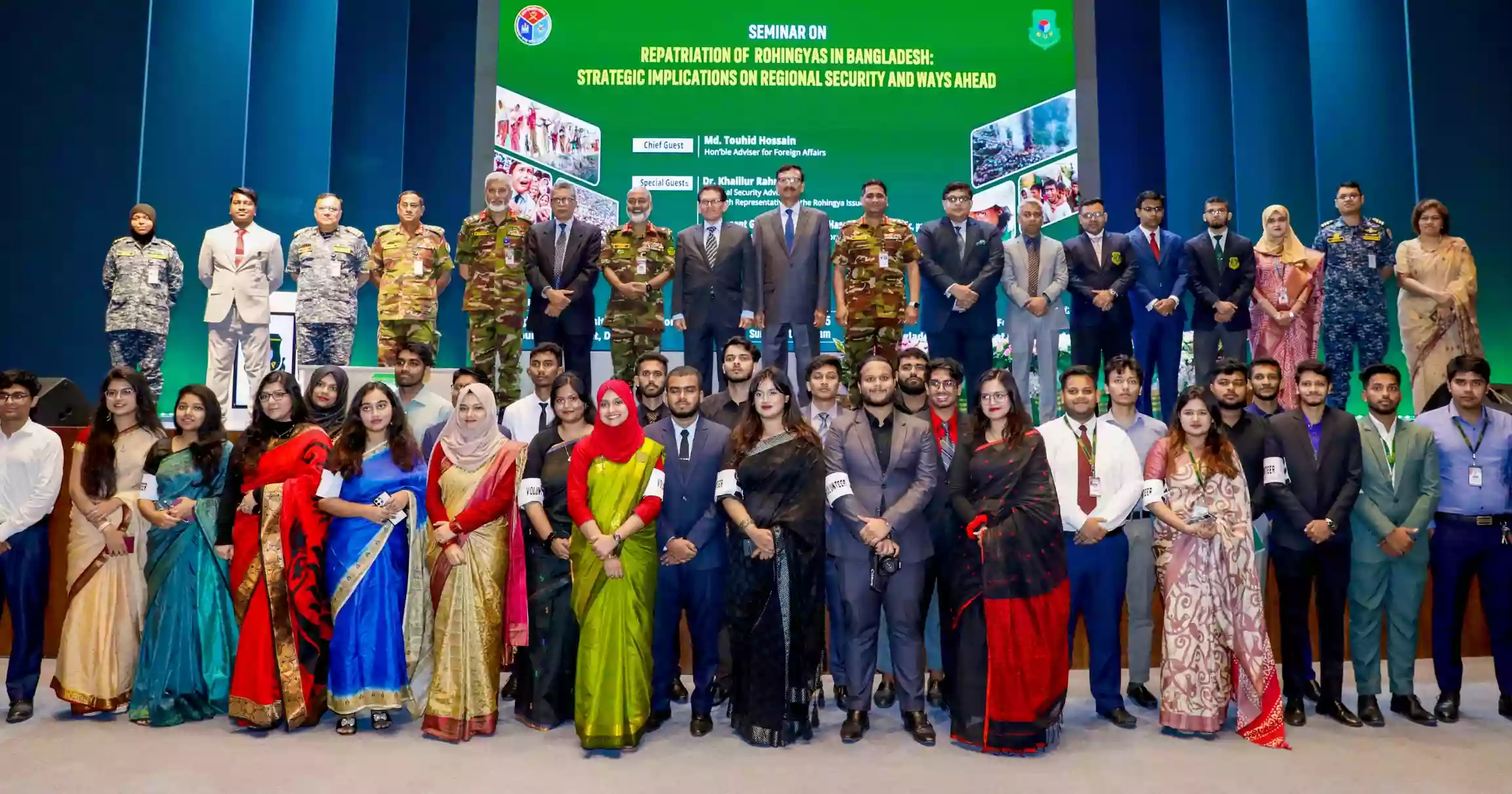
Speakers at a seminar on Sunday called for adopting a multipronged strategy combining bilateral and multilateral diplomacy, security and international cooperation as the government eyes the repatriation of the Rohingyas to their place of origin in Myanmar.
They identified current instability in the Rakhine State of Myanmar, unclear position of the Arakan Army and geopolitical divides as some of the barriers towards the Rohingya repatriation which remains the ultimate goal of the government.
At the same time, the speakers emphasised the importance of stabilising Rakhine for repatriation, ensuring global commitment, and building trust among all parties, considering the Rohingya repatriation in the larger context of regional security.
The seminar titled ‘Repatriation of Rohingyas in Bangladesh: Strategic Implications on Regional Security and Ways Ahead’ was hosted jointly by the Armed Forces Division (AFD) and Bangladesh University of Professionals (BUP) at the ‘Swadhinata Auditorium’ BUP campus.
Foreign Affairs Adviser Md Touhid Hossain spoke at the seminar as the chief guest. National Security Adviser and High Representative to the Chief Adviser Dr Khalilur Rahman and Principal Staff Officer of the AFD Lieutenant General SM Kamrul Hassan addressed it as special guests.
Diplomats stationed in Dhaka, military attaché of various countries, Rohingya issue experts, officials of various ministries, agencies and BUP students also participated in the seminar.
BUP Vice-Chancellor Major General Md Mahbub-ul Alam delivered the welcome speech at the seminar.
The Principal Staff Officer of the Armed Forces Division highlighted the recent influence of the Arakan Army in Myanmar’s Rakhine State and the complexity of the absence of Myanmar government authorities in the border areas.
He emphasised the need for coordinated cooperation of the international community and regional partners, including bilateral initiatives, for a sustainable solution to the Rohingya problem.
The Foreign Affairs Adviser and National Security Advisor said the current government is working towards a sustainable solution for the repatriation of the Rohingyas.
The government is hopeful of a solution to this problem by adopting all possible means and multi-dimensional diplomatic approaches for the repatriation of the Rohingya, they said.
The speakers said it is important to ensure that the international community does not divert attention from the Rohingya crisis amid other global conflicts.
Besides, the need for a roadmap for the return of the Rohingya was also emphasized.
Since the main partners in Myanmar are the military junta, the Arakan Army and the National Unity Government (NUG), the speakers said any permanent solution must involve all three parties.
Prof Dr Sahab Enam Khan, Department of International Relations, Jahangirnagar University presented the keynote speech.
Abu Salah Md Yousuf, Research Director, Bangladesh Institute of International and Strategic Studies and Assistant Professor Md. Ataur Rahman Talukder, Department of International Relations, BUP presented papers as panelists, according to ISPR release.
M Humayun Kabir, former Ambassador and President of Bangladesh Enterprise Institute, moderated the open discussion.
On August 25, 2017, hundreds of thousands of refugees started crossing the border to Bangladesh on foot and by boats amid indiscriminate killings and other violence in Myanmar’s Rakhine state.
Since 2017, Bangladesh has attempted at least twice to send the refugees back and has urged the international community to build pressure on Myanmar for a peaceful environment inside Myanmar that could help start the repatriation.