
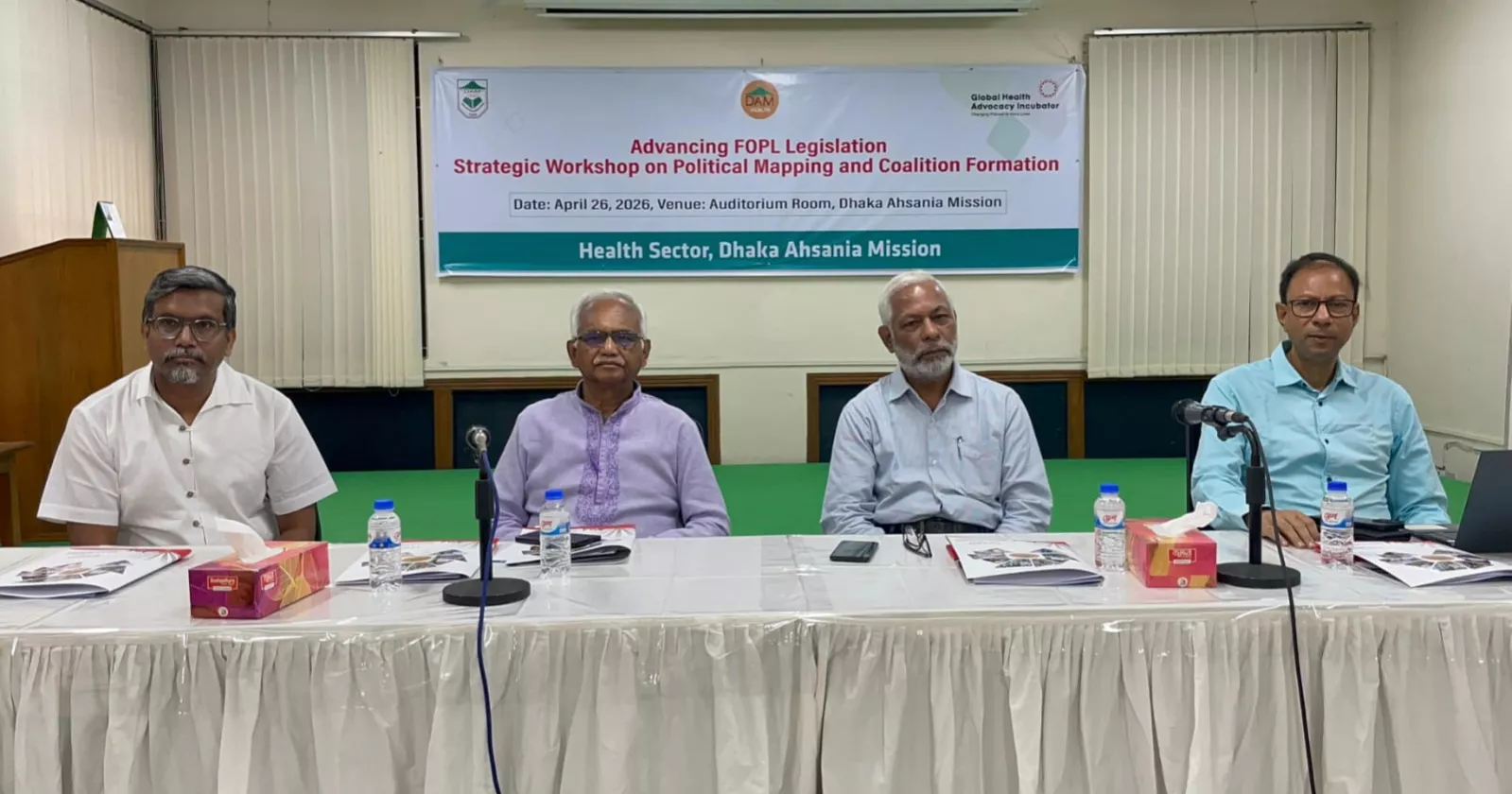
A day-long workshop was held in Dhaka on Sunday to promote the introduction of clear and easy-to-understand Front-of-Pack (FOP) nutrition warning labels on packaged food products, aiming to curb the growing burden of diet-related non-communicable diseases (NCDs) in Bangladesh.
The workshop was organized by the Health Sector of Dhaka Ahsania Mission, with support from Global Health Advocacy Incubator, at the mission’s head office in Dhanmondi.
The event focused on reviewing global and national contexts, assessing political realities, identifying key stakeholders, and developing a coordinated action plan for implementing FOP labeling in Bangladesh.
Speaking at the workshop, Iqbal Masud, Director of Health and WASH Sector at Dhaka Ahsania Mission, and Muhammad Ruhul Quddus, Bangladesh Country Lead of the “Reducing Demand for Unhealthy Food” initiative, shared international experiences on FOP labeling.
They noted that 44 countries have already introduced front-of-pack labeling systems, including 10 where it is mandatory, resulting in improved consumer choices, reduced consumption of unhealthy foods, and reformulation of products by manufacturers.
Public health expert and former adviser of IEDCR, Dr. M. Mushtaq Hossain, described FOP labeling as a critical public health intervention rather than just a labeling mechanism. He said its implementation could help protect future generations from the rising burden of NCDs.
He also warned that excessive consumption of ultra-processed foods high in sugar, salt (sodium), saturated fat, and trans fat is driving a rapid increase in diabetes, cardiovascular diseases, obesity, and other NCDs. According to the World Health Organization, around 70–71 percent of all deaths in Bangladesh are caused by non-communicable diseases.
Policy expert Taifur Rahman said nutrition information on the back of packaged foods is often too complex for consumers to understand. He added that although nearly 97 percent of people in Bangladesh consume packaged foods at least once a week, many are unable to make informed choices due to the lack of clear and visible nutritional information.
He emphasized that simple warning labels on the front of packages could play a crucial role in helping consumers make healthier decisions.
The workshop, moderated by Project Coordinator Mahbuba Rahman, was attended by representatives from various organizations, including Advocate Syed Mahbubul Alam, CEO of Center for Law and Policy Affairs; Aminul Islam Sujon, Technical Advisor at Vital Strategies; Syeda Anannya Rahman, Head of Program at Work for a Better Bangladesh; Saad Ibne Walid, Senior Officer at Youth Policy Forum; Md. Bazlur Rahman, Associate Professor at Dhaka International University; Abu Rushd Md. Ruhul Amin, Senior News Editor at Banglavision; Shahnaz Sharmin, Chief Reporter at Ekattor TV; Sushanta Sinha, Special Correspondent; and Marzana Muntaha, Coordinator of Ahsania Mission Youth Forum for Health and Wellbeing, among others.
Participants also took part in group exercises to identify policymakers, political leaders, potential supporters, and opposing stakeholders, analyzing their roles and influence.
The workshop highlighted the importance of political mapping, conflict of interest analysis, stakeholder engagement, and coordinated strategy development. A six-month strategic action plan was also formulated during the event.