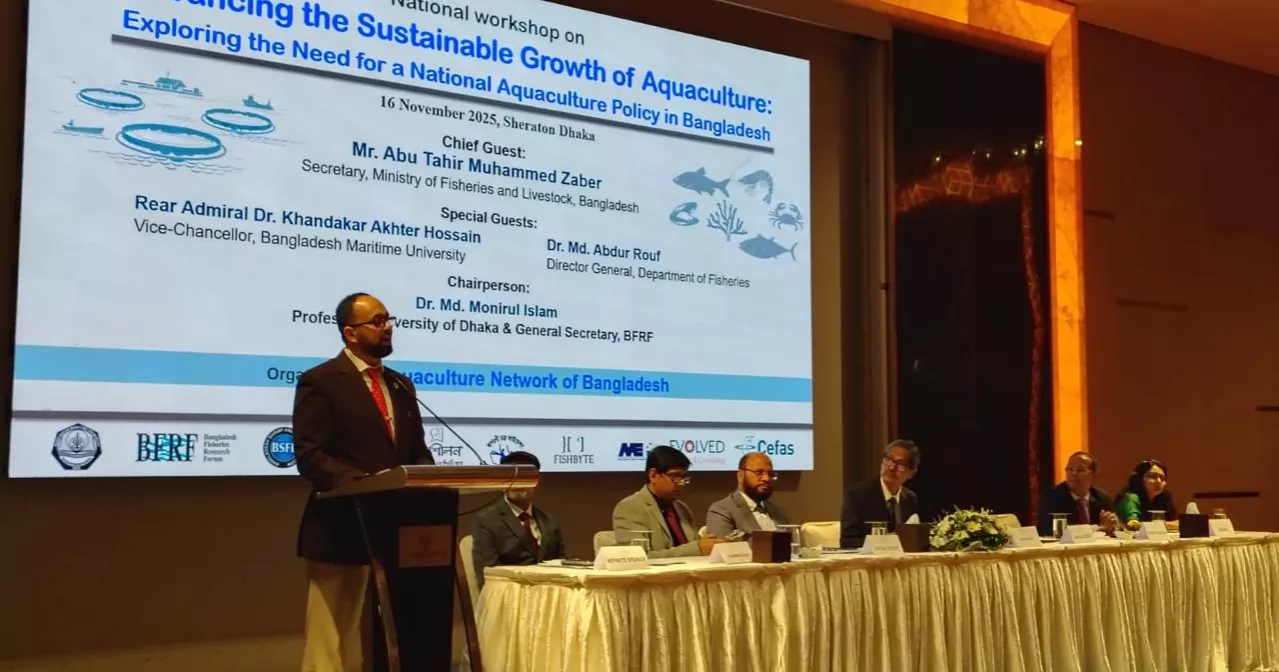
The future of Bangladesh’s fast-growing aquaculture sector came under sharp focus on Sunday as policymakers, researchers, industry leaders, and farmers gathered at Sheraton Dhaka for a national workshop calling for a dedicated National Aquaculture Policy.
Organized by the Aquaculture Network of Bangladesh (ANB) with support from CEFAS, Evolved Research Consulting, and MacAlister Elliot & Partners (UK), the event highlighted both the sector’s remarkable progress and its growing vulnerabilities.
Aquaculture now accounts for more than 58 percent of the country’s total fish production, transforming into a technology-driven, high-output industry. But these gains have brought new challenges, including environmental degradation, disease outbreaks, and biosecurity risks—issues especially evident in coastal shrimp, prawn, and crab farming.
Speakers noted that while the National Fisheries Policy of 1998 offers a broad framework, it no longer aligns with the sector’s current realities.
Prof. Dr. Md. Lifat Rahi of Khulna University delivered the opening remarks, while Dr. Md. Motaleb Hossain, Director of Inland Fisheries at the Department of Fisheries, presented the keynote outlining the state of aquaculture and the hurdles that lie ahead, said a media statement.
Prof. Dr. Md. Abdul Wahab of Bangladesh Maritime University emphasized the need for a dedicated policy to secure long-term, sustainable growth.
Rear Admiral Dr. Khandakar Akhter Hossain, Vice-Chancellor of Bangladesh Maritime University, attended as a special guest.
A panel discussion moderated by Prof. Dr. Md. Mostafizur Rahman Mondol of Rajshahi University brought together sector leaders, including Dr. Farukul Islam of WorldFish Bangladesh; Md. Zia Haider Chowdhury of the Department of Fisheries; Sazzad Hossain of the Fish Hatchery and Farm Owners Association, Mymensingh; Mohammed Tarique Sarker of Fishtech Hatchery Limited; and Dr. Helena Khatoon, Associate Professor.
Panelists stressed the importance of climate resilience, gender inclusion, and marine spatial planning in shaping future policies. Dr. Maria Zaman of Bangladesh Maritime University presented strategies for strengthening gender equality and social inclusion within the sector.
Closing the event, Secretary of the Ministry of Fisheries and Livestock Abu Tahir Muhammed Zaber reiterated the government’s commitment to sustainable and inclusive aquaculture. Dr. Md. Abdur Rouf, Director General of the Department of Fisheries, also addressed the participants.
The workshop ended with a call for a clear roadmap and coordinated national action.