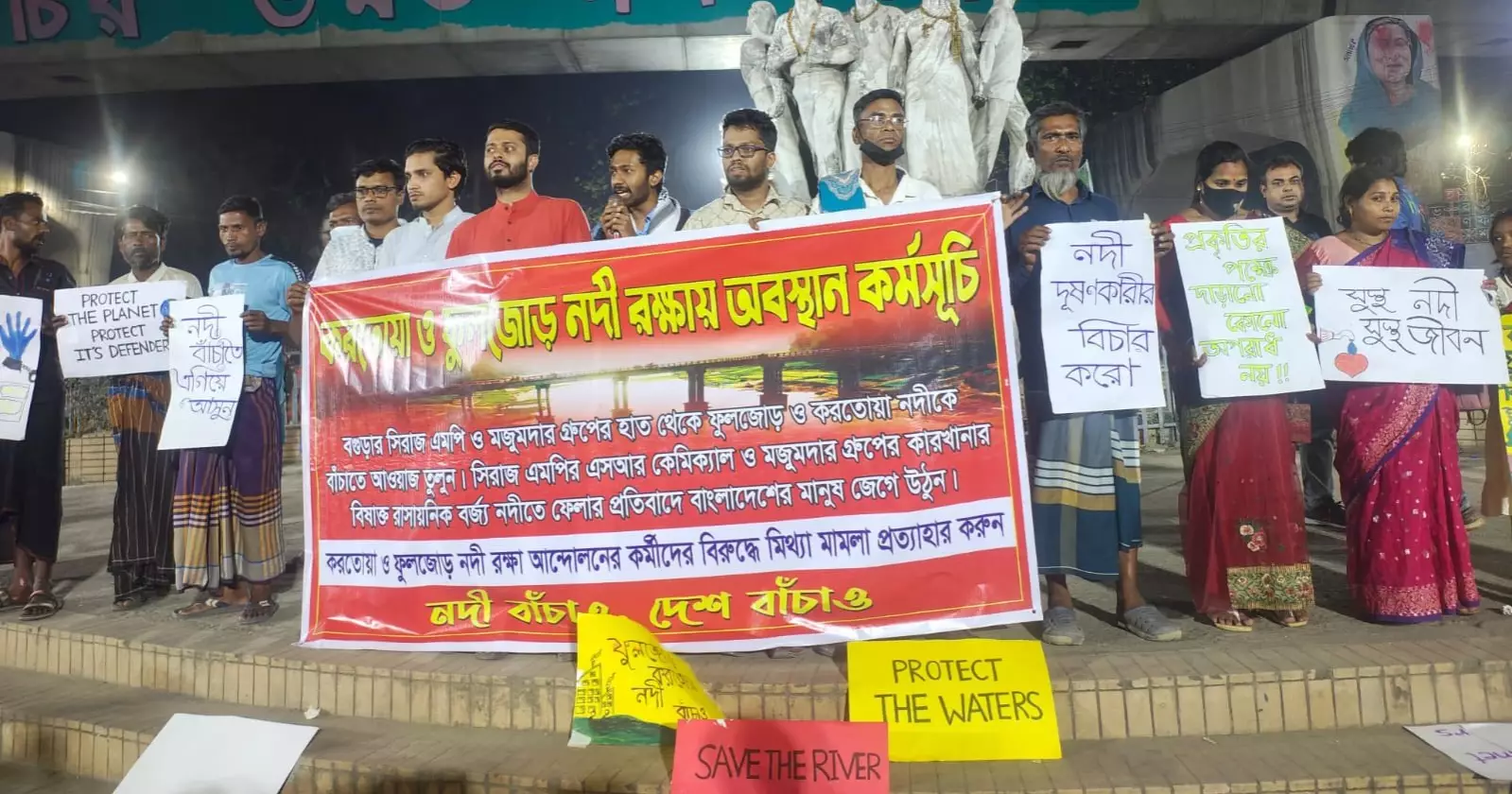
Young climate and environmental activists protested today in front of the Raju Sculpture at Dhaka University, calling for urgent measures to protect the Phuljor and Karatoa rivers in northern Bangladesh from industrial pollution.
The program was organized by environmental group YouthNet Global and included nearly fifty indigenous women, men, and children from Sirajganj.
Speakers at the event included Santosh Singh Babu, President of the Bogura District Committee of the National Indigenous Council; Sarbamitra Chakma, Executive Member of the Dhaka University Central Students’ Union (DUCSU); and Mocha. Ruku Khatun, General Secretary of Sufia Kamal Hall. The assembly was presided over by Sohanur Rahman, Executive Coordinator of YouthNet Global, while climate activist Seyam Sikder moderated the event.
Protesters demanded immediate investigation of industrial waste pollution, strict enforcement of environmental laws, accountability for responsible industries and individuals, and an end to harassment of environmental defenders.
Indigenous participants reported that industrial pollution has severely contaminated river water and the surrounding environment, threatening agriculture, fisheries, and local livelihoods. Many families have already faced hardships due to land grabbing and industrial waste.
The 55-kilometer Phuljor River supports the livelihoods of hundreds of thousands along its banks in Sirajganj and Bogura districts. Yet industrial waste has polluted the river, endangering aquatic biodiversity. Protesters specifically blamed chemical waste from several factories, including SR Chemicals and Majumdar Products, which they alleged were owned by the family of Golam Mohammad Siraj, the Bogura-5 Member of the Parliament.
“Protection of the Phuljor and Karatoa rivers is about preserving the lifeline of our communities. If the rivers die, our culture, our food, and our future will be lost,” said Santosh Singh Babu.
Faisal Biswas, a young environmentalist from Sirajganj, added: “Rivers are the lifeblood of our communities. Without effective action to stop pollution, we risk not only environmental disaster but also our livelihoods. We will continue this struggle until the rivers are safe.”
Sohanur Rahman, Executive Coordinator of YouthNet Global, said: “Rivers are living entities. Industrial waste is destroying our rivers and harming ecosystems. Bangladesh’s rivers form the foundation of our environment and livelihoods. Pollution in one river affects the entire ecosystem. Young people and local communities are uniting to demand effective measures to protect them.”
During the protest, several rickshawpullers joined in solidarity, singing songs about river protection. Md Khaleque, a rickshawpuller from Dinajpur, said: “A river is not just water, it is part of our lives. If the rivers survive, we survive.”
In a landmark 2019 ruling, the High Court of Bangladesh declared all rivers as “living entities” and appointed the National River Protection Commission as their guardian. Protesters stressed that this legal recognition must be enforced to save the rivers.
Environmental groups reported that on February 21 and 22, chemical discharges into the Phuljor River caused massive deaths of fish, crabs, frogs, snakes, and snails. Protests followed, including human chains and memorandum submissions to local authorities in Dhangar on February 24 and at Chandikona bus stand on February 25.
Subsequently, protesters staged a peaceful demonstration in front of SR Chemicals and Majumdar Products in Sherpur, Bogura. Participants claimed they were later targeted with extortion cases. Police arrested two activists, Touhidur Rahman alias Babu (45) and Ali Reza Biswas (50), from Sherpur Union market on Sunday night. They were presented in court the following day and released on bail. Other environmental defenders reportedly remain under harassment.