
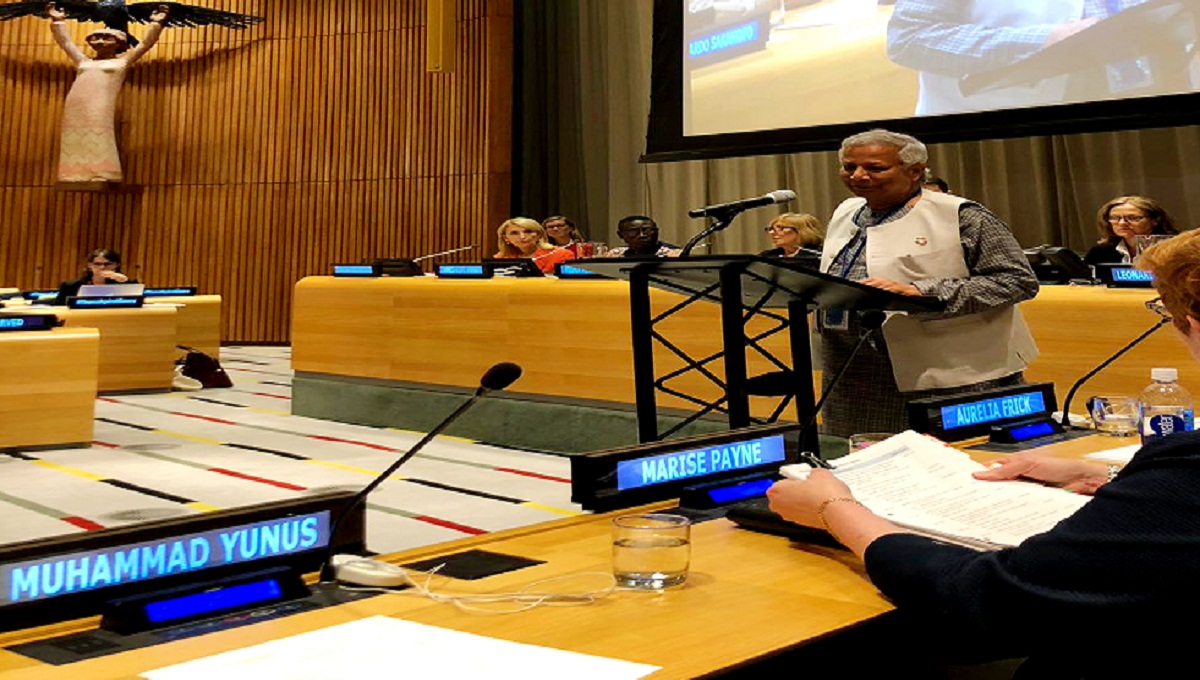
The international initiative brought together leaders from across the financial sector, global regulators, survivors and non-governmental organizations to find innovative ways to end these pervasive human rights abuses.
By the best available estimate, over 40.3 million men, women and children experienced one of these forms of exploitation in 2016 – equating to 1 in every 185 people. Though illegal, proceeds from forced labor alone are estimated to generate over $150 billion annually, said a press release.
The Commission was convened by Foreign Minister of Liechtenstein .Dr Aurelia Frick, along with co-conveners Minister of Foreign Affairs of Australia Senator the Hon Marise Payne, and Professor Muhammad Yunus.
It was chaired by Fiona Reynolds, the CEO of the UN-backed Principles for Responsible Investment.
The first consultation of the Financial Sector Commission was held on 20-21 September in at Greentree Estate of New York.
The next consultation is scheduled to be held in Vaduz, Liechtenstein in early 2019 with a further consultation in Australia in spring 2019.
On the occasion professor Yunus said that “In order to address modern slavery we have to go to the root of the process which creates it in the first place. Economic flows are like ocean currents. It flows from weak currents to stronger currents. Poor people follow the path of economic flows out of desperation to find opportunity for survival.”
“If we create opportunities for people in their places of birth they'll not take high risk to head for unknown places. We need to put emphasis on entrepreneurship rather than on job-seeking. We need to build financial system supporting new entrepreneurs coming from bottom-most levels of income, and remote places. We'll have to replace traditional job-seeking to entrepreneurship,” he said.