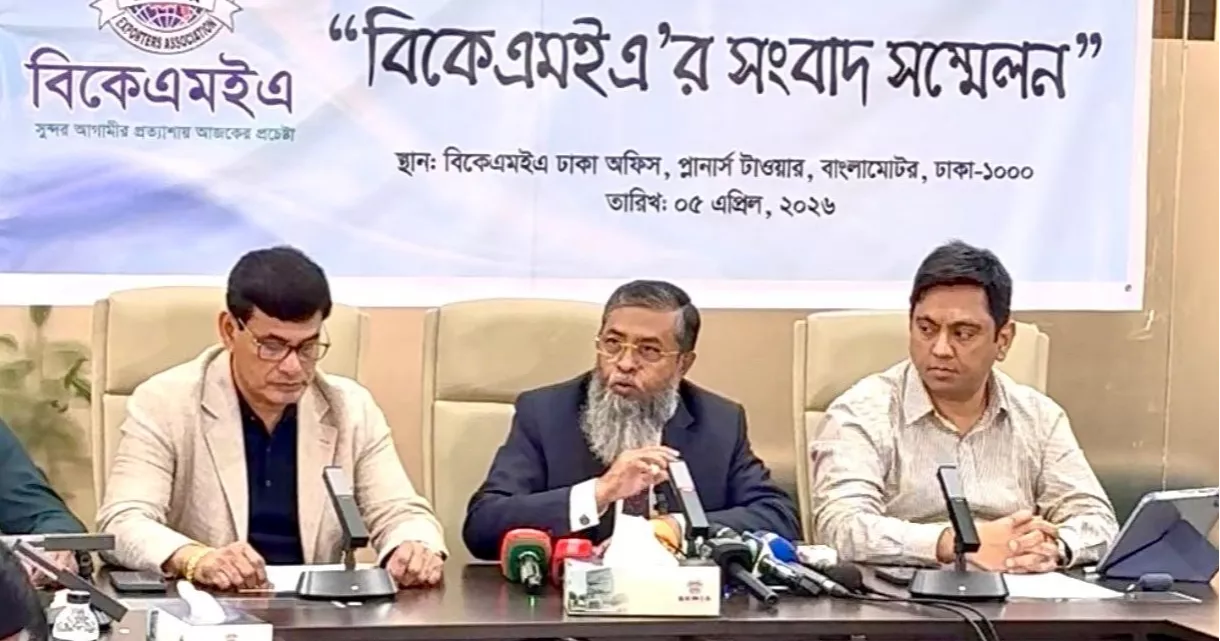
The Bangladesh Knitwear Manufacturers and Exporters Association (BKMEA) has called upon the Prime Minister and Members of Parliament to reconsider and amend several provisions of the Bangladesh Labor (Amendment) Ordinance, 2025.
In a press conference, BKMEA President Mohammad Hatem expressed deep concern that some of the amendments proposed by the previous interim government were "ambiguous" and appeared to be part of a "planned effort" to destabilize the industrial sector.
He alleged that "over-enthusiastic individuals" within the former administration may have designed these rules to undermine the export-oriented industry.
The press conference was held at BKMEA office in Bangla Motor in the capital on Sunday.
The trade body warned that certain sections of the new ordinance create administrative complexity, increase production costs, and threaten the global competitiveness of the country's readymade garment (RMG) sector.
The BKMEA highlighted several specific areas where the 2025 Ordinance deviates from the industry's practical needs and the recommendations of the Tripartite Consultative Council (TCC).
Redefining ‘Worker’: BKMEA argued that the amended definition of a "worker" is too broad and creates confusion between general employees and management/administrative officers. They are seeking a clearer distinction to prevent administrative overlap.
Compensation for Resignation: Under the new ordinance, a worker is entitled to 7 days of wages as compensation (for every service year) due to resignation after only three years of service. BKMEA recommends that this benefit should only kick in after a minimum of three to five years of continuous service, with a graded scale for longer tenures (e.g., 15 days for 5–10 years and 30 days for over 10 years).
Collective Bargaining Agent (CBA): BKMEA proposed that even if a facility has only one trade union, it must secure a majority (50% + 1) in an election to be recognized as the CBA.
Mandatory Provident Fund: The amended ordinance makes a Provident Fund (PF) mandatory for any factory with 100 permanent workers. BKMEA has recommended increasing this threshold to 500 workers to reduce the financial and administrative burden on smaller and medium-sized units.
Trade Union Registration: The ordinance allows for up to five trade union registrations in a single establishment or group of establishments. BKMEA expressed concern over the potential for industrial unrest and recommended strict oversight on these registrations.
Harassment Grievance Committees: While the ordinance mandates a 5-member committee to handle complaints of discrimination and violence, BKMEA is seeking further clarity on the operational guidelines of these committees to ensure they function fairly.
Impact on Sustainable Development
The association emphasized that while they support the welfare of workers, the law must be "investment-friendly" to ensure the industry's sustainability. They noted that the current version of the ordinance creates "intentional hurdles" that could lead to the destruction of factories and a decline in national exports.
"We believe some provisions were drafted with the intent to destroy our industrial infrastructure," said Mohammad Hatem.
"To ensure the continuous growth of the knitwear sector, it is essential to align the law with the realistic recommendations provided by the owners and the TCC," he
BKMEA concluded by urging the government to engage in further dialogue to ensure the Labor Act fosters a stable environment for both workers and employers, maintaining Bangladesh's position as a leading global apparel exporter.
Fazlee Shamim Ehsan, Executive President of BKMEA, Senior Vice President Amal Podder, CIP, and Vice President Mohammad Rashed, among others, were present in the press conference.