
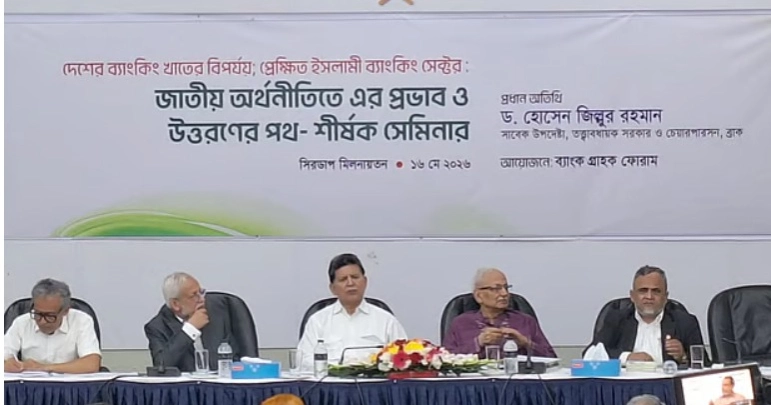
Hossain Zillur Rahman, former adviser to the caretaker government, on Saturday warned that the ongoing downfall of the economy cannot be arrested unless the deep-seated crisis in the banking sector is effectively resolved.
He made the observations while speaking as the chief guest at a seminar titled "Disaster in the Country's Banking Sector; Context of Islamic Banking Sector: Impact on National Economy and Way Forward." Organized under the banner of the ‘Bank Customer Forum’, the seminar was held at the CIRDAP auditorium in the capital, aiming to bring together Islamic Bank customers and sector insiders.
SACIN begins journey to advance circular economy across Asia in Dhaka
Emphasizing that political will is crucial for a turnaround, Dr. Zillur noted that political influence heavily dictates economic decisions. He strictly questioned why new provisions are being introduced into laws to facilitate the return of those who are responsible for creating the crisis in the finance sector.
During the discussion, some speakers went as far as to propose that the photographs of those who plundered the banking sector should be publicly displayed in museums.
Former Vice President of FBCCI Abul Kashem Haider delivered the welcome address at the event, while Mizanur Rahman, a researcher, presented the keynote paper.
In his keynote speech, Hossain Zillur Rahman stated that while opinions vary regarding the current state of the economy, there is an absolute consensus on six core challenges that demand sustainable solutions. These are a major disaster has unfolded in the economy, corrupt policy-making processes have accelerated the economic crisis, which continues unabated, depositors are silently enduring immense suffering, the economy remains stagnant; its wheels have stalled, investments have dried up, and unemployment is on the rise, ongoing national transition presents a vital opportunity to solve this deep-rooted crisis, and a sustainable solution is urgently required, one that must be held to the highest standards of morality.
Dr. Zillur highlighted that many citizens are currently unable to withdraw their deposited money from banks, a critical issue that must be addressed immediately to ensure consumer stability.
While noting that Bangladesh Bank is currently working on the issue, he stressed the need to monitor whether the regulator can maintain its moral stance. For this to happen, the autonomy of Bangladesh Bank is absolutely essential, he added.
The economist further warned that failure to tackle the rising unemployment problem would cause social unrest to spill over into other sectors. He called for timely, courageous, and sustainable decisions executed with high professionalism and capability.
Urgent Call for Political Will and Reforms:
Participating in the discussion, Faruq Mainuddin, former managing director of Trust Bank, asserted that the banking sector cannot be fixed without genuine political commitment. He demanded strict measures, adding that banks must segregate the losses incurred from institutional looting and move forward with a fresh balance sheet.
Badiul Alam Majumdar, Secretary of Citizens for Good Governance (Sujaon), described the banking sector as the primary engine of the national economy.
"When looting occurs in this sector, the entire economy collapses, which is exactly what we are witnessing today," Majumdar said. "The revelations surrounding hostile bank takeovers are shocking enough to inspire thriller movies. Even the current President was once the vice-chairman of a forcibly taken-over bank."
Sharing his personal grievance as an affected depositor, the Sujon secretary noted that long queues of citizens waiting to withdraw money have now become common. He demanded exemplary punishment for the financial fraudsters.
Majumdar also emphasized the need to continue the bank restructuring process, reduce reliance on physical cash, and immediately repeal the newly introduced controversial clauses in the Bank Resolution Act.
Several professionals and clients of Islamic banks also spoke at the seminar. They alleged that Islamic Bank Bangladesh PLC and Social Islami Bank were forcibly taken over through orchestrated political decisions, pointing out that an enabling environment for the takeover was prepared well in advance while regulators remained silent.
The speakers questioned the legal loophole that allows an entity holding a mere 2 percent stake to take over an entire bank. They also demanded an official government statement regarding the alleged controversial role played by state intelligence agencies during those takeovers.
Warning against any further destabilization, the speakers declared that if Islami Bank faces another crisis, it will never recover, and this time, the depositors themselves will build a resistance to protect their interests.